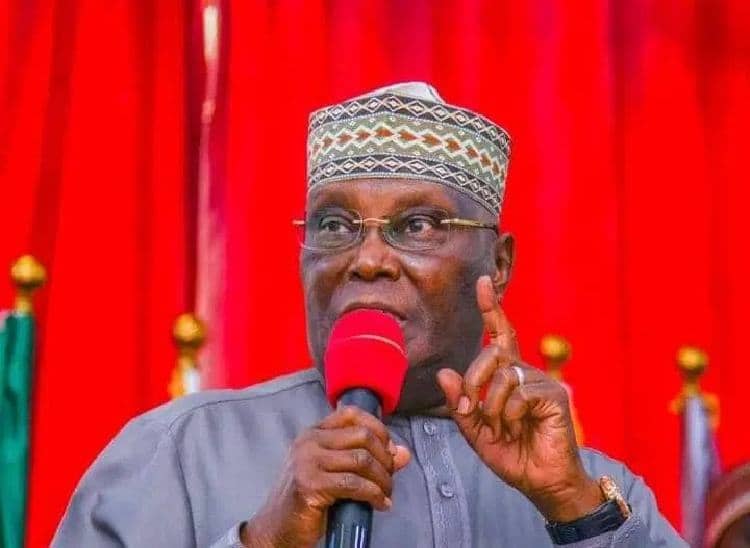
Former Vice-President Atiku Abubakar has criticised the federal government’s proposed ₦50,000 fee for the Senior Secondary Certificate Examination (SSCE), warning that it could shut out children from poor and middle-income families.
Atiku, the presidential candidate of the African Democratic Congress (ADC), also faulted the recent increase in fees for federal unity colleges, describing current education policies as “cruel,” economically insensitive, and inconsistent with the government’s responsibility to make education accessible.
The Federal Government had, on June 18, approved ₦50,000 as the new examination fee for candidates of the West African Examinations Council (WAEC) and the National Examinations Council (NECO), effective from 2027. The decision followed a request by WAEC to raise the fee from ₦27,500, with both examination bodies directed to adopt a uniform rate.
In a statement issued by his media aide, Phrank Shaibu, Atiku said the increase comes at a time when Nigerians are grappling with inflation, rising food prices, transport costs, electricity tariffs, and unemployment.
“A government that genuinely believes in the future of its people does not erect financial barriers between children and education — it removes them,” he said.
“Education is not a privilege reserved for the wealthy; it is the birthright of every Nigerian child and the foundation upon which prosperous nations are built.”
He noted that Nigeria already has one of the largest populations of out-of-school children globally, warning that the new fee could worsen the situation.
“Between 10.5 million and about 15 million Nigerian children and young people are already out of school. Any government faced with such a crisis should be investing aggressively to bring them back into classrooms, not introducing policies that will increase their number,” he said.
Atiku argued that the higher examination fee would disproportionately affect low- and middle-income households and could have long-term social consequences.
“Every child priced out of education today risks becoming tomorrow’s victim of unemployment, poverty, child labour, criminal exploitation, drug abuse, or insecurity,” he said.
He further warned that the proposed fee could limit access to tertiary education, particularly given the already limited admission capacity of Nigerian universities.
“For many children from low-income families, the journey to university ends long before admission — it is cut off by the inability to afford the qualifying examinations,” he said.
According to him, Nigerian universities currently admit between 500,000 and 700,000 students annually, despite more than two million applicants each year, leaving over one million qualified candidates without placement.
“Instead of expanding access and infrastructure, the government is constricting opportunity through higher fees. This amounts to a double burden — limited spaces and now higher barriers to entry,” he added.
Atiku described the policy as “the systematic rationing of opportunity” that could further widen inequality in access to higher education.