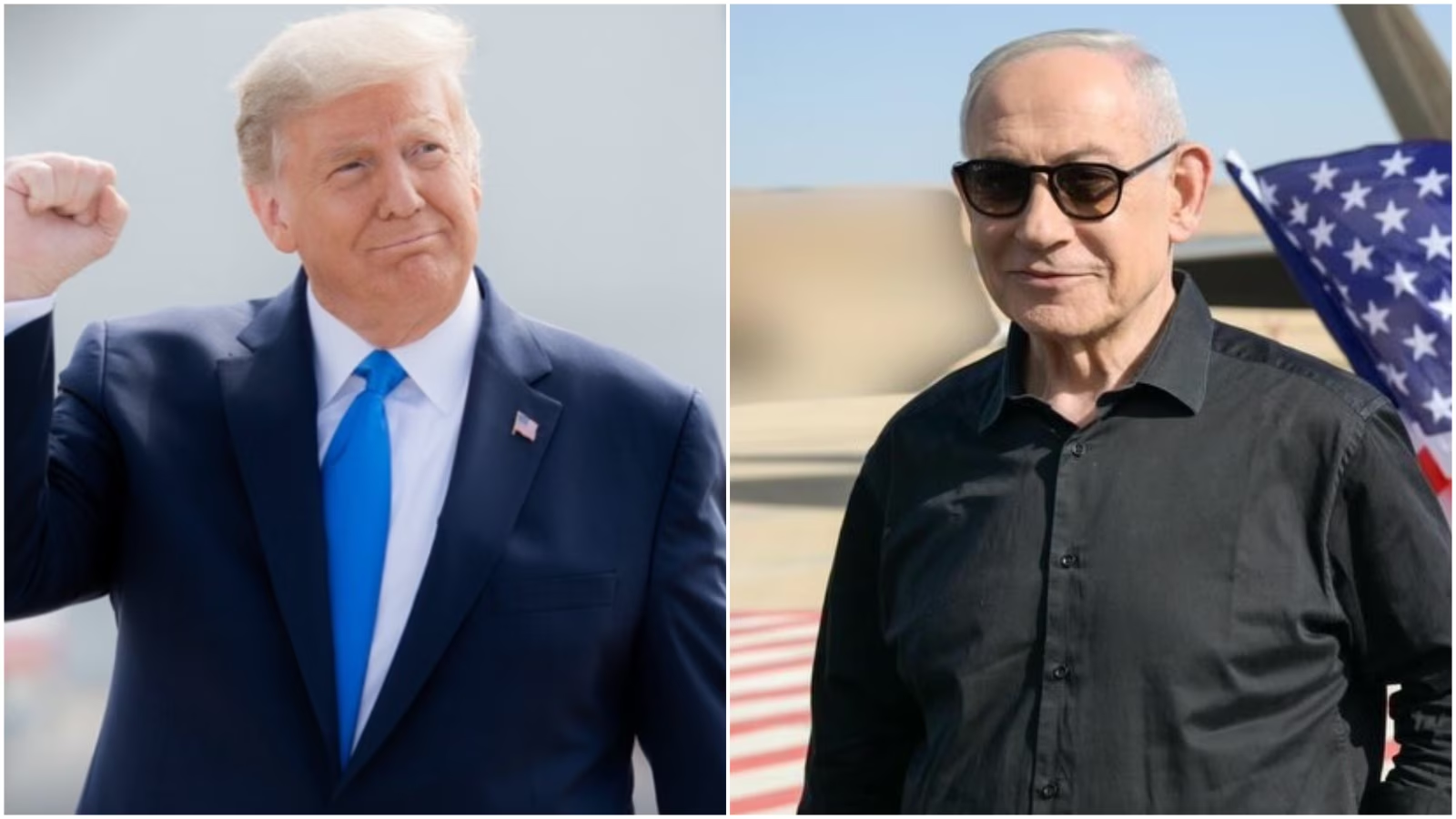
As the Iran-Israel war stretches into its fifth week, cracks are widening between Washington and Tel Aviv; and the world’s most critical oil chokepoint is caught in the middle. The Strait of Hormuz has become the defining fault line of a war that has already reshaped global energy markets, tested the US-Israel alliance, and sent oil prices to their highest levels in years. Now, Donald Trump and Benjamin Netanyahu are showing clear signs of divergence over their war objectives.
When the US-Israel campaign against Iran launched on February 28, the message from Washington was unambiguous: Iran must reopen the Strait of Hormuz or face consequences. Trump set an April 6 deadline, threatening to destroy Iran’s oil wells, electricity plants, and even desalination infrastructure if the waterway wasn’t immediately reopened.
That position has since shifted. According to the Wall Street Journal, Trump told aides he is prepared to wind down the US military campaign against Iran even if the Strait of Hormuz remains largely closed. Trump and his aides had said that a mission to reopen the waterway would extend the conflict beyond his preferred four-to-six-week timeline.
White House Press Secretary Karoline Leavitt confirmed that reopening the Strait is not among the “core objectives” Trump has set for ending the military operation. Secretary of State Marco Rubio, however, struck a tougher tone, saying the Strait would “reopen one way or another” – either through Iranian compliance or a coalition of nations.
The White House signaled Trump may end the Iran war even if the Strait of Hormuz isn’t fully reopened.
Press Secretary Karoline Leavitt said reopening the Strait is “not one of the core objectives” of the operation. pic.twitter.com/sDWQL273kD
— Clash Report (@clashreport) March 30, 2026
Netanyahu’s long game
Israel’s Prime Minister Benjamin Netanyahu, meanwhile, is singing a very different tune. Netanyahu told US broadcaster Newsmax that more than half of the military objectives have been achieved, but said he does not want to put a deadline to the conflict.
On the Strait specifically, Netanyahu suggested a long-term fix that bypasses military action entirely, rerouting Gulf energy pipelines westward across Saudi Arabia to the Red Sea and Mediterranean, cutting Iran out of the equation geographically.
But his broader war plan tells a different story. Netanyahu appears to favour a “mowing-the-grass” approach – continuously weakening Iran and prolonging the conflict. On the other hand, Trump leans toward something resembling the Venezuela model: aligning with a pragmatic insider and gaining access to Iran’s vast oil reserves, according to Carnegie Endowment For International Peace.
The most glaring illustration of this divergence came when Israel struck Iran’s South Pars gas field. Trump publicly distanced himself from the attack, saying, “The United States knew nothing about this.” Netanyahu later confirmed Israel had acted alone.
Story continues below this ad
An energy crisis of historic proportions
While the two leaders navigate their differences, the world is paying a steep price. Brent crude surpassed $100 per barrel on March 8 and peaked at $126 per barrel – the fastest oil price surge during any conflict in recent history. The closure has been described as the largest energy supply disruption since the 1970s oil crisis.
The International Energy Agency has said the disruption is the “largest supply disruption in the history of the global oil market”.
Meanwhile, Iran’s parliament has approved an early plan to charge a toll for vessels passing through the Strait, according to Wall Street Journal. If implemented, the move would effectively monetise the blockade.
Are Washington and Tel Aviv drifting apart?
It does seems so. Director of National Intelligence Tulsi Gabbard acknowledged it plainly at a Senate hearing on March 19: “The objectives that have been laid out by the President are different from the objectives that have been laid out by the Israeli government.”
Gabbard: “The objectives that have been laid out by the president are different from the objectives that have been laid out by the Israeli government. We can see through the operations that the Israeli government has been focused on disabling the Iranian leadership.” pic.twitter.com/qCfTXxvGd1
— Aaron Rupar (@atrupar) March 19, 2026
Trump faces mounting pressure from his MAGA base to avoid another protracted Middle East conflict, while Netanyahu operates within a domestic political environment that rewards hawkish escalation. Tel Aviv is reportedly uneasy about any early US exit from the war.
Story continues below this ad
According to Gabbard, Israel wants to disable Iranian leadership, while the US aims to destroy Iran’s ballistic missile production and launching capabilities and its Navy.
If we were to go by Trump’s statements over the one month of the war, active military conflict should have been over… and even Trump seems to believe so. He has said on more than one occasion: “The war is over”, “We are roaming free over Tehran”, and that Iran is on its knees “begging to the US” for a deal to end the assault.
However the ground reality is quite different. While Trump believes Iran has only “a few missiles left” in its arsenal, US intelligence officials told The Guardian that over two-thirds of Tehran’s weapons stock is still left.
With Israel and US drifting away from each other on the war objectives, Netanyahu is putting up a united face and citing concerns over America’s security. “Iran tried to kill President Trump twice. They’re still trying to kill him. But more importantly, they chant ‘death to America’. They also say ‘death to Israel’. But they say ‘America is the Great Satan’… Israel is considered the ‘Little Satan’,” he said in the Newsmax interview, seemingly in a bid to keep Trump in the war.
Netanyahu: “Iran tried to kill President Trump twice. They’re still trying to kill him.”
Netanyahu knows how unpopular this war is in the US and feels his puppet wavering so he is saying this to make sure Trump stays in the war for as long as possible. pic.twitter.com/YiZB7Clhrj
— Power to the People ☭🕊 (@ProudSocialist) March 31, 2026
At this point, US and Israel seem to firmly agree on only objective — ending Iran’s ballistic missile programme.