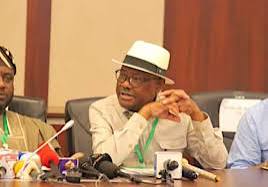

The FCT Minister Nyesom Wike faction of the People’s Democratic Party (PDP) has slated the 17th and 18th of May for its Presidential Primary Election, while the governorship comes up May 27th.
A schedule of activities and timetable for the 2027 General Election released by the National Organising Secretary, Umar Bature, indicates that primaries for House of Representatives will take place on the 21st, Senate 23rd and State House of Assembly on the 25th of May.
Also, the party has pegged the cost of Expression of Interest and Nomination Form for President at N51million, governorship N21million, and the Senate goes for N6million.
For the House of Representatives, aspirants are to pay N4 million, State House Assembly N3million while female aspirants are to pay only the cost of Expression of Interest across offices which is N1million.
According to the timetable, the sale of forms begins on the 27th of April and closes on the 4th of May.
It sets the 11th of May for screening of State and National Assembly aspirants, while 12th of May is scheduled for the screening of governorship and presidential aspirants.
…S/Court reserves judgment
Meanwhile, the Supreme Court Wednesday reserved its judgment on an appeal where the Turaki-led PDP is seeking validation of the outcome of the national convention held in Ibadan, the Oyo state capital on November 15 and 16, 2025.
In the appeal marked SC/CV/164/2026, filed by the Turaki factional national executives of the party who emerged from the convention, the appellants (PDP NWC) are specifically urging the apex court to set aside the judgments of the Court of Appeal and the Federal High Court in Abuja, which faulted the conduct of the Ibadan convention.
A five-member panel of the apex court, headed by Justice Mohammed Lawal Garba, had on April 14, approved an expedited hearing of the appeal and reserved the matter for judgment after all parties argued and adopted their respective briefs of argument.
The panel held that the judgment date would be communicated to the parties.
…Timeline of events
In their brief of argument filed on April 2, the appellants, while adopting it through their team of lawyers, led by Chief Paul Erokoro, SAN, urged the Supreme Court not only to allow their appeal but also to dismiss a cross-appeal lodged against them by the rival faction of the party.
A former Jigawa state governor, Sule Lamido, who was represented by Mr. J. C. Njikonye, SAN, as well as the Wike-backed faction, represented by Mr. J. B. Daudu, SAN at the proceedings, filed preliminary objections seeking dismissal of the appeal.
The respondents insisted that, contrary to the contention by the Turaki-led group, the appeal did not fall within the sphere of the PDP’s internal affairs.
The respondents’ insisted that both the High Court and the Appellate Court had rightly exercised jurisdiction over the matter.
Before now, the appellate court had faulted the PDP for defying the November 14, 2025, judgment of Justice Peter Lifu of the High Court, which stopped the Ibadan convention.
In its pronouncement, the High Court barred INEC from supervising, monitoring, or recognising any convention held without including the former Jigawa state governor.
The restraining order followed a suit filed by Lamido, a party stalwart, alleging he had been arbitrarily denied the chance to contest for National Chairman.
He cited the PDP and INEC as the first and second defendants, respectively.
The trial court affirmed that Lamido had been unjustly denied a nomination form, contrary to the PDP Constitution and guidelines.
It then declared that the party must create opportunities for members to aspire to positions.
Justice Lifu then went ahead by halting the convention to allow Lamido obtain the form, mobilise supporters, and campaign.
But dissatisfied with the decision, the Turaki-led PDP filed an appeal to set it aside.
While dismissing the appeal, the appellate court held that the PDP had resorted to self-help and contemptuous conduct by proceeding with the convention despite the restraining order.
The Appeal Court ruled that the party should have sought suspension of the judgment from a higher court rather than obtaining a favourable order from another court of coordinate jurisdiction.
The appellate court described the PDP’s action as a direct affront to judicial authority and a gross abuse of court process.
…Second appeal
Meanwhile, the apex court is equally hearing a second appeal on the contentious Ibadan convention.
The appellants in the matter—PDP, its National Working Committee (NWC), and National Executive Committee (NEC)—had, in a motion filed on April 8 through their team of lawyers led by Chief Chris Uche, SAN, prayed for a departure from the Supreme Court Rules and the abridgement of time for all respondents to file their briefs of argument.
They are also challenging the judgment of the Court of Appeal, which upheld judgments barring the PDP from proceeding with the Ibadan convention.
The appellate court had held that the convention, which produced the Turaki factional leadership, lacked legal backing as it disobeyed two Federal High Court judgments in Abuja delivered on October 31 and November 14, 2025.
The Justice Mohammed Danjuma-led panel dismissed the appeal marked CA/ABJ/CV/1613/2025, filed by the PDP faction aligned with Governors Seyi Makinde of Oyo State and Bala Mohammed of Bauchi state.
It found no reason to overturn Justice James Omotosho’s verdict of the high court, which had barred INEC from validating the Ibadan convention outcome.
According to the appellate court, evidence showed that statutory conditions precedent were not met before the convention.
The panel held that the trial court had rightly stopped the convention and dismissed the Turaki-led faction’s claim that the matter was a non-justiciable domestic affair of the party.
Justice Uchechukwu Onyemenam, in the lead judgment, held that the lower court had properly assumed jurisdiction, as the suit sought compliance with the Electoral Act, the 1999 Constitution (as amended), and the PDP’s guidelines and regulations for political parties.
The appellate court rejected arguments that the appellants lacked locus standi (legal right).
It nevertheless acknowledged that Article 42 of the PDP Constitution requires legal actions to pass through the National Legal Adviser.
The panel noted the claim that Mr. Kamaldeen Ajibade, SAN—the legal adviser—had been suspended by the party’s NWC.
It emphasised that Ajibade’s suspension was a non-justiciable internal party matter, disqualifying him from handling the PDP’s legal interests.
The appellate court was satisfied that the Turaki-led group had received a fair hearing and that evidence proved the PDP’s failure to comply with statutory provisions and guidelines before the convention.
It found merit in the substantive suit by three aggrieved members—Hon. Austin Nwachukwu (Imo PDP Chairman), Hon. Amah Abraham Nnanna (Abia PDP Chairman), and Turnah Alabh George (PDP Secretary, South-South)—aligned with the Wike faction.
The high court had in its judgement that precipitated the appeal, faulted the PDP for failing to conduct valid state congresses in 14 states before the convention.
The convention it held could not proceed without congresses to produce voting delegates for national officers in those states.
The court also noted that notices for the convention were signed only by the National Chairman, excluding the National Secretary, rendering them a nullity.
Justice Omotosho, in his ruling, held that the PDP’s failure to follow procedures had jeopardised the convention.
He then directed the party to conduct proper meetings and congresses with 21 days’ statutory notice to INEC for monitoring.
The defendants in the suit were INEC; PDP; National Chairman Ambassador Umar Iliya Damagum; National Secretary Senator Samuel Anyanwu; National Organizing Secretary Umar Bature; national officers Ali Odefa and Emmanuel Ogidi; and the PDP’s NWC and NEC.
The plaintiffs argued that the 1999 Constitution (as amended) requires INEC monitoring for valid party congresses and that no valid notice had been served for the convention.
Agreeing, the court dismissed the defendants’ preliminary objections on jurisdiction over “internal affairs.”
It restrained INEC from receiving, publishing, or recognising the convention outcome until compliance with the 1999 Constitution (as amended), Electoral Act 2022, and INEC guidelines.
The court held that INEC needed not recognize a convention without proper delegate election frameworks.
But about 72 hours after the judgment, the party secured a contradictory order, allowing it to proceed with the convention.
The Turaki-led faction then appealed, but the appellate court dismissed it on March 9 with N2 million costs.
The Wike-backed group has since conducted a national convention in Abuja, which has produced its newly elected National Working Committee (NWC) members.
A few days ago, too, the group also secured a high court judgment granting it access to the Wadata national party secretariat situated in Zone 5 Abuja.