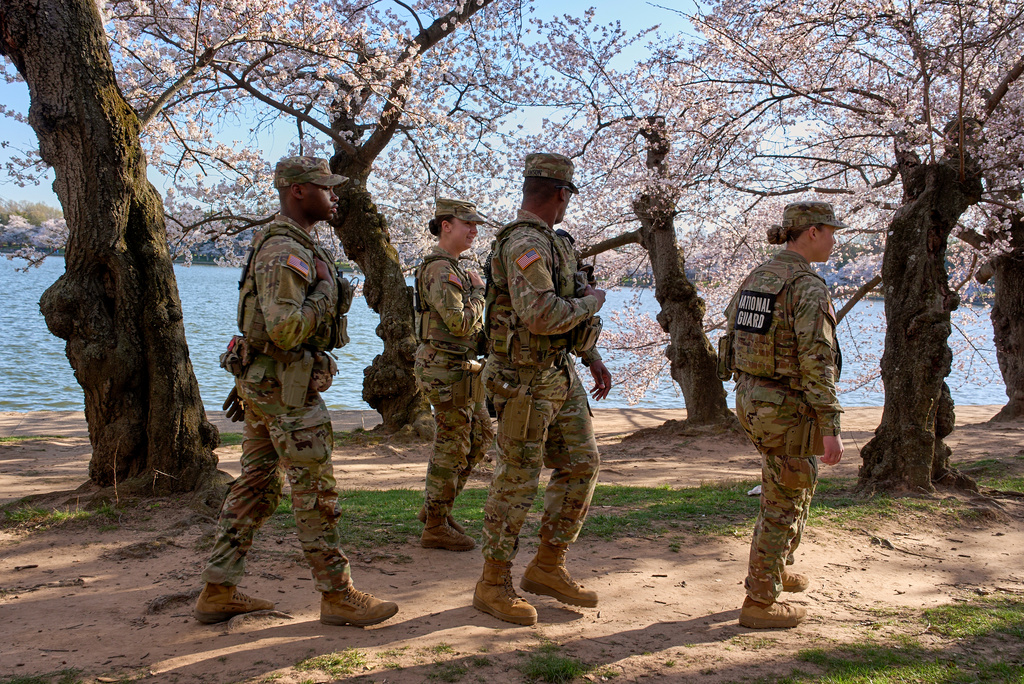
The cherry blossoms draw more than a million visitors to Washington’s Tidal Basin annually. This year was no different, except some strolling the area between the Lincoln Memorial and the Thomas Jefferson Memorial were dressed in camouflage — and armed.
Eight months after President Donald Trump declared a crime emergency in the nation’s capital and called up the National Guard, more than 2,500 troops remain, in a deployment that has grown increasingly routine, with no clear end in sight.
Deployments to other cities have ended or been paused by courts in California and Illinois, while more limited operations are ongoing in cities including New Orleans. But in Washington, guard members still walk city streets and patrol metro stations, tourist attractions, neighborhoods and parks.
Even with pivotal elections looming this year, that lingering presence is barely mentioned in city council meetings or by candidates running for mayor and Congress — perhaps reflecting both competing priorities and a sense that local officials have little power to stop it. Unless the courts step in, the guard will remain at least through the end of the year, if not longer.
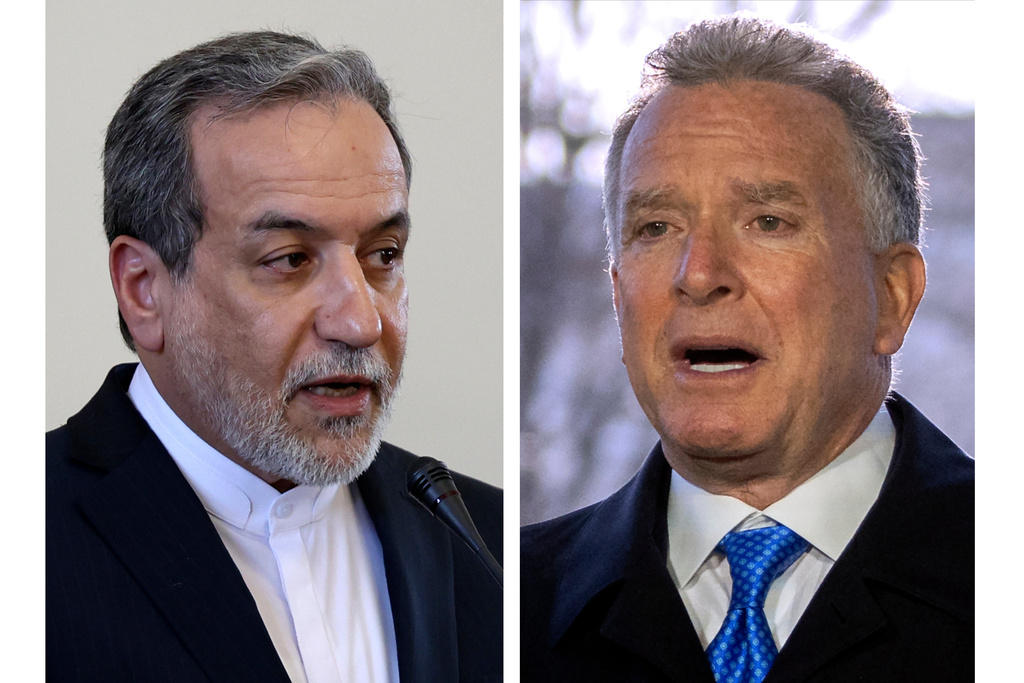
“Taxpayers are paying more than a million dollars a day to have them walk around,” said Phil Mendelson, chairman of the District of Columbia Council, in an emailed response to questions.
And, he said, “the presence of armed soldiers on American streets is not a good look.”
An indefinite deployment drags on
Trump, a Republican, issued an executive order in August to deal with what he called a crime emergency. The order brought the guard in, along with hundreds of additional federal law enforcement officers.
Over the months, guard members have responded to medical emergencies, assisted with arrests, helped local police enforce the city’s juvenile curfew and carried out beautification projects. The D.C. Guard helped with snow removal during a major storm in January.
While the guard members do not make arrests, the Trump administration argues their support to the broader mission has helped reduce crime. The White House said 12,000 arrests have been made by the task force since operations began, including 62 known gang members, and thousands of illegal firearms were seized.
White House spokesperson Abigail Jackson said the president’s crime task force in the city has “yielded tremendous results for local communities.”
“Every local leader should want to mimic this success in their own locales,” Jackson said.
But officials disagree over how much credit the deployment can be given in Washington, a heavily Democratic city. Figures show crime was already on the decline before, although those figures are being investigated after claims arose against local police that they may have been manipulated.
A court battle over the guard deployment is ongoing, and without a judge stepping in it could go on as long as the White House wants.
Asked how long the guard deployment would continue, Jackson said in an email that there were “no announcements to make.”
The office of D.C. Attorney General Brian Schwalb, which is challenging the deployment in court, declined to comment, citing the pending lawsuit. The National Guard Bureau at the Pentagon did not answer requests for comment.
Guard presence absent from public discourse
Mayor Muriel Bowser, who is not running for reelection, has walked a fine line on the guard’s deployment and the broader federal intervention, at once appearing to work with the president but also pushing back on some of his demands, like local cooperation for immigration enforcement.
Leading candidates to replace Bowser and the city’s 18-term non-voting delegate in Congress, Eleanor Holmes Norton, have focused on affordability, statehood and trying to hold federal agencies accountable for their role in the surge.
The District Council, which includes at least four candidates for mayor or delegate, unanimously approved a measure to increase transparency in federal law enforcement operations. While the military deployment is mentioned at times on campaign websites and in ads, it isn’t currently a central campaign issue.
Other pressures on the city, including unemployment and lost revenue tied to federal workforce cuts, have taken priority. The city’s primaries are June 16, along with a special election for an at-large city council seat.
Some residents say frustrations over the guard eased after two members of the West Virginia contingent were ambushed just blocks from the White House, killing Specialist Sarah Beckstrom, 20, and severely injuring her colleague.
Kevin Cataldo, a neighborhood commissioner who joined the local Metropolitan Police on a walkalong in his neighborhood recently, said he already treated the guard members courteously, making a point to acknowledge them because they did not choose to be in the city. The shooting ambush deepened his sympathies for them. “That was just horrible,” he said.
District Council member Brianne Nadeau said constituents continue to ask why the guard is still around but the complaints are far fewer than at the start of the deployment.
“It would be great if the federal government would use its money and resources to help the District on the things we need help with and not act like an invading army,” Nadeau said in an email.
Fellow council members and mayoral candidates Janeese Lewis George and Kenyan McDuffie have raised similar issues, including the high costs.
There has been little recent public polling specifically on attitudes toward the presence of uniformed personnel in U.S. cities.
With DC’s limited autonomy, pushback is a challenge
Several groups are planning protests and other events on May 1 to oppose the federal surge, including the continuing presence of the National Guard, said Keya Chatterjee co-founder and executive director of Free DC, an advocacy group that fights for the city’s autonomy. Among the goals: “an end to the military occupation of D.C. before the June election.”
Chatterjee said normalizing the guard’s presence makes it easier to suppress dissent and “tilt the playing field” in elections.
The presence of guns and military personnel could create an intimidating atmosphere during elections, Chatterjee said. Citizens have to step in and “number one, we have to help our neighbors feel safe voting.”
Scott Michelman, legal director at the American Civil Liberties Union of the District of Columbia, said the situation underscores the city’s limits on self-governance.
Washington is a federal district with limited autonomy where Congress retains authority to review the city’s laws and control its budget and where the president has direct control of the D.C. Guard and can authorize an indefinite military deployment with little effective resistance from local authorities.
“We should have local control and local democratic accountability for the people who enforce our laws,” Michelman said. “D.C. is uniquely disempowered in our system in many ways.”
(AP)