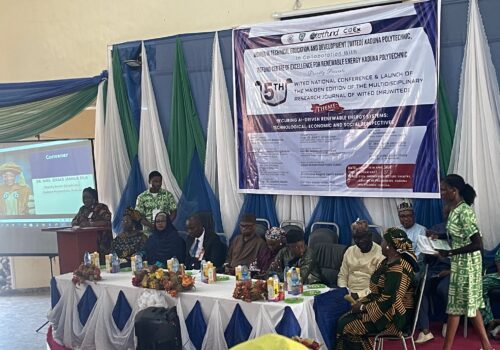

Experts have identified artificial intelligence (AI) as a critical tool for addressing Nigeria’s persistent energy challenges, particularly in expanding access to renewable power and improving efficiency in the sector.
This formed the focus of discussions at the 5th National Conference of the Women in Technical Education and Development (WITED), Kaduna Polytechnic chapter, where stakeholders highlighted the intersection of AI, energy and economic development.
Speaking at the event, the Rector of Kaduna Polytechnic, Dr. Suleiman Umar, said the integration of AI into renewable energy systems is transforming operations and creating new pathways for economic growth.
Represented by the Dean, School of Technical and Vocational Education, Dr. Abubakar Jadas, the rector noted that AI-driven systems can reduce operational costs while improving energy output and efficiency.
The keynote speaker, Dr. Abel E. Airoboman of the Nigerian Defence Academy, said nearly half of Nigeria’s population still lacks access to electricity, stressing that the adoption of renewable energy solutions remains slow due to high capital costs.
He called on government to subsidise renewable energy technologies, noting that AI can play a major role in predicting energy demand, detecting faults and optimising grid performance.
“Today, we stand at the intersection of two powerful revolutions: renewable energy and artificial intelligence,” he said.
Airoboman, however, cautioned against the misuse of AI, warning that over-reliance without proper human oversight could pose risks.
Also speaking, the Chairperson of the occasion, Chioma Wogu-Ogbonna, said over 600 million people in Africa still lack access to electricity, urging researchers to provide practical solutions to energy poverty.
Earlier, the convener of the conference, Dr. Grace Jamila Bila, described AI as a necessity for development, stressing that its adoption is crucial for driving innovation and progress.
The conference also featured the launch of the maiden edition of the WITED multidisciplinary research journal.