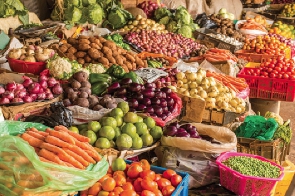

Nigeria is blessed with a vast expanse of fertile land. Even in the northern part of the country where the Sahara Desert is advancing to the Atlantic Ocean, massive chunk of land is still left for cultivation.
The journey from Kano to Dutse, the capital of Jigawa State is well over 200 kilometers. Throughout that long journey one is thrilled by the vast expanse of fertile land that stretches as far as the eye could see. In some instances all that is needed for high yield is irrigation to ensure that the crops are adequately watered.
Rice can grow in any part of northern Nigeria. One therefore wonders why Nigeria imports millions of tonens of rice annually. In the southern part of the country where the tropical rain forest dominates everywhere, the land is just waiting to be cultivated and it is willing to yield abundant crops of all sorts.
That explains why Nigeria remains the largest producer of cassava in the whole globe. No one rivals Africa’s most populous nation in the production of cassava.
Even yam is produced in enviable quantities in the southern part of the country. The production of yam is a keen contest in Nigeria. It is difficult to determine which part of the country produces more tubers of yam.
The middle belt, which is deep in the northern part of the country produces yam in very large quantities. The city of Gboko in Benue state deserves kudos for the production of large delicious yams. The tubers of yam produced in Gboko are not just large but they are very delicious and nutritious.
Gboko produces such a large quantity of yam that during the harvest period one could buy a large tuber of yam for as cheap as N300. That size of yam sells in Lagos for a minimum of N4, 000. That is how fertile the land in Gboko is.
Therefore, there is something strange about Nigeria. Despite the extensive fertile land and the effort of the hard working people to cultivate the land, Nigerians are perennially besieged by hunger and starvation. The World Bank warned last year that millions of Nigerians will this year be plagued by hunger as a result of the harsh effect of climate change in some parts of the country.
Everyone wonders what happens to the large quantity of food produced in Nigeria annually as millions of its citizens suffer from hunger and malnutrition.
The United Nations (UN), the European Union (EU) and the German embassy in Nigeria all have a unanimous answer to that intriguing question. The three organisations are unanimous in their conclusion that Nigeria produces enough food but lacks the ability to preserve it.
Consequently, post-harvest losses consumed 38 million tonnees of food in 2025 in Nigeria. That is a conservative estimate by the three institutions.
The inability to preserve the food it produces explains why Nigeria imports large quantities of the food. Daniel Krull, Germany’s consul-general in Nigeria recently captured the puzzle in an intriguing rhetorical question.
“Why should I buy tomatoes from China in a country like Nigeria where tomatoes grow everywhere”, the German diplomat demanded rather rhetorically. Krull’s question emanated from the fact that Nigeria recorded post harvest losses estimated at N5 trillion in 2025 alone.
That explains why Nigeria spent a colossal sum of N7.65 trillion on food imports in 2025. Nigeria spent N2.86 trillion on food imports in 2022 but the figure escalated tremendously in 2025. Pundits, however, argue that the more than 300 per cent increase in food imports between 2022 and 2025 cannot be traced only to the quantity of food imported.
It was argued that most of the blame for the huge import bill can be traced to the massive depreciation of the naira in the last two years.
The naira traded at N460 to the dollar in 2022 when the import bill was N2.86 trillion. By 2025 when the import bill escalated to N7.65 trillion the naira was trading at N1,520 to the dollar. In fact, at a certain point in 2024 the naira traded at as low as N1,700 to the dollar. That probably explains the tremendous escalation in the import bills between 2022 and 2025.
However, that explanation does not in any way justify the inauspicious expenditure on food imports by a country naturally blessed with extensive arable land and very hard working people.
The truth is that Nigerians plant and the land responds with abundant yield. What happens after that is the result of negligence at the top level of the food production chain.
Krull, the German diplomat in Nigeria, Zissinon Veros, the deputy ambassador of the EU to the Economic Community of West African States (ECOWAS) and even the UN are unanimous in their simple answer to the complex problem.
They conclude that foods rot away after harvest because they are not processed and preserved. Food retailers capitalise on that problem and help to worsen Nigeria’s inflation rate. The women who retail tomatoes, bananas, fresh pepper, sweet potatoes, mango, oranges and other perishable food items factor their post purchase losses into the prices of their products and compel buyers to pay for the losses.
In most cases they sell less than 40 per cent of what they buy while the rest rot away. They factor the costs of the 60 per cent they lose into the 40 per cent they sell and compel consumers to pay for the losses.
Post-harvest losses contribute immensely to the escalation of inflation rates in Nigeria. Krull concludes that the solution to Nigeria’s inauspicious food imports bill lies in investing in food processing rather than cultivation.
Nigeria cultivates and harvests enough food but leaves it to rot away. Krull said Germany is poised to teach Nigeria how to process and preserve food. That depends on the student’s willingness to learn. Nigeria was a bad student of automobile technology transfer. It refused to learn from the six vehicle assembly plants. Hunger may force a change this time.