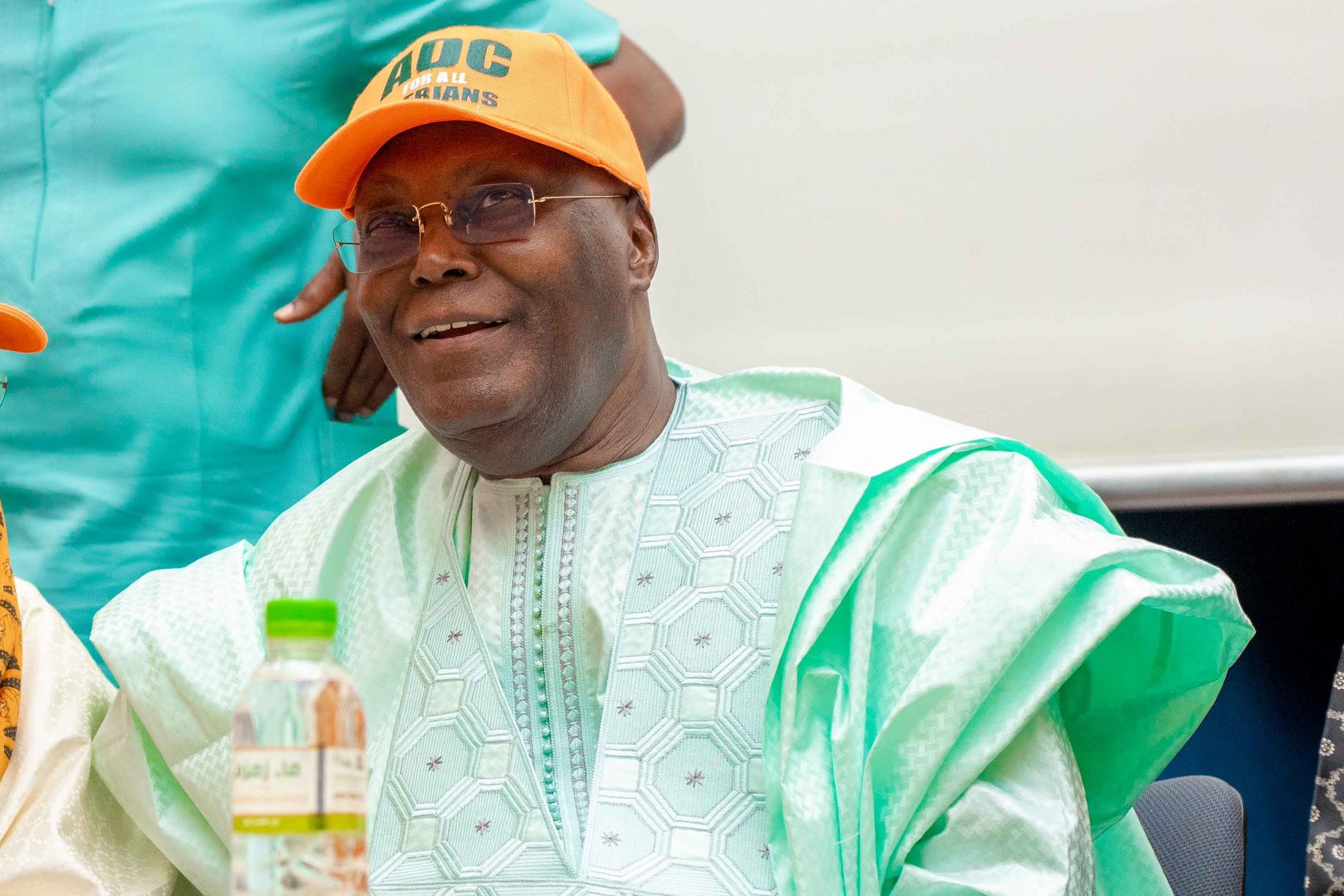
Atiku also commits to respecting the outcome of the ADC primary, including stepping aside for rivals like Peter Obi.
Former Vice President Atiku Abubakar has signalled that the 2027 presidential election could mark the end of his long-running ambition to lead Nigeria, pointing to his age and what he described as the heightened stakes of the contest.
Atiku, who was the presidential candidate of the Peoples Democratic Party (PDP) in the 2019 and 2023 elections, disclosed during a live interview on Arise Television on Wednesday. He was responding to a question on whether turning 80 by the next election would influence his ambition.
“Certainly yes, because the stakes are higher and I believe that will be my last outing,” he said, signalling what could be the closing chapter of a decades-long pursuit of the presidency.
Atiku has been expressing interest in becoming Nigeria’s president for decades.
The former vice president also addressed the prospect of a competitive primary under the African Democratic Congress (ADC), where he is widely believed to be positioning himself amid ongoing realignments in the opposition space.
Asked whether he would be willing to step aside if another aspirant, including former Labour Party presidential candidate Peter Obi, clinches the party’s ticket, Atiku said he would respect the outcome of a credible process.
“Yes, I will step aside for any winner,” he said. When pressed specifically on Mr Obi, who was his running mate in the 2019 election, he added, “Of course, if he is a contender, why not?”
Dismissing suggestions that such a decision could be politically difficult, Atiku emphasised democratic principles, noting that leadership emergence must be anchored either on consensus or a transparent electoral process.
“What is difficult there? It is democracy. It is either you go through consensus, or you go through an election. You emerge through consensus or emerge through the electoral process,” he stated.
The comments come amid growing speculation about a possible coalition of opposition figures ahead of 2027, with Atiku and Mr Obi seen as leading contenders within the ADC.
Other prominent politicians, including former Kano State governor Rabiu Kwankwaso and former Minister of Transportation Rotimi Amaechi, are also reported to be weighing their options within the evolving political configuration.
Beyond the question of candidacy, Atiku used the interview to assert his enduring political influence, particularly in Northern Nigeria, a region considered critical in determining electoral outcomes. He argued that none of the current or emerging political leaders from the region commands a voter base comparable to his.
“Can you tell who is a current leader in the North who has more votes than I have? Talking of leaders like Tambuwal, Kwankwaso, El-Rufai and also the emerging political leaders, none of them have got that northern vote as much as I’ve got,” he said.
He specifically downplayed Mr Kwankwaso’s reach, describing his support base as largely confined to Kano State. According to him, even that influence is no longer consolidated, citing the political dynamics involving the incumbent governor, Abba Yusuf.
“Kwankwaso’s popularity is restricted to only Kano State. Kano is even now split between him and Governor Abba Yusuf,” he added.
Atiku has long positioned himself as a proponent of economic reforms centred on liberalisation, privatisation, and private-sector-led growth. He has also consistently advocated restructuring, arguing that Nigeria’s federal system requires significant devolution of powers to unlock development and address longstanding governance challenges.
His latest remarks add to a political career spanning over three decades, marked by repeated attempts to clinch the presidency. He first sought the office in the 1993 Social Democratic Party (SDP) primaries but stepped down in support of the late Moshood Abiola, who went on to win the annulled election.
Following his tenure as vice president between 1999 and 2007 under President Olusegun Obasanjo, Mr Atiku contested the presidency in 2007 on the platform of the Action Congress but lost to the late President Musa Yar’Adua of the PDP.
Although he contested for the presidential ticket of the Peoples Democratic Party (PDP) in the 2011 elections, he lost in the party’s primary election to Goodluck Jonathan, who was the flagbearer of the then-ruling party and the eventual winner of the election.
He left the PDP in February 2014 to join the All Progressives Congress(APC), which was formed in February 2013 but registered by INEC in July 2013. He participated in the party’s presidential primary but lost to Muhammadu Buhari, who went on to win the 2015 presidential election.
He returned to the PDP in 2017 and emerged as its candidate in the 2019 election, but was defeated by former President Muhammadu Buhari of the All Progressives Congress (APC).
In 2023, he secured the PDP ticket once more but lost to the current president, Bola Tinubu.


