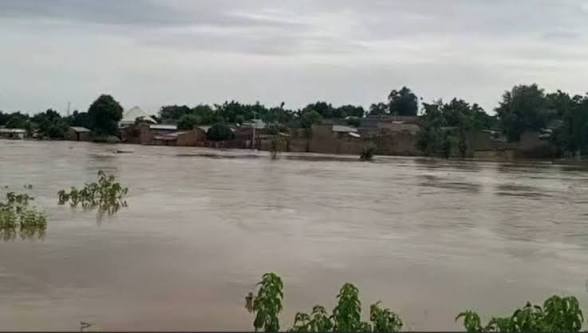

Penultimate Wednesday, the federal government released the 2026 Annual Flood Outlook (AFO), forecasting that the annual flood would sweep through 33 states including the Federal Capital Territory (Abuja). Only three states, namely, Akwa Ibom, Anambra and Ekiti may be fortunate to escape the destructive deluge. Specifically, littoral states like Adamawa, Lagos, Bayelsa, Benue, Delta, Cross River, Kebbi, Kogi, Niger, and Rivers are among those to be at the mercy of the annual disasters this year.
The Minister of Water Resources and Sanitation, Engr. Joseph Utsev, painted the gloomy picture in his keynote address delivered at the AFO public presentation held at the Presidential Banquet Hall, Abuja, under the auspices of the Nigeria Hydrological Services Agency (NiHSA). The theme of this year’s conference is “Smart Water Resources Management: Moving from Oil to Water-Based Economy”.
Utsev stressed that early warning alert was imperative to save lives, livelihoods, protect infrastructure, as well as reducing economic losses, saying that part of the government’s commitment to improving flood forecasts and preparedness, was the modernisation of the national hydrological monitoring network.
The minister also said his ministry was strengthening collaboration with the Nigerian Meteorological Agency (NiMet), to ensure better integration of weather and water information, which were critical for delivering reliable forecasts that support farmers, disaster managers, urban planners, and other key sectors of the economy.
However, Utsev acknowledged that forecasts alone were not sufficient if the information failed to translate into action at the community level, assuring that his ministry was working with other relevant government agencies to mitigate the impacts of flooding.
Earlier, the Director General/Chief Executive Officer, Nigeria Hydrological Services Agency, Umar Ibrahim Mohammed, said the 2026 AFO aligns with the Renewed Hope Agenda of the Tinubu administration in terms of economic diversification, infrastructure development, climate resilience, food security, and sustainable water management.
He said, “The AFO has evolved into an important national planning instrument that provides early scientific prediction of flood risks in the country, an evidence-based guide for decision-makers, and a platform for emergency coordination among stakeholders.
“In producing this year’s forecast, the agency undertook a comprehensive and data-driven process to provide tailored information for high-risk flood zones and flash floods in urban cities and towns.
“Building on the success achieved through AFO publications, we have upgraded from reporting flood forecast to Flood Risk Intelligence Architecture and from the traditional modelling to Hybrid AI-Integrated Modelling system to improve forecast reliability, reduce false alarms, and improve the lead time accuracy.”
The Director General/Chief Executive Officer, Nigeria Meteorological Agency, NiMET, Prof Charles Anosike, in a goodwill message, acknowledged the devastating effects of flooding that Nigerian and other African countries still struggle to contain.
Anosike also said that with technology, there had been predictions to mitigate the impacts, and said the NIHSA had done well with the presentation of AFO to protect the nation.
Evidently drawing from the sad lessons of the 2012 flood disaster, which killed 363 people and displaced 2.1 million others in 30 states of the federation, all relevant government agencies have routinely issued pre-flood warnings, which many potential victims now see as mere rituals and pay little or no attention to them.
In recent times, flooding has been a recurrent problem in most parts of the world. In Nigeria, the rainy season usually comes with its seasonal flash floods. These natural calamities are oftentimes life-threatening, especially in the rural areas or overcrowded slums, where drainage is poor or does not exist at all. Although there have been reports of flooding across the country during heavy downpours, so far none compares with the flood of 2012, which was described as the worst in 50 years.
Between June and September 2012, unprecedented rainfall was experienced in Cameroon, leading to excessive flooding around the Lagdo Dam such that the dam had to spew out the excess volume of water. The resultant outcome was a flow of water to Nigeria through the Benue River and into the seas through the Niger River. All the 11 states transverse by both rivers were overflooded, and lots of physical damage were recorded, including the destruction of farmlands and houses. Economic life was halted, people were displaced, and many lost their lives. An estimated total of seven million people were affected, while damages and losses caused by the floods were put at N2.6 trillion.
The then President Goodluck Jonathan had declared the flooding a “national disaster” and established a National Committee on Flood Relief and Rehabilitation. On October 9, 2012, his administration announced it was providing $110 million in financial assistance. In the areas affected by flooding, the displaced are huddled together in camps set up by the state governments.
It is now apparent that relevant agencies have run out of ideas because their annual admonitions are beginning to sound like a broken record. Saving Nigerians living in flood-prone areas from themselves requires an aggressive sermon, and some arm-twisting is required in order to whip them to the line. Sadly, many have come to accept the monumental loss of lives and properties as a fait accompli. Insanity is defined as doing the same thing repeatedly and expecting different results. Government at all levels should think outside the box and come up with sustainable solutions to the perennial calamities.