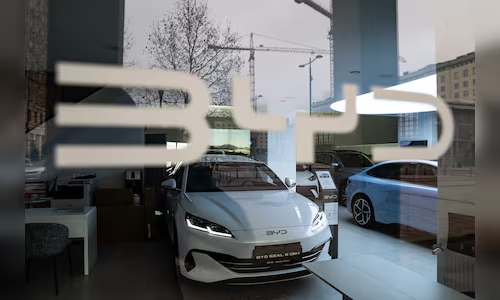
The average discount on BYD vehicles rose to a record 10% in March, based on China Auto Market data compiled by Bloomberg. Discounts from rivals, including Geely Automobile Holdings Ltd. and Chery Automobile Co., also increased.
The developments point to continued pressure from competition and excess production as the Beijing auto show opens this week. Carmakers such as BYD and Geely are expanding into overseas markets, including Brazil, the UK, Australia, and Canada, due to margin pressure in China. Government efforts to limit falling prices have not been effective, and analysts expect discounting to continue.
“Price competition will always exist,” said Yale Zhang. “It won’t go away this year or the next.”
Nearly a year ago, Chinese authorities met with leaders of more than a dozen EV companies to try to stop the price war. Officials warned against selling below cost or offering unreasonable discounts, and similar warnings have been issued at least three times this year. The earlier meeting also addressed “zero-mileage” used-car sales and delays in payments to suppliers.
Soon after, BYD Chief Executive Officer Wang Chuan-Fu became emotional at an investor meeting while discussing “short-term pressures” and being “misunderstood.”
BYD, which was an early investment of Warren Buffett, remains the market leader, although its China sales have declined for seven straight months.
Under increased regulatory scrutiny, BYD has sped up payments to parts suppliers and faces limits on using discounts to boost sales, according to people familiar with the matter. The company is moving away from an IOU-based system that allowed delayed payments and is instead using more interest-bearing debt.
As a result, BYD’s net debt-to-equity ratio has risen to 25% after being negative for four years. The company did not respond to requests for comment.
The combination of higher debt and lower revenue from price cuts is affecting earnings. BYD recently reported its first annual profit decline since the pandemic. In a letter to shareholders, Wang said China’s auto industry has entered a “brutal knockout stage.”
“The auto industry is facing enormous pressure,” said Cui Dongshu. “The performance shows the struggles.”
Overcapacity remains a key factor. China’s factories can produce 55.5 million vehicles per year, while domestic sales were about 23 million in 2025, according to the China Automotive Technology and Research Center. This implies capacity use of about 50%.
Some of the excess capacity may decline if weaker companies exit through consolidation or closure. However, such changes could increase unemployment, which authorities are trying to avoid through subsidies and supportive policies.
Part of the surplus is being exported. China’s EV exports more than doubled to a record level in March. This has led to trade responses, with the European Union and some Latin American countries increasing tariffs.
In China, major carmakers are trying to maintain market share by shortening product cycles and adding features. BYD has introduced stronger batteries and faster charging. At Xiaomi Corp., Chief Executive Officer Lei Jun said the latest SU7 electric car includes nearly 20,000 yuan ($2,930) of added features while its price increased by 4,000 yuan.
(With input from agencies)