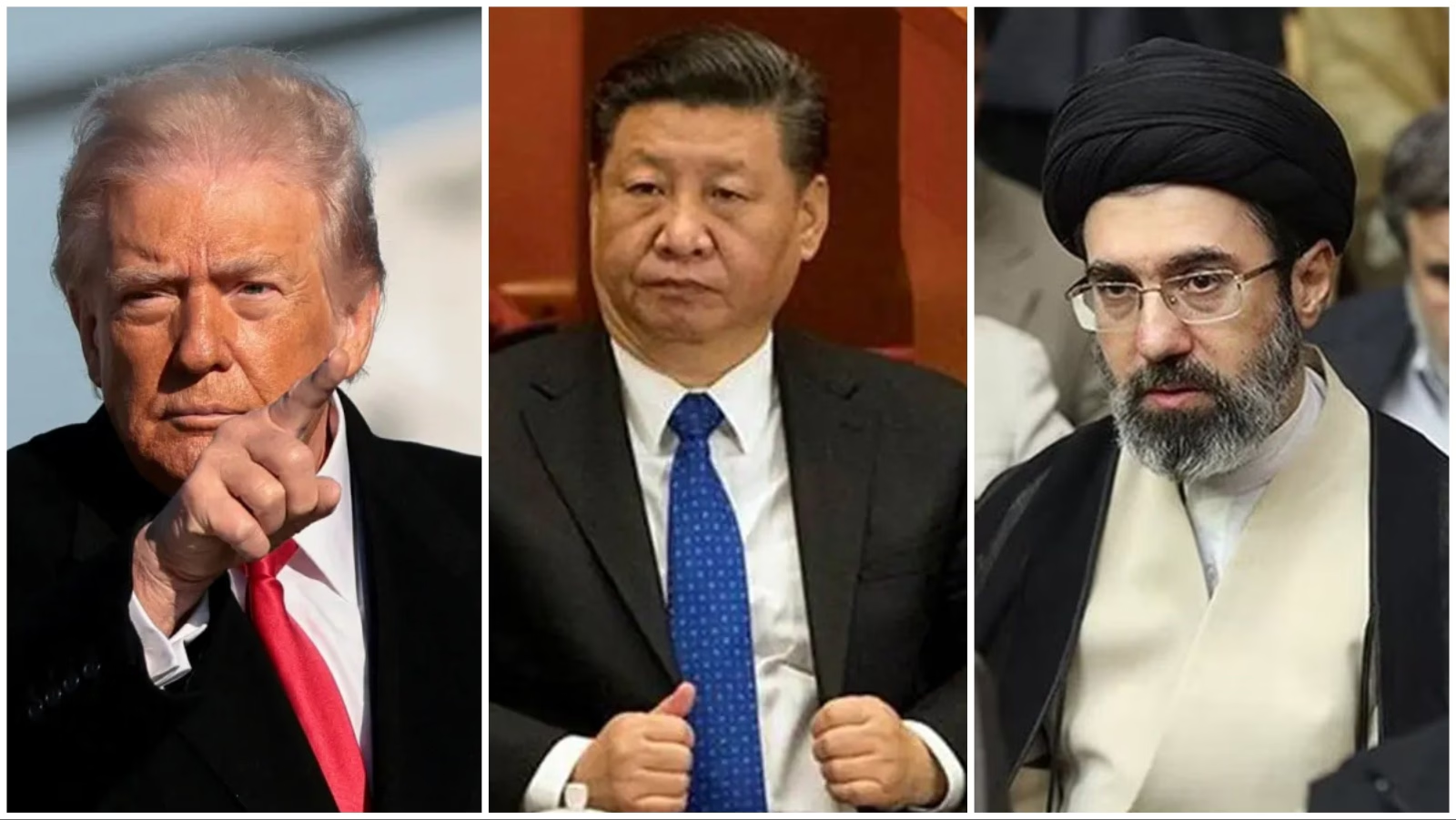
China’s growing involvement in efforts to de-escalate the ongoing Iran war is drawing global attention, as Beijing positions itself as a responsible international actor at a time when US foreign policy is straining long-standing alliances.
China’s profile in global diplomacy has risen steadily in recent years, with its diplomats taking a more active role in conflicts beyond its immediate region. Historically cautious about engaging in distant geopolitical disputes, Beijing has increasingly stepped into mediation efforts across regions ranging from Southeast Asia to Europe, the Associated Press (AP) reported.
In the current Iran war, China is not formally designated as a mediator. However, all key parties, including Donald Trump’s administration and Tehran, have acknowledged its role in attempting to ease tensions. Analysts note that Beijing’s diplomatic approach across multiple conflicts has followed a consistent pattern, yielding mixed outcomes but gaining visibility at a time when US actions have heightened friction with traditional allies.
A look into China’s influence in Iran negotiations
According to diplomats cited by the AP, Beijing leveraged its position as the largest buyer of sanctioned Iranian oil to encourage Tehran to return to negotiations. These efforts reportedly contributed to the resumption of direct talks earlier this month in Pakistan.
While Beijing has not officially confirmed its involvement, experts suggest this may be a deliberate choice to avoid appearing aligned with a US-led security framework. Yaqi Li of the S. Rajaratnam School of International Studies noted that China prefers to maintain strategic ambiguity in such situations.
Trump has publicly stated that China played a role in persuading Iran to consider a ceasefire, which he has since extended. Meanwhile, Beijing has continued to criticise US and Israeli military actions in the conflict.
Chinese Foreign Minister Wang Yi has been actively engaged, holding discussions with counterparts from Israel, Saudi Arabia, Bahrain, and the United Arab Emirates. By mid-April, he had conducted 30 calls related to the conflict, according to China’s Ministry of Foreign Affairs. Wang also presented a five-point proposal advocating for an end to hostilities and the reopening of the strategically critical Strait of Hormuz.
Story continues below this ad
Strategic economic leverage
China’s influence in the Iran conflict is underpinned by its economic ties with Tehran. As Iran’s largest oil customer, Beijing holds significant leverage. Experts note that this relationship gives China a unique ability to influence Iran’s decision-making, particularly as the conflict disrupts global energy markets.
George Chen of The Asia Group told the AP that China’s role is “irreplaceable” due to its economic engagement with Iran and its relatively sympathetic stance at international forums such as the United Nations.
China’s involvement extends beyond trade. According to the US government, Iran’s ballistic missile programme has incorporated Chinese technology, and Beijing continues to supply dual-use industrial components that can support missile production.
Analysts say China’s long-term value lies in its ability to offer post-war incentives. Tuvia Gering of the Atlantic Council noted that Beijing could provide investment and economic relief to Iran after the conflict, potentially encouraging Tehran to accept and adhere to negotiated constraints.
Story continues below this ad
Xi Jinping’s assertive messaging
Chinese President Xi Jinping has taken a more vocal stance than usual during the crisis. He recently warned against what he described as a global slide toward “the law of the jungle” and called for the reopening of the Strait of Hormuz.
His remarks align with China’s broader diplomatic messaging, which emphasises sovereignty, international law, and peaceful coexistence.
China’s diplomatic ambitions have been evident in other recent conflicts. One of its most notable successes came in 2023, when it helped facilitate renewed diplomatic engagement between Saudi Arabia and Iran, widely seen as a significant geopolitical breakthrough.
Beijing has also been involved in mediation efforts in Southeast Asia, including the Thailand-Cambodia conflict, where it participated in ceasefire negotiations alongside the United States. Additionally, China has proposed peace initiatives in the Ukraine war while maintaining close ties with Russia.
Story continues below this ad
However, experts caution that China’s mediation strategy tends to be selective. Muhammad Zulfikar Rakhmat of Indonesia’s Centre of Economic and Law Studies told the AP that Beijing often intervenes when conditions are already favourable for agreement, minimising risk while maximizing diplomatic gains.
A calculated diplomatic approach
China’s diplomatic playbook remains consistent across conflicts. Analysts say Beijing typically reiterates principles such as respect for sovereignty and adherence to the United Nations Charter, without taking overtly partisan positions.
Hoo Tiang Boon of Nanyang Technological University, also quoted by the AP, noted that these recurring themes reflect a deliberate and cautious approach to global engagement.
At the same time, shifting dynamics in the US foreign policy have created opportunities for China to expand its influence. Thitinan Pongsudhirak of Chulalongkorn University told the AP that Beijing is positioning itself as a defender of the rules-based international order, drawing a contrast with Washington’s current approach.
Story continues below this ad
As the Iran war continues, China’s evolving role underscores a broader transformation in global diplomacy, where economic power and strategic positioning are increasingly shaping conflict resolution efforts.