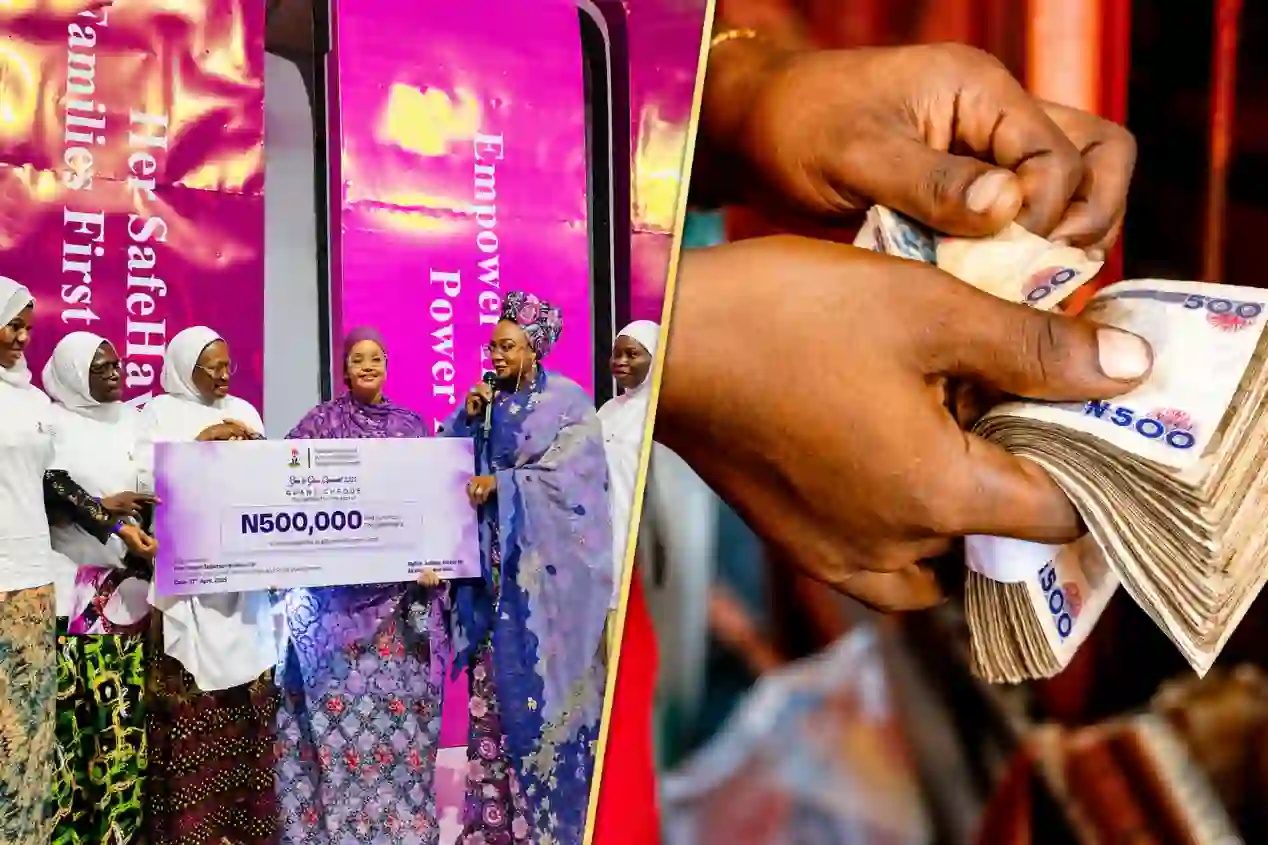
The Federal Government has launched the “Give to Gain” initiative as part of activities marking the grand finale of Nigeria’s 2026 International Women’s Day (IWD) commemoration, setting the stage for a broader national push to economically empower women, including the planned rollout of the 10 Million Women Mega Empowerment and Rally.
Speaking at the summit, Nigeria’s First Lady, Oluremi Tinubu, commended the resilience and contributions of Nigerian women, while signalling a deliberate shift from symbolic celebration to structured economic inclusion. Represented by Fatima Abbas, wife of the Speaker of the House of Representatives, the First Lady emphasised that the government’s current direction aligns with the Renewed Hope Agenda of President Bola Tinubu, particularly its focus on inclusive growth and social development.
She noted that 2026 has been designated as the “Year of Families and Social Development,” underscoring the central role women play in building stable households and productive communities. According to her, government interventions are being expanded across enterprise development, agriculture, innovation, and social protection to ensure long-term prosperity for women and their families.
“The conversations here must lead to action, to partnership, to investment, and programmes that make a measurable difference,” she said, calling on stakeholders to translate policy discussions into tangible outcomes that directly impact women at the grassroots.
Also speaking at the event, the Minister of Women Affairs, Imaan Sulaiman-Ibrahim, described the “Give to Gain” initiative as more than a theme, positioning it as a strategic framework for driving economic participation among women. In her keynote address, she characterised the initiative as a transition from rhetoric to what she termed a “mandate of renewed prosperity.”
Highlighting the economic realities facing women, the minister noted that although women account for over 50 per cent of Nigeria’s population and nearly 40 per cent of its agricultural workforce, they remain significantly excluded from formal financial systems. She stressed that closing this gap is critical, not just for equity but for national economic growth.
“Closing this gap is not charity; it is strategy. When we give women access, tools, and trust, we unlock exponential returns for families and the economy,” she stated.
Central to this strategy is the implementation of the Renewed Hope Social Impact Interventions (RH-SII 774), a nine-pillar framework designed to deliver targeted support across all 774 local government areas in the country. The framework focuses on direct economic empowerment, access to microcredit, and agricultural support, with the aim of strengthening livelihoods at the community level.
The minister also highlighted the recently approved Affirmative Procurement Policy, which is expected to provide women-owned businesses with improved access to government contracts. By leveraging public procurement as an economic tool, the policy is intended to create more inclusive opportunities within Nigeria’s business ecosystem.
Addressing broader structural issues, Sulaiman-Ibrahim drew attention to the global care economy, noting that policy frameworks must begin to reflect and support the unpaid labour historically carried by women. “This is ‘woman o’clock’—a year where her labour is valued, her role is dignified, and her contributions are institutionalised,” she said.
As part of the next phase of implementation, the minister announced plans for the 10 Million Women Mega Empowerment and Rally, a large-scale mobilisation effort aimed at deepening participation and awareness. The event, themed “One Voice, One Movement, One Choice,” is scheduled to hold on May 5 at the Moshood Abiola Stadium, bringing together women from across the country, development partners, and key stakeholders.
She described the rally as a unifying platform that would amplify women’s voices while accelerating the delivery of empowerment programmes nationwide. The event is expected to draw participation from groups including the National Council of Women Societies, representatives of the United Nations Human Rights system, and anti-trafficking organisations.
In her closing remarks, the minister urged women to build networks of support and mentorship, emphasising collective advancement. “When you gain a seat at the table, create room for many more. Do not throw away the ladder,” she said.
Contributions from other stakeholders at the summit further reinforced the link between infrastructure, policy, and women’s economic empowerment. The Managing Director of the Rural Electrification Agency (REA), Abba Aliyu, identified energy access as a critical enabler of productivity, particularly for women in rural and underserved communities.
Represented at the event, Aliyu noted that access to reliable electricity supports business expansion, improves healthcare delivery, and enhances educational outcomes. He cited ongoing REA projects, including solar mini-grid deployments, as examples of how targeted interventions can significantly improve the productivity of female entrepreneurs.
The agency, he added, is integrating gender inclusion into its operations through initiatives such as its STEM internship programme, which has trained hundreds of young women in technical fields, as well as the Gender, Environment, Social Inclusion and Counselling (GESIC) Unit.
“Progress for women is progress for all of us. When we invest in women—through energy access, skills development, and inclusive opportunities—the returns are far-reaching,” he said.
From the development perspective, UN Women reiterated the need for stronger political inclusion as part of the broader empowerment agenda. Representing Country Representative Beatrice Eyong, Acting Deputy Representative Patience Ekeoba stated that increasing women’s participation in governance is essential for democratic growth.
She observed that despite women’s contributions across sectors, they remain under-represented in decision-making roles, calling for reforms such as reserved seats, campaign finance support, and safeguards against political violence. Drawing comparisons with countries like Rwanda and Senegal, she emphasised that deliberate policy actions are required to achieve meaningful inclusion.
“When we speak of women, power and leadership, we are speaking about justice, representation and the future of nations. Leadership is strongest when it reflects the people it serves,” she said.
Ekeoba further urged political actors to invest in mentorship pipelines and strengthen legal frameworks ahead of the 2027 electoral cycle, noting that inclusive governance is fundamental to sustainable development.
Earlier, Permanent Secretary of the Federal Ministry of Women Affairs and Social Development, Mrs Esuabana Asanye, opened the summit with a call for actionable investment in women’s empowerment. She emphasised that beyond institutional support, progress must also be driven by individual agency and identity.
Welcoming stakeholders to the event, she stressed the importance of developing scalable strategies that can be implemented across states and local governments. “When women thrive, societies flourish,” she said, reinforcing the central message of the “Give to Gain” initiative.
Nigeria Startup News reports that the summit marked a transition point in Nigeria’s approach to women-focused policies, combining programme launch, policy direction, and large-scale mobilisation plans. With the introduction of the “Give to Gain” initiative and the forthcoming 10 Million Women Mega Empowerment and Rally, the Federal Government is signalling a more structured and outcome-driven framework for advancing women’s economic inclusion nationwide.
What do you think about this?
Drop your opinion in the comment section.
FOLLOW US & Share this with someone who needs to see this.