The war in West Asia has severely dented the US’s weapons stockpile, wiping out nearly half of some of its key munitions, the New York Times reported.
The report comes at a time when US President Donald Trump’s administration faces headwinds in increasing the defence budget, and the US military industrial complex confronts an uphill task in upscaling production as demand outpaces output.
The war has also cost the Pentagon between $28 billion and $35 billion – under $1 billion a day, NYT reported, citing two independent groups. In the first two days alone, the military used $5.6 billion of munitions.
- The US military has used up about 1,100 Joint Air-to-Surface Standoff Missile-Extended Range (JASSM-ER) missiles, leaving about 1,500 in the inventory. These missiles have a range of roughly 600 miles and cost roughly $1.1 million apiece.
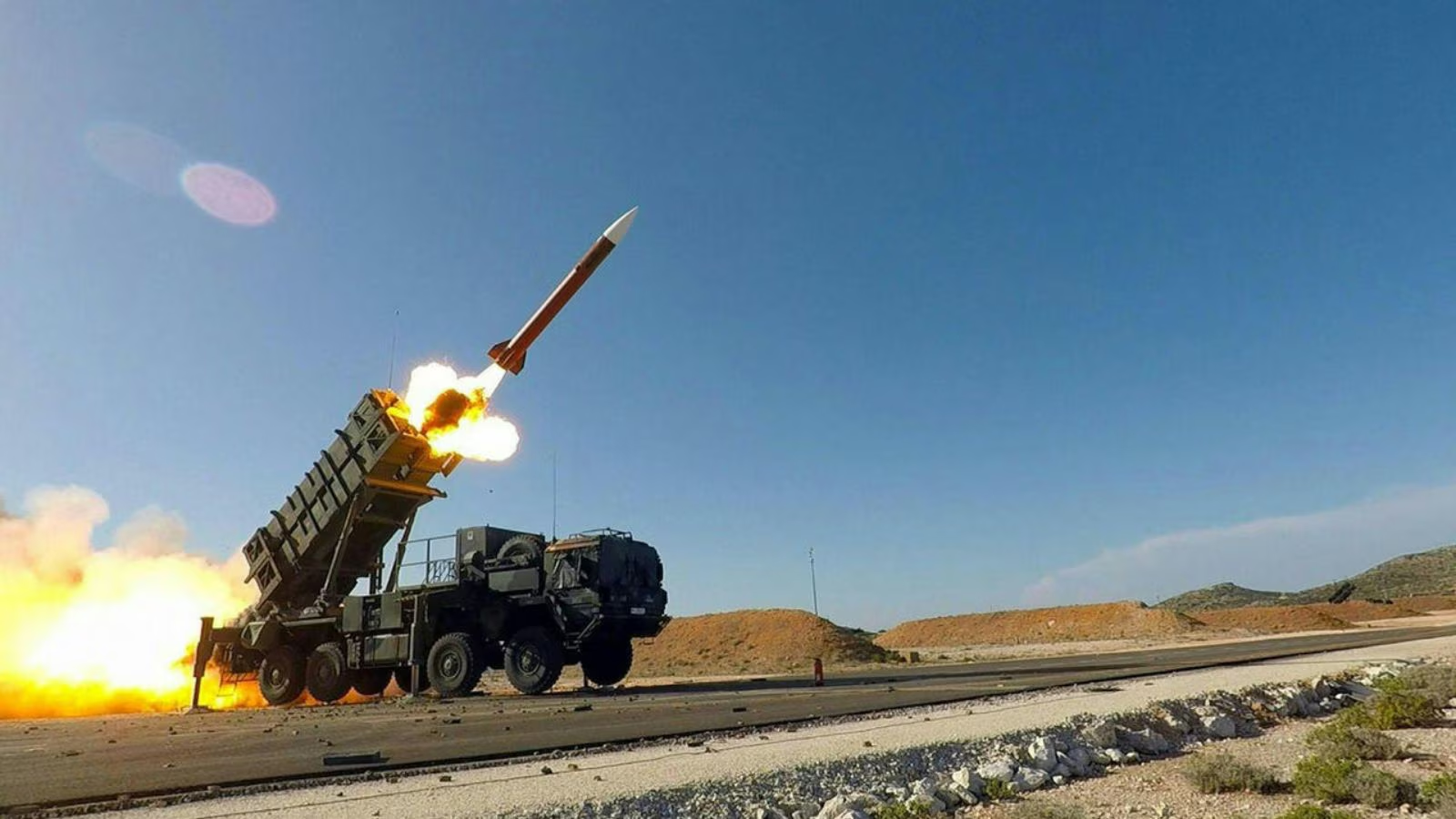
- The US Central Command has also used up 1,200 Patriot missiles. To put this into perspective, the US produced 600 of these interceptors in all of 2025, costing more than $4 million each.
- The CENTCOM has fired over 1,000 units of its flagship Tomahawk cruise missiles – roughly 10 times the number the US buys each year for $2.5 million per unit. There are 3,000 of these long-range cruise missiles left in storage.
- The US has fired off more than 1,000 Precision Strike Missile (PrSM) and Army Tactical Missile System (ATACMS) ground-based missiles.
The US forces struck more than 13,000 targets in Iran, War Secretary Pete Hegseth notified earlier. The attacks have mostly focused on the Islamic Republic’s military assets, especially its ballistic missiles and their supply chains. However, the numbers do not include the number of munitions used to hit each target.
“At current production rates, reconstituting what we have expended could take years,” Democrat Senator Jack Reed of Rhode Island, the top Democrat on the Armed Services Committee, said.
Adding to the cost are also losses of aerial assets. The US has lost around a dozen drones and aircraft, including three F-15 fighter jets in friendly fire by Kuwaiti air defences. In late March, an Iranian missile barrage on a Saudi airbase damaged an E-3 Sentry AWACS. According to a Wall Street Journal report, the US Air Force has only 16 of these aircraft left in its fleet. Each unit costs about $270 million.
The US military had to destroy two MC-130 cargo planes and at least three MH-6 helicopters during a recent operation to rescue an Air Force officer from Iran to prevent the technology from falling into enemy hands. The decision has costed a $275 million, according to a Marine officer-turned-senior adviser at the Centre for Strategic and International Studies.
Story continues below this ad
How is the US tackling the issue?
While the CENTCOM burns through its munitions, the Pentagon says that it is waiting for Congressional approval for additional funding before it can pay weapons manufacturers to replenish the depleted American supply.
In January, the Department of Defence announced that it secured seven-year agreements with key defence contractors, including Lockheed Martin and RTX, to quadruple production of precision-guided munitions and THAAD missile interceptors. However, the production has not expanded yet owing to roadblocks in the funding approvals.
Iran’s heavy usage of its economical Shahed kamikaze drones has worn down the US’s expensive air defence systems. US interceptors costing millions of dollars are being used to take down these drones, which cost $30,000 dollars each. An identical strategy is being utilised by Russia on the Ukrainian front.
To balance the financial arithmetic in West Asia, the US has reverse-engineered the Shahed drone and developed the Low-cost Unmanned Combat Attack System (LUCAS), which costs $35,000 a piece.
Story continues below this ad
The path ahead: Difficulties in posturing
As demand outpaces output, the US has been diverting vast amounts of military resources from other key theatres. The war has led to the depletion of weapons systems from Eastern Europe, amid fears of Russian aggression.
The USS Abraham Lincoln Carrier was moved from the South China Sea to the region before the war began. The New York Times reported in March that the US also moved its Patriot missiles and THAAD system from South Korea, one of the only East Asian allies hosting the advanced missile defence system, deployed by the Pentagon to counter North Korea’s missile threat.
Notably, the US National Defence Strategy, published this January, downplayed Russia’s relevance in the world order, while reaffirming Beijing as a competent rival. With resources stretched, Washington faces difficulties in positioning itself in what it regards as a priority theatre.
China has steadily risen over the past few decades, building a naval fleet that now outnumbers the US in vessel count. Beijing has been displaying aggressive manoeuvres while sharpening its rhetoric on reunification with Taiwan.
Stay updated with the latest – Click here to follow us on Instagram
© IE Online Media Services Pvt Ltd