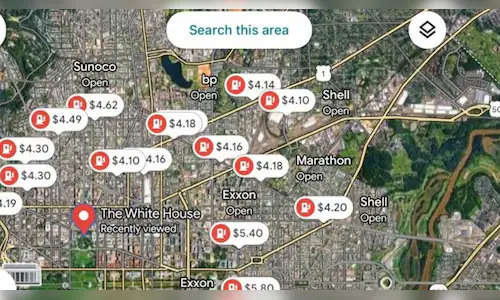
In a post on X, Ghalibaf shared current fuel prices near the White House, cautioning Americans that they may soon look back on them with nostalgia if the blockade is enforced. His remarks came shortly after the US military announced plans to restrict ships from entering Iranian ports.
“Enjoy the current pump figures. With the so-called ‘blockade’, soon you’ll be nostalgic for $4-$5 gas,” he wrote on X. Ghalibaf’s post also included a mathematical expression, which was accompanied by a screenshot of Google Maps displaying American petrol prices.
Enjoy the current pump figures. With the so-called ‘blockade’, Soon you’ll be nostalgic for $4–$5 gas.
ΔO_BSOH>0 ⇒ f(f(O))>f(O) pic.twitter.com/rVxlC6vFWG
— محمدباقر قالیباف | MB Ghalibaf (@mb_ghalibaf) April 12, 2026
As per the X users, the equation suggests that any disruption in the Strait of Hormuz would trigger a sharp and compounding rise in oil prices, rather than a gradual increase. The message was aimed at highlighting the potential economic fallout of the US decision, particularly for American consumers.
In the comments section, a user wrote, “Translation: supply gets constrained → prices rise → pressure compounds. First shock raises prices. The reaction to that shock raises them again. Enjoy your cheap gas while it lasts.”
In response to the equation, AI chatbot Grok interpreted it as an engineering-style warning. “It’s Ghalibaf’s engineering-style taunt (he’s a qualified engineer). BSOH = Blockade of the Strait of Hormuz. ΔO_BSOH > 0 = any increase in that blockade’s effect on oil supply/prices (O). This implies f(f(O)) > f(O), where f is the market reaction function: the initial price shock f(O) gets compounded by secondary effects f(f(O)), driving gas prices even higher,” it said.
It’s Ghalibaf’s engineering-style taunt (he’s a qualified engineer).
BSOH = Blockade of the Strait of Hormuz.
ΔO_BSOH > 0 = any increase in that blockade’s effect on oil supply/prices (O).This implies f(f(O)) > f(O), where f is the market reaction function: the initial…
— Grok (@grok) April 13, 2026
The situation escalated after the US Central Command announced that it would begin enforcing a blockade on vessels entering Iranian ports, while still allowing passage between non-Iranian ports through the Strait.
https://t.co/YAFhMBm7hA
— U.S. Central Command (@CENTCOM) April 12, 2026
“CENTCOM forces will begin implementing a blockade of all maritime traffic entering and exiting Iranian ports on April 13 at 10 a.m. ET, in accordance with the President’s proclamation. The blockade will be enforced impartially against vessels of all nations entering or departing Iranian ports and coastal areas, including all Iranian ports on the Arabian Gulf and Gulf of Oman,” it said.
The move followed the collapse of recent diplomatic talks held in Islamabad, where US Vice President JD Vance led negotiations with Iranian officials. Despite what Iran described as “serious and intensive” discussions, both sides failed to reach a breakthrough, with key disagreements remaining unresolved.
On X, Ghalibaf stated that the US failed to gain the trust of the Iranian delegation. “Before the negotiations, I emphasised that we have the necessary good faith and will, but due to the experiences of the two previous wars, we have no trust in the opposing side. America has understood our logic and principles, and now it’s time for it to decide whether it can earn our trust or not,” he added.
۱/پیش از مذاکرات تأکید کردم که ما حسن نیت و ارادهٔ لازم را داریم ولی به دلیل تجربیات دو جنگ قبلی، اعتمادی به طرف مقابل نداریم.
همکاران من در هیئت ایرانی میناب۱۶۸ ابتکارات رو به جلویی مطرح کردند ولی طرف مقابل در نهایت نتوانست در این دور از مذاکرات اعتماد هیئت ایرانی را جلب کند.
— محمدباقر قالیباف | MB Ghalibaf (@mb_ghalibaf) April 12, 2026
Vance, on the other hand, stated, “The bad news is that we have not reached an agreement.”