
The federal government has approved sweeping reductions in import duties on electric vehicles, mass transit buses, and key manufacturing inputs.
The decision is part of the government’s efforts to cushion rising living costs and support economic activity amid global oil market volatility triggered by geopolitical tensions.
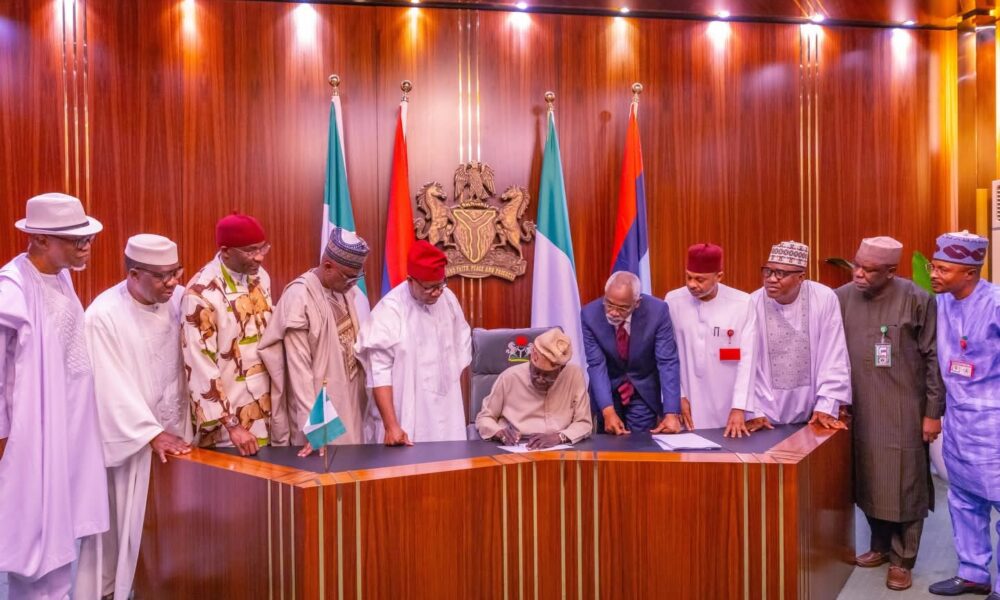
The policy directive, approved by President Bola Ahmed Tinubu, forms part of a broader set of fiscal measures designed to mitigate the impact of the ongoing Middle East crisis on Nigeria’s economy, particularly as higher crude oil prices continue to drive up fuel and transportation costs.
Details of the intervention were disclosed on Monday by Special Assistant to the President, Dada Olusegun, on his X account, who said the tariff adjustments were aimed at easing inflationary pressures, improving affordability for consumers, and supporting local businesses.
“President Tinubu’s administration has approved a massive reduction in import duties of selected products in order to further reduce inflation, empower local businesses and increase affordability for consumers,” Olusegun said.
Under the new policy, import duties on electric vehicles (EVs) and mass transit buses have been reduced from five per cent to zero, a move expected to lower the cost of transportation and accelerate the adoption of cleaner mobility options.
The government also eliminated the five per cent levy on manufacturing machinery, a step aimed at reducing production costs and stimulating industrial output.
Further adjustments were made across several critical import categories. Duties on passenger vehicles were cut from 70 per cent to 40 per cent, while tariffs on bulk rice were reduced from 70 per cent to 47.5 per cent and broken rice from 70 per cent to 30 per cent. Raw cane sugar duties were lowered from 70 per cent to between 55 per cent and 57.5 per cent, and crude palm oil tariffs were reduced from 35 per cent to 28.75 per cent.
In the industrial and construction sectors, import duties on steel sheets and coils were reduced from 45 per cent to 35 per cent, while tariffs on glazed ceramic tiles were cut from 55 per cent to 46.25 per cent, measures expected to ease costs across manufacturing and real estate value chains.
The government has also introduced a 90-day transition period beginning April 1 to allow markets adjust gradually to the new tariff regime and prevent supply disruptions or pricing shocks.
The policy comes amid renewed turbulence in global crude oil markets triggered by the Israel–US–Iran conflict, which has disrupted shipping routes around the Strait of Hormuz — a corridor that accounts for roughly 20 percent of global crude supply.
Fuel prices in Nigeria had climbed to about N1,350 per litre in recent weeks, reflecting rising international crude benchmarks and higher shipping and insurance costs.
In a statement issued by the presidential spokesperson, Bayo Onanuga, after a civic reception in Yenagoa, President Tinubu directed the Ministries of Finance and Budget, alongside the Head of Service, to develop measures that would ease economic hardship while aligning with global realities.
The renewed blockade of the Strait of Hormuz by the United States has further driven oil prices upward, with Brent crude trading above $102 per barrel and West Texas Intermediate exceeding $104 per barrel as of April 13.
…Analysts comment
Economic analysts say the tariff adjustments could provide short-term inflation relief but stress the need for complementary reforms.
In his reaction, Chief Executive Officer of the Centre for the Promotion of Private Enterprise (CPPE), Dr. Muda Yusuf, described the move as “a targeted fiscal stimulus.”
“Scrapping duties on manufacturing machinery and reducing tariffs on industrial inputs such as steel will lower production costs and improve competitiveness. This is critical in an environment of exchange rate volatility and high energy costs,” he said.
However, Yusuf cautioned that food tariff reductions must be carefully managed to avoid undermining domestic producers.
“There must be a balance between protecting local agriculture and ensuring food affordability. If not properly sequenced, it could discourage local investment in farming,” he added.
On transport and clean energy, mobility expert, Aisha Suleiman said zero-duty EV imports could help Nigeria diversify away from petrol dependence.
“With proper charging infrastructure and financing models, this policy could reduce long-term exposure to global oil price shocks. But infrastructure readiness will determine the speed of adoption,” she noted.
Fiscal policy analyst, Ken Ife, warned that government revenue may take a short-term hit due to lower customs collections.
“Nigeria relies significantly on non-oil revenue streams, including import duties. The challenge will be ensuring that economic growth stimulated by lower tariffs offsets immediate revenue losses,” he explained.
As global energy markets remain volatile, the government’s strategy reflects a broader shift toward targeted economic intervention aimed at shielding households, supporting industrial productivity and stabilising prices in a challenging international environment.
…The trigger
The policy response comes against the backdrop of heightened global uncertainty stemming from the ongoing Israel–US–Iran conflict, which has disrupted oil supply chains and driven volatility in energy markets.
The crisis has significantly affected shipping routes around the Strait of Hormuz, a critical corridor responsible for roughly one-fifth of global crude oil flows.
Since the onset of the conflict late February, crude oil prices have experienced sharp swings, surging to as high as $120 per barrel amid supply concerns before retreating below $95 following a temporary ceasefire announcement on April 8. However, renewed tensions have reignited market fears.
On April 12, U.S. President Donald Trump ordered a naval blockade of vessels entering or leaving the Strait of Hormuz after peace talks between the United States and Iran collapsed. The escalation pushed Brent crude prices above $102 per barrel, while West Texas Intermediate (WTI) climbed to $104.16 per barrel on April 13.
Analysts say the surge in oil prices has heightened inflation risks globally, with Nigeria particularly exposed due to its reliance on imported refined petroleum products and vulnerability to exchange rate pressures.
The latest tariff reductions signal a proactive fiscal approach by the federal government to counter imported inflation and sustain economic momentum. By lowering the cost of transportation, food imports, and industrial inputs, authorities aim to shield households and businesses from the ripple effects of global energy shocks.
Market watchers note that the effectiveness of the measures will depend on implementation and broader macroeconomic conditions, including exchange rate stability and global commodity price trends.
Nonetheless, the policy underscores the administration’s intent to deploy targeted fiscal tools to navigate an increasingly uncertain global environment while supporting domestic growth.
…I’m not afraid of Trump – Pope
Meanwhile, Pope Leo XIV has rejected criticism from U.S. President Donald Trump of his appeal to end the various wars around the world and said he is not afraid of the American president.
Leo made the comments Monday on board an aircraft taking him to Algiers, the first stop on his Africa trip.
“The things I say are not meant as attacks on anyone,” the head of the Catholic Church said.
“I am not a politician. I am inviting all people to look for ways of building bridges of peace and reconciliation of looking for ways to avoid war any time that’s possible. I am not afraid of the Trump administration.” Leo stressed.
Shortly before the pontiff’s departure, the U.S. president accused him of pursuing a terrible foreign policy.
On the Truth Social platform, Trump wrote that Leo only came into office because people had hoped that a pope from the United States would be able to deal with him better.
“If I wasn’t in the White House, Leo would not be in the Vatican,” Trump had said , stressing he did not want a pope who thought it was acceptable for Iran to have a nuclear weapon.
Leo told journalists on board his aircraft: “The message of the gospel is very clear: ‘blessed are the peacemakers.’ I will not shy away from announcing the message of the gospel.
“To put my message on the same plane as what the president has attempted to do here.
“I think is not understanding what the message of the gospel is, I am sorry to hear that but I will continue on with what I believe is the mission of the Church in the world today,’’ Leo added.