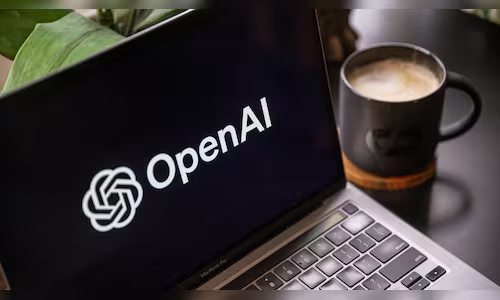
The trial, overseen by Judge Yvonne Gonzalez Rogers in Oakland, marks the culmination of a years-long fallout between the two co-founders of OpenAI. What began in 2015 as a nonprofit effort to build AI for the benefit of humanity has since evolved into one of the world’s most valuable AI companies—with a hybrid for-profit structure and deep backing from Microsoft.
At the core of the dispute is Musk’s claim that OpenAI abandoned its founding principles. He alleges that the company shifted toward a profit-driven model, misleading him and others who supported it early on. Musk, who says he contributed about $38 million in OpenAI’s early days, argues that this support was given on the understanding that the organisation would remain nonprofit and open in its approach.
He is seeking damages of up to $134 billion—though he has said any compensation would go to OpenAI’s nonprofit arm—and has also asked the court to remove Altman and president Greg Brockman from leadership. Crucially, Musk is pushing to unwind OpenAI’s for-profit restructuring altogether, a move that could fundamentally alter the company’s trajectory.
OpenAI has strongly pushed back, arguing that Musk’s claims are inconsistent with his own past positions. The company says he had, at one stage, supported a for-profit pivot and even explored integrating OpenAI into Tesla. It also maintains that Musk’s contribution was a donation—not an investment—and accuses him of using litigation to undermine a competitor, given his involvement with rival AI venture xAI.
Also Read: Microfinance disbursements fall, but asset quality at record levels: Equifax
The case arrives at a critical moment. OpenAI, reportedly valued at around $852 billion, is widely expected to pursue a public listing. Any disruption to its structure or leadership could complicate those plans. Microsoft, which holds a significant stake in the company following multi-billion-dollar investments, also has a direct interest in the outcome.
The trial will revisit OpenAI’s early years, including internal emails, messages, and disagreements that led to Musk’s exit in 2018. Both Musk and Altman are expected to testify, along with potential witnesses such as Microsoft CEO Satya Nadella and former OpenAI chief scientist Ilya Sutskever.
Proceedings are divided into two phases: first, determining whether Musk’s remaining claims—primarily breach of charitable trust and unjust enrichment—hold; and second, deciding on remedies if the court rules in his favour. While a jury will deliver an advisory verdict, the final decision rests with the judge.
Beyond the legal arguments, the trial reflects a deeper tension within the AI industry: how to balance public-interest goals with the massive capital demands of cutting-edge technology. OpenAI argues that its for-profit structure is essential to fund the development of artificial general intelligence (AGI), while Musk contends that this shift compromises the original mission.
Even if Musk does not prevail, the case is expected to bring unprecedented transparency to OpenAI’s inner workings. That alone could influence the competitive landscape, especially as rivals—including Musk’s own ventures—seek to challenge its dominance.
For now, what started as a philosophical split between co-founders has escalated into one of the most consequential legal battles in tech—one that could redefine how the AI industry is built, funded, and governed.