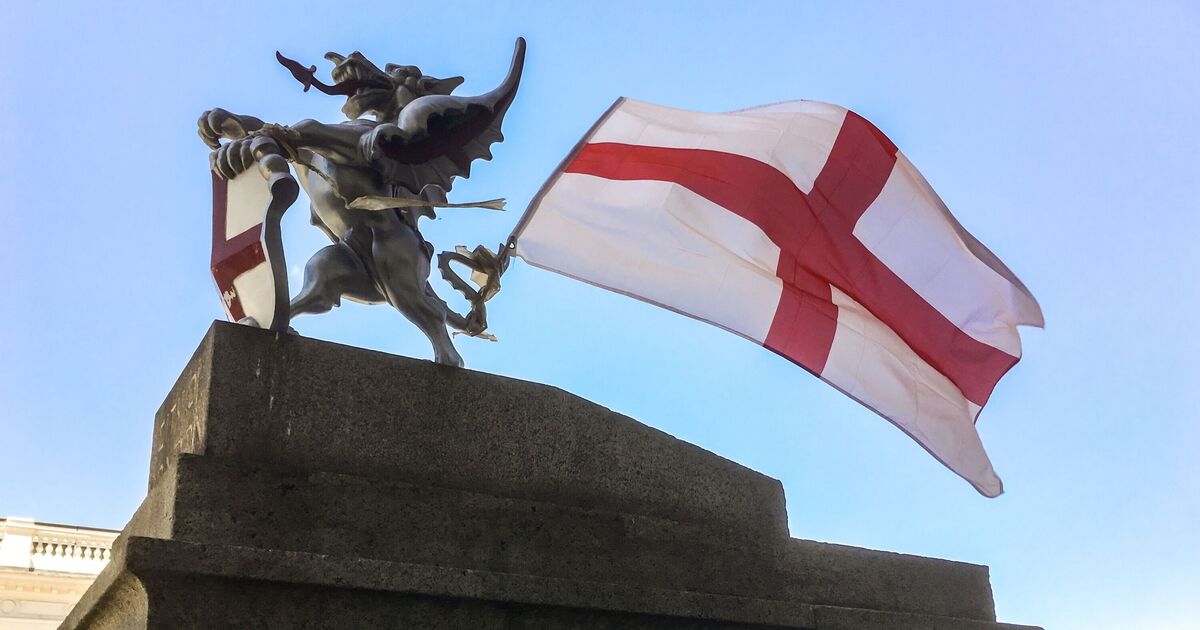
St George’s Day is celebrated globally (Image: Getty)
St George’s Day is the most important day on the calendar for England, but the patron saint is celebrated around the world in April and May – not just here in the UK.
While England will officially honour its patron saint on Thursday, April 23, many other countries will also pay their respects to the legendary figure who is championed in both Christian and Islamic mythology.
It means that St George, who is believed to have died 1,700 years ago in 303 AD, is celebrated by many countries around the globe this week and beyond.
As explained by English Heritage: “England shares St George with Venice, Genoa, Portugal, Ethiopia and Catalonia among others as their patron saint and many of these places have their own celebrations and ceremonies in his honour.”
Indeed, many more countries around the world will hold events for St George, who is honoured by the Eastern Orthodox Church as ‘a great martyr’.
Read more: St George’s Day date moved for 2026 as plans for future date changes confirmed
Read more: St George’s Day London Tube strikes confirmed with exact date and times
In Bulgaria, George’s Day is held on May 6 and is a public holiday (unlike in England, where it is still not a Bank Holiday).
In Serbia and Bosnia and Herzegovina, the day is also celebrated on May 6, while in Egypt, the day is celebrated on May 1.
In India, feasts and events for George are held from April 27 to May 14.
The nation of Georgia, in Europe, is not technically named after St George but does use the St George’s Cross as its national flag, which makes it very similar to the English flag (always confusing during football matches).
Turkey and Brazil also celebrate St George, as well as Greece, Romania, Syria, Lebanon and others – a truly international event.
English Heritage adds: “He might be our national patron, St George was likely a Greek-speaker who lived and died in the Roman Near East. A Christian, he died a martyr’s death in about AD 303.
“His tomb at the city of Diospolis or Lydda (now Lod in Israel) in Roman Palestine soon attracted pilgrims.”
It adds about his mythology: “During the Middle Ages, people, especially in German-speaking lands, believed that St George was one of the ‘Fourteen Holy Helpers’ – a group of saints whose assistance was especially esteemed.
“St George’s protection was invoked against several nasty diseases, many fatal and with infectious causes, including the Plague and leprosy.
“Although George is often depicted in popular culture as a knight in shining armour, the truth is less fanciful. Whilst St George was depicted from the 11th century as a chivalric knight or a warrior on horseback, it is more likely that he was an officer in the Roman army.”
Indeed, St George’s mythos is so universal that he’s also mentioned in Muslim legends too.
Al-Thaʿlabi states that George was from Palestine and lived during the time of some of Jesus’s disciples, and that he was a prophetic figure in Islamic sources.
According to the myths, he was killed many times by the king of Mosul and resurrected each time. When the king tried to starve him, he touched a piece of dry wood brought by a woman and turned it green, with varieties of fruits and vegetables growing from it. After his fourth death, the city was burnt along with him.
This mythical figure was chosen by Royalty in England, despite the fact that he never visited this country.
English Heritage adds: “Although St George never visited England, his reputation for virtue and holiness spread across Europe and his feast day – the 23rd April – was celebrated in England from at least the early 8th century.
He became popular with English kings. Edward I (1272-1307) had banners bearing the emblem of St George (a red cross on a white background), and Edward III (1327-77) had a strong interest in the saint and owned a relic of his blood.
“St George’s cross didn’t become England’s national flag until the early 16th century.”


