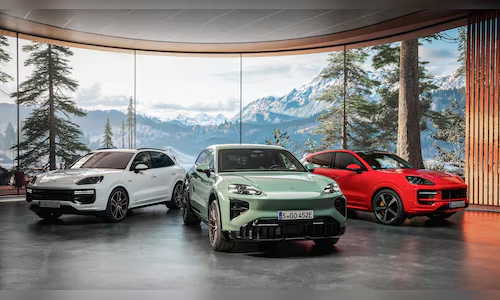
The Volkswagen AG brand on Wednesday reported operating profit of €595 million ($696 million) for the first quarter, yielding a return of 7.1%, close to the top of its annual range. The profit was lower than a year earlier, as expected, due in large part to US tariffs and lower deliveries, including a 21% slump in China.
German automakers have been shuffling their model lineups and strategies as they grapple with excess factory capacity, tariffs and weak sales in China, the world’s largest car market. The fallout from the Middle East conflict threatens to deal them another blow.
Porsche, once the major profit generator for parent VW, has been hit particularly hard. Last year’s deliveries fell the most since 2009, and the stock is worth roughly half what it was when it listed in 2022. The manufacturer was forced to cut guidance four times last year, taking nearly €4 billion in charges after walking back its electric-vehicle plans.
In an effort to slim down the company, new Chief Executive Officer Michael Leiters is due to begin negotiations with labor leaders on job cuts in the coming months. Porsche previously agreed to reduce its headcount by some 3,900 by the end of the decade, including 2,000 temporary workers. It currently employs roughly 40,000 people.
The manufacturer is also mulling future models and derivatives positioned above its two-door sports cars and the Cayenne sport utility vehicle to underpin margins.
Porsche is “scrutinizing each and every cost item that we have, optimizing everything that we have, questioning everything that we have,” Chief Financial Officer Jochen Breckner said on a conference call Wednesday.
The company confirmed its guidance for the year, noting that the forecast doesn’t factor in the effects of the ongoing Iran conflict. As well as adding to costs and hitting demand, the war in the Middle East risks causing supply-chain disruptions.
Revenue fell 5.2% to €8.4 billion in the first quarter from a year earlier. Deliveries dropped 15% in the period after Porsche ended production of the 718 Boxster and Cayman models, and US tax incentives were discontinued.
Sales risk being squeezed further when Porsche stops making its popular combustion-engine Macan SUV this summer.
Solid first-quarter results and unchanged guidance “gives us confidence that we may finally be at trough,” Citi analyst Harald Hendrikse wrote in a note.
The automaker last week agreed to sell its stake in the venture that owns the Bugatti supercar brand as part of a plan to retreat from ultra-luxury cars and focus more on its core business.
The company is looking at other deals to slim down further, Breckner said. While he didn’t specify which businesses, Breckner repeated that Porsche may be open to selling at least some of MHP, its IT consultancy.
“We think an updated MHP shareholder structure would be beneficial,” the CFO said. “Changes there might be something that we want to look at,” he added.