Mr Shettima said the proposed framework must extend beyond ‘slogans and applause’ to influence how education, public service, enterprise, and civic institutions are designed.
Vice President Kashim Shettima has called for a new national framework for youth leadership development, warning that Nigeria’s status as one of the youngest countries in the world could become insignificant without deliberate planning and investment.
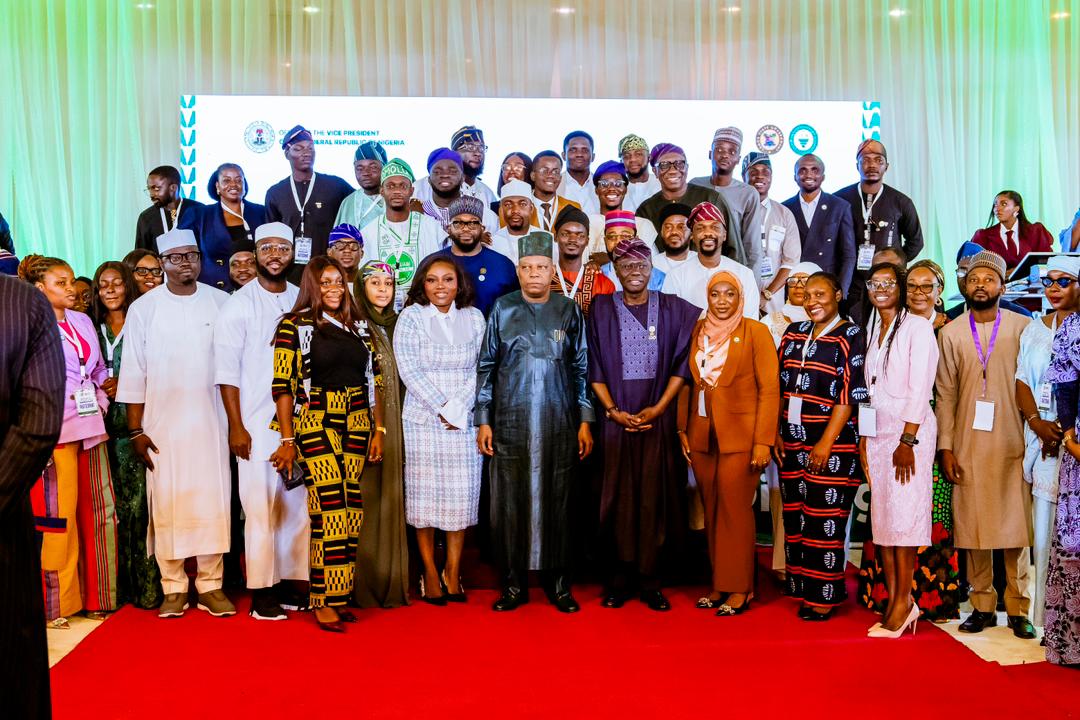
Mr Shettima spoke in Abuja on Monday at the 2026 Abuja Dialogue, convened by the Office of the Vice President and Lagos State’s Lateef Jakande Leadership Academy, under the theme, “Scaling Excellence: Youth Leadership as Strategic Infrastructure for National Transformation.”
He noted that Nigeria is one of the youngest nations in the world and said this should not be reduced to a talking point for conferences or a statistic for brochures
“It is a national condition with profound consequences,” he added.
The Vice President said Nigeria’s demographic profile should no longer serve as a rhetorical talking point but must be treated as a policy priority.
He cautioned that the country’s future would depend less on natural resources or government ambition and more on “the systems built to sustain leadership continuity and national development.”
He argued that youth leadership must move beyond symbolism, describing it as a deliberate and institutional process rather than a generational transition.
“Youth leadership must be understood with clarity. It is not a ceremonial handover waiting for age to perform its arithmetic,” he said.
“It is a structured process through which young men and women are prepared, trusted, integrated, and supported within the institutions that shape our future.”
Youths urged to embrace responsibility
Addressing young Nigerians, Mr Shettima said leadership requires readiness to make difficult choices and prioritise the collective interest.
“Leadership is not defined by age. It is defined by readiness to bear consequences, to choose the long view over easy applause, and to place the common good above private comfort,” he said.
He added that the country’s future would be shaped by citizens who see excellence as a duty rather than an option.
He added that the proposed framework must extend beyond ‘slogans and applause’ to influence how education, public service, enterprise, and civic institutions are designed.
He stressed the importance of creating gradual pathways for young Nigerians to assume responsibility, linking leadership development to practical experience and accountability.
“Leadership grows when young people are given room to learn, to contribute, to make decisions, and to be held accountable for results. Responsibility is the workshop where capacity is refined,” he said.
Speaking earlier at the event, Lagos State Governor Babajide Sanwo-Olu, said the dialogue reflects growing recognition of youth leadership as a national priority.
Mr Sanwo-Olu described the Lateef Jakande Leadership Academy as not merely a fellowship but ‘a talent incubator’
where young Nigerians receive real public sector immersion, cross-sector learning, policy exposure, mentorship from seasoned leaders, and the opportunity to execute capstone projects that address real societal challenges.
According to him, the Academy sits within a broader ecosystem that includes the IBILE Youth Academy, the Lagos State Employment Trust Fund, youth-focused skills and job creation programmes, digital literacy and innovation initiatives, and robust support for entrepreneurship and MSMEs.
He, however, noted that unlocking youth potential would require “commitment, policy frameworks, budgetary allocations, and the kind of political will that turns good intentions for young people into functioning institutions.”
Other speakers at the event echoed the call for a more deliberate approach.
The Deputy Chief of Staff to the President, Ibrahim Hadejia, said the significance of the dialogue lies in its focus on youth development, preparing them for leadership with knowledge, discipline and enthusiasm.
Mr Hadejia said, “Youth leadership cannot be approached as a symbolic gesture but a deliberate idea that recognises leadership as infrastructure that determines the strength of institutions and shapes the trajectory of national development.
Also, the Minister of Youth Development, Ayodele Olawande, said the timing of the dialogue was apt, noting that Nigerian youths are prepared, ready and committed to playing their roles in the advancement and development of the country.
Mr Olawande stated that the administration of President Bola Tinubu, through the Federal Ministry of Youth Development, remained committed to providing the necessary platforms and enabling environment for the youths to fulfil their destinies and take up leadership positions at all levels of government and in different sectors of the economy.
In her remarks, Ayisat Agbaje-Okunade, executive secretary of the Lateef Jakande Leadership Academy, said the dialogue revealed the need to scale the conversation about youth leadership development as a strategic pillar of governance, economic growth, and institutional resilience.
Ms Agbaje-Okunade said the dialogue is also an opportunity to build national consensus, align institutions and move youth leadership from the margins of policy to the centre of development, transforming policy pronouncements to actionable programmes and projects.
The initiative aims to build consensus and align institutions toward translating policy pronouncements into actionable programmes and projects.
While speakers emphasised frameworks, systems, and political will, the dialogue highlighted a recurring theme in government policy discussions: the gap between commitments and execution.