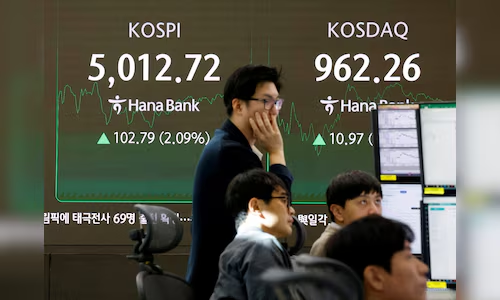
The total market capitalisation of Korean-listed companies has surged more than 45% this year to $4.04 trillion, while the UK’s has climbed about 3% to $3.99 trillion, according to data compiled by Bloomberg. The size of the UK market was about double that of Korea’s as recently as the end of 2024.
The surge in Korean stocks underscores the global pivot toward companies linked to artificial intelligence, which has driven gains in the Asian nation’s two biggest listed companies: Samsung Electronics Co. and SK Hynix Inc.. The two memory-chip behemoths now account for more than 40% of the total market cap of the benchmark Kospi index, which has more than 800 constituents. A further tailwind has been provided by President Lee Jae Myung’s push to bolster equity prices via corporate governance reforms and pro-market policies.
“The rapid ascent of Korea and Taiwan reflects a structural rebalancing in global equity markets, driven by their dominance in AI hardware rather than tactical asset allocation,” said Francesco Chan, emerging markets and Asia Pacific investment specialist at JPMorgan Asset Management in Hong Kong. “As the backbone of the AI supply chain — with a ‘super-cycle’ advantage in high-end foundries and memory — these economies are attracting sustained structural capital inflows.”Also Read: Paramount seeks approval for foreign investors; Saudi, Qatar, Emirates in fray for a piece of Warner Bros
The rally in Korean stocks mirrors that of Taiwan’s, which in April also overtook the UK to become the world’s seventh-largest share market. Taiwan’s gains have also been powered by the world’s largest chip foundry, Taiwan Semiconductor Manufacturing Co., which now accounts for about 45% of the island’s benchmark gauge. Taiwan’s stock market value, now at $4.48 trillion, is now approaching that of Canada.
The UK’s FTSE 100 Index has gained about 4% this year, not much less than the MSCI all-country world index, but well behind the supercharged gains of markets that have benefited from the AI boom. The nation’s equity market, which is Europe’s biggest, remains dominated by traditional sectors such as financials, consumer staples and energy-and-mining firms.
Forces such as the potential of AI, global defence spending and corporate government reforms “support a much steeper trajectory for Korean and Taiwanese equities than for Europe,” said Patrick Kellenberger, an emerging-market equity strategist at Lombard Odier in Geneva. “Europe continues to struggle with commercialising and scaling innovation. Creating the conditions for innovative firms to emerge and grow is critical — but also time-consuming.”
While equity values have soared for the Asian chip powerhouses, economies in the region remain much smaller than those of the major European ones. South Korea’s gross domestic product is estimated to be $1.9 trillion this year and Taiwan’s at $977 billion, well below the forecasts for more than $3 trillion for Germany, the UK and France, based on estimates from the International Monetary Fund.
For now, Wall Street strategists remain bullish over Korean stocks, citing earnings upgrades from AI demand and favourable valuations. Goldman Sachs Group Inc. has raised its Kospi target to 8,000, mainly driven by an increase of more than 200% in its 2026 earnings growth projection.