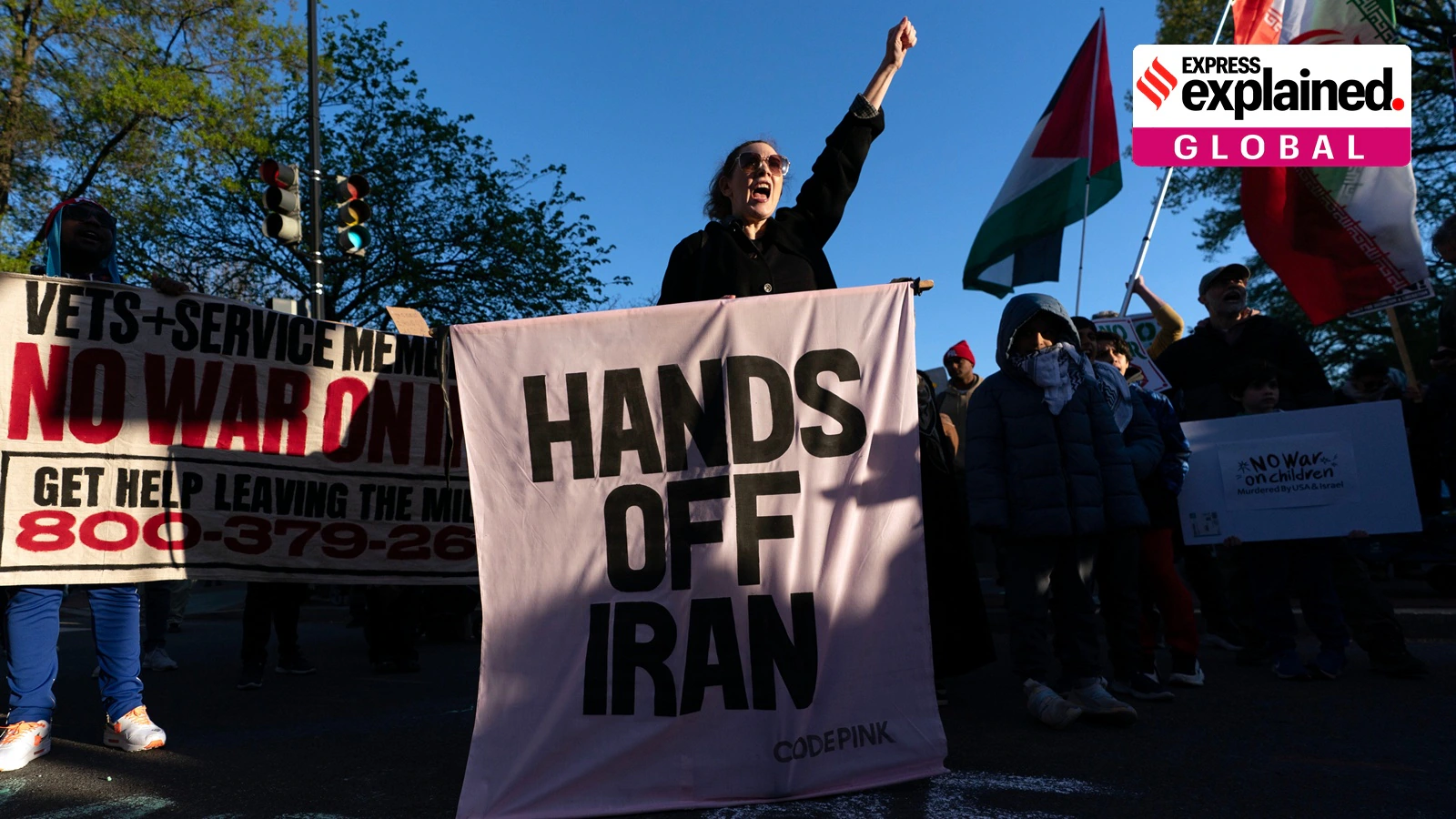
A months-long West Asia conflict has paused after US President Donald Trump announced a two-week ceasefire with Iran, following Tehran’s acceptance of a 10-point proposal. The war was triggered by US-Israel strikes on Iran on February 28.
Trump announced the truce hours after warning he would “wipe out” Iran’s “entire civilisation” if it failed to allow safe passage through the Strait of Hormuz.
The ceasefire comes after weeks of strikes on military bases, oil depots, and key infrastructure by both sides. Just before his self-imposed deadline for further attacks, Trump called Iran’s proposal “a significant step” and a “workable basis” for talks, reversing his earlier stance.
Before the pause, the US and Israel struck key Iranian infrastructure, with Israeli Prime Minister Benjamin Netanyahu saying railways and bridges linked to the Revolutionary Guards were targeted.
Pakistan helped broker the truce, proposing a two-week pause during which Iran agreed to allow oil and commercial vessels through the Strait of Hormuz.
Iran’s National Security Council has confirmed the deal. The next round of talks is set for April 10 in Islamabad.
Here is the timeline of events that took place in the past month:
February 28
The United States and Israel launched coordinated strikes across Iran, hitting a government compound in Tehran and multiple military targets a day after nuclear negotiations between Washington and Tehran ended without a breakthrough in Geneva.
Story continues below this ad
The strikes reportedly killed several political officials and senior commanders of the Islamic Revolutionary Guard Corps (IRGC) including Supreme leader Ayatollah Ali Khamenei.
Among the dead were civilians, including at least 175 people — most of them girls, who were killed in a strike on a primary school in Minab, in Iran’s Hormozgan province. Initial reports said 51 were killed, but the toll later rose sharply. US media reports suggested the strike may have been a targeting error by the American military.
Iran’s foreign ministry condemned the attacks, calling them “renewed military aggression” carried out in the midst of an ongoing diplomatic process.
The strikes followed sustained pressure from the White House on Iran to abandon its nuclear enrichment programme — a demand Tehran has repeatedly rejected.
Story continues below this ad
In retaliation, Iran targeted US and Israeli assets across several Gulf countries, escalating tensions and disrupting global energy markets. The strikes also affected shipping through the Strait of Hormuz, a critical global trade route.
Ayatollah Ali Khamenei killed
Ayatollah Ali Khamenei, who led Iran for over three decades and shaped its confrontation with the United States and Israel, was killed on February 28 in US-Israeli airstrikes, Iranian media confirmed. He was 86.
US President Donald Trump claimed that Khamenei died during strikes targeting Iran’s leadership.
Khamenei rose to prominence during the 1979 Islamic Revolution that overthrew the Shah. After the death of Ruhollah Khomeini in 1989, he was appointed the supreme leader, despite not holding the highest clerical rank at the time.
Story continues below this ad
Iran escalates retaliation across Gulf
In response to US-led strikes, Iran intensified attacks on American targets across the Gulf, including US consulates in the UAE and Saudi Arabia. An Iranian drone strike on Port Shuaiba in Kuwait killed six US soldiers — the first American casualties of the war. These remain the only confirmed US military deaths since Washington joined Israel’s campaign against Iran.
The US military later identified four of the victims — all Army Reserve members — as Capt Cody Khork (35), Sgt Noah Tietjens (42), Sgt Nicole Amor (39), and Sgt Declan Coady (20), according to BBC.
The UAE said it has faced over 1,000 Iranian attacks following the February 28 US-Israel offensive. According to the UAE’s Defence Ministry, the attacks have left three people dead and injured 58 residents of multiple nationalities, most sustaining minor wounds.
Iran-backed Hezbollah also expanded the conflict into Lebanon, firing rockets toward Israel in retaliation for the killing of Iran’s Supreme Leader.
Story continues below this ad
Saudi’s Aramco refinery hit
Saudi Aramco’s Ras Tanura refining facility was shut down temporarily after it was hit by a drone triggering a small and isolated fire that has since been brought under control, reported Reuters, citing a Semafor reporter who quoted unnamed sources, reported the development. Saudi Arabia also intercepted Iranian missiles that were targeting Riyadh’s international airport and the Prince Sultan Airbase, which hosts US forces, AFP reported citing a Gulf source.
Mojtaba Khamenei named successor
Within days of the assassination of Iran’s Supreme Leader Ayatollah Ali Khamenei, his second-eldest son, Mojtaba Khamenei, was named as his successor on March 9.
US President Donald Trump criticised the choice, calling Mojtaba an “unacceptable” leader and a “lightweight.” He also said the new leader would need approval from the US administration, warning, “If he doesn’t get approval from us, he’s not going to last long.” Trump added that he would need to be involved in the appointment process, comparing it to past US involvement in Venezuela.
Iran pushed back strongly. Foreign Minister Abbas Araghchi said, “We will allow nobody to interfere in our domestic affairs.”
Story continues below this ad
Iran restricts Strait of Hormuz
Iran’s Revolutionary Guards announced that the Strait of Hormuz — one of the world’s most critical shipping lanes — will be closed to vessels from the US, Israel, Europe, and other Western allies, as traffic through the route sharply declined amid the war. “We had previously said that, based on international laws and resolutions, in times of war the Islamic Republic of Iran will have the right to control passage through the Strait of Hormuz,” the Islamic Revolutionary Guard Corps said, according to state broadcaster IRIB.
US submarine sinks Iranian warship
In another major escalation, Iran accused the United States of committing an “atrocity at sea” after a US submarine sank an Iranian warship in international waters. At least 87 people were reported dead after the vessel, returning from Visakhapatnam following an Indian Navy exercise last month, was torpedoed off Sri Lanka’s southern coast early Wednesday. Sri Lankan Foreign Minister Vijitha Herath identified the ship as IRIS Dena.
Mojtaba Khamenei’s first address
Iran’s new Supreme Leader, Mojtaba Khamenei, issued his first statement on March 12, directing the military to continue restricting access to the Strait of Hormuz. In his message, he also called for national unity and urged public participation in Quds Day, according to Iranian state media.
US aircraft crashes in Iraq
A US military refuelling aircraft crashed in western Iraq while supporting operations linked to the war with Iran, US Central Command said. The aircraft, a KC-135 tanker used for aerial refuelling, went down during the US campaign known as Operation Epic Fury. At least six US crew members were on board. Four were confirmed dead. A US official, speaking to the Associated Press on condition of anonymity, said a second aircraft involved was also a KC-135 refuelling tanker. The incident marks the fourth known aircraft loss linked to US operations against Iran since the war began on February 28.
Story continues below this ad
US strikes Kharg Island
The US carried out bombing raids on Kharg Island, Iran’s main oil export hub, with President Donald Trump saying the strikes targeted military infrastructure. The eight-km-long coral island, located about 50 km off Iran’s mainland in the Persian Gulf, has been “heavily bombed” after largely being spared in earlier US-Israel strikes.
In a post on Truth Social, Trump said military targets on the island were “totally obliterated” in “one of the most powerful bombing raids in the history of the Middle East,” adding that oil infrastructure was not targeted.
Kharg Island is Iran’s most critical oil export terminal, handling the bulk of its crude shipments. It hosts major storage facilities and is linked by pipelines to key oil and gas fields.
The island is also home to key energy installations, including Falat Iran Oil Co., a major crude producer, and Kharg Petrochemical Co., along with large storage and shipping facilities for oil and liquefied natural gas.
Story continues below this ad
Ali Ardeshir Larijani killed
Iran’s powerful national security advisor, Ali Ardeshir Larijani, was killed by Israel. Larijani, 67, served as the secretary of the council and was widely believed to be effectively running the country following the assassination of Supreme Leader Ayatollah Ali Khamenei. Larijani’s son, Morteza, was also killed in the attack, the council said.
Israel strikes South Pars gas field
Israel carried out an airstrike on the South Pars gas field, the world’s largest natural gas deposit, shared by Iran and Qatar across the Gulf. This marks the first attack on Iranian energy infrastructure since the US-Israel war began on February 28. Workers were evacuated, and emergency crews were deployed to control the fire. South Pars accounts for roughly 70–75% of Iran’s natural gas production, making it a strategically vital energy hub.
Iranian strike injures US troops in Saudi Arabia
An Iranian attack on Saudi Arabia’s Prince Sultan Air Base injured 12 US troops in one of the most serious breaches of American air defenses since the war began. According to Tehran’s state-owned Press TV, an American E-3 Sentry AWACS stationed at the base was damaged during a missile barrage on Saturday. Visuals of the aircraft and debris have circulated on social media.
Houthis launch missile at Israel
Yemen’s Iran-backed Houthis joined the war by firing ballistic missiles at Israel, marking their first attack since the US-Israel conflict with Iran began on February 28. The group claimed it targeted “sensitive Israeli military sites,” while Israel said it successfully intercepted the missile.
Iran shoots down US F-15E fighter jet
Iran shot down a US Air Force F-15E fighter jet carrying two crew members, marking the first time a US combat aircraft has been lost in the war. One crew member was recovered safely on the same day, while a risky two-day search-and-rescue operation was launched for the second airman, involving commandos operating deep inside Iranian territory.
Trump threatens Iran over Strait of Hormuz
US President Donald Trump issued an expletive-laden post on his Truth Social platform, warning Iran to reopen the Strait of Hormuz or face targeted strikes on its power plants and bridges. The warning comes ahead of Trump’s self-imposed deadline for reopening the Strait of Hormuz, a vital oil and gas passage responsible for 20% of global oil traffic, which has been effectively closed since the war began.
Trump sets April 7 deadline for Strait of Hormuz
US President Donald Trump warned that “a whole civilisation will die tonight, never to be brought back again” if Iran does not reopen the Strait of Hormuz, setting a deadline of 7 April, 8 PM ET (5:30 AM IST, 8 April).
Speaking at a White House press conference, Trump said it would take “about four hours” to destroy Iran’s bridges and power plants if Tehran fails to comply. He added he was “not at all” concerned about committing possible war crimes in carrying out the strikes.
Trump described a proposed 45-day ceasefire as a “significant step” but “not good enough.” Iran, meanwhile, rejected the plan, calling instead for a permanent end to the war.