After spending millions on defending its interests in West Asia using expensive technology, the United States (US) has turned to economical Ukrainian counter-drone architecture.
The US military has deployed a Ukrainian-developed command and control platform, Sky Map, to handle the incoming drone swarms sent over by Iran targeting Saudi Arabia’s Prince Sultan Air Base. The move marks a rare decision to employ foreign technology from the Russia-Ukraine conflict in the present theatre of war. Ukrainian military officials arrived at the base in recent weeks to train US warfighters with Sky Map, Reuters reported.
The technology is known for being cheap and was widely employed and produced, with Pentagon investment, to defend Ukraine against Russian attacks. According to analysts that spoke to Reuters, the usage of Ukrainian technology to counter the drone and missile attack at the Saudi air base, which is about 640 km away from Iran, sheds light on the vulnerabilities in the US defence structure.
What is Sky Map?
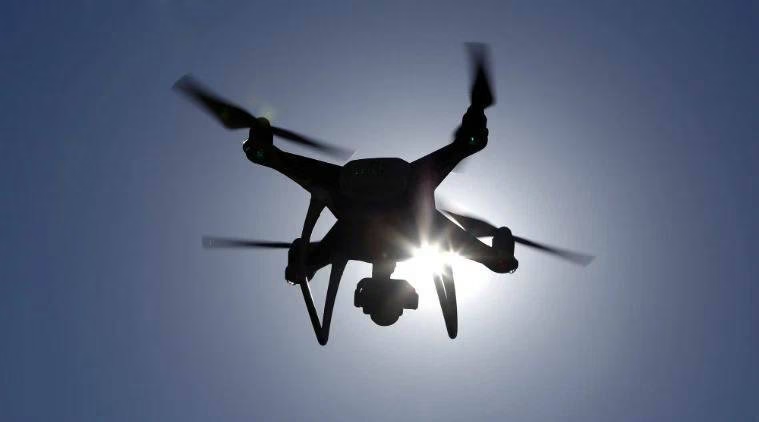
Sky Map is used widely by the Ukrainian military to detect incoming drone threats, and in this war counter the Iranian-developed Shahed drones with its own interceptor drones. This type of platform, typically a dashboard featuring maps and video feeds, synthesizes data from radars and sensors to detect incoming threats.
The company behind Sky Map, Sky Fortress, was launched in 2022 by Ukrainian engineers, and deployed over 10,000 acoustic sensors across Ukraine to detect Russian attacks. It received funding from the Ukrainian military, specifically from a unit called Brave 1, for the creation of Sky Map – initially a software platform to coordinate counter-drone attacks.
Inside US defence bets
US is also testing Merops Interceptors, a drone developed by Project Eagle, which is a company backed by the former Google CEO Eric Schmidt. However, officials faced early testing challenges, marked by the crash of the counter-drone interceptor at the Prince Sultan base due to a loss of control.
Last month, the Pentagon’s counter-drone unit announced it had committed $350 million to bolster defences against drones in support of Operation Epic Fury. Adam Scher, a spokesperson for the unit, known as Joint Interagency Task Force 401, said the unit was providing an array of new technologies, including sensors, cameras and interceptors.
Story continues below this ad
“There is no ‘silver bullet’ tool that will stop every drone threat,” Scher said.
A spokesperson for Schmidt declined to comment.
About-turn for Trump
The usage of Sky Maps came a month after US President Donald Trump declined an offer for help from Ukrainian President Volodymyr Zelenskyy.
“We don’t need their help in drone defence,” Trump had told Fox News on March 6.
Why defending Prince Sultan Airbase is key
Located deep within the Saudi Arabian desert, the Prince Sultan Air Base offers a vital foothold to the US in West Asia. Its strategic depth makes it harder for adversaries to attack the base, in comparison to coastal bases. The airbase also remains a centre for high-value assets for the US due to being the launch point of the E-3 AWACS and THAAD batteries for ballistic missiles. It remains the anchor of the integrated air and missile defence architecture designed to protect US interests and partners from aerial threats.
Story continues below this ad
The airbase has suffered significant damage from the drones and missile strikes during the Iran war. One of the Air Force’s E-3 AWACS radar planes was destroyed during an attack on March 27, and multiple KC-135 refuelling tankers were damaged. A tent believed to be housing a radar system used to support the base’s counter-missile battery THAAD system was also destroyed, according to CNN. While defence contractors defend the effectiveness of their tech, the scale of the attacks has successfully pierced existing US defences.
A Northrop Grumman platform for command and control called Forward Area Air Defense (FAAD) is one of the key defence technology used to defend the base. First deployed by the US army in the 1990s, it is primarily used to ward off Iranian missiles and drone strikes. The platform allows the base to combat incoming threats, such as spanning mortar, rockets and drones, by providing tracking data.
The base also largely uses Coyote interceptors, a low-cost, rail-launched missile variant used for high-speed counter-unmanned aircraft system (C-UAS) missions. The Coyote interceptors can be used as a “one-way attack drones”, and began to be used by the US army in September after a $5 billion agreement between the army and the company Raytheon (RTX), according to the company website.
With inputs from BBC News, Reuters and CNN