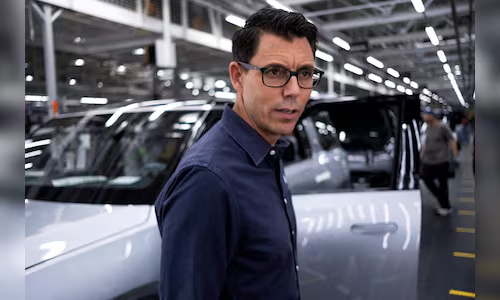
The package was driven mainly by a $373.5 million stock option grant and $26.6 million in stock awards, alongside a $1.12 million salary and a $1.02 million bonus paid in restricted stock units.
A $403 million payday tied to high-risk targets
The filing shows how sharply Scaringe’s pay rose from prior years. He received $14.9 million in 2024 and $14.4 million in 2023. Rivian’s board approved the new package in November after cancelling an earlier 2021 award that it said had set goals that were too hard to reach.
The company said the new grant was “entirely at-risk” and tied to “achievement of significant stock price and financial improvements.”
The award could be worth as much as $4.6 billion over 10 years if Rivian meets a series of stock price, operating income and cash flow targets. The structure resembles other large performance plans in the auto and tech sectors, including those of Elon Musk.
Rivian said the vesting of the options would reflect nearly $153 billion in added shareholder value if the highest goals are met.
13 times more than Detroit rivals
Scaringe’s pay was far above that of his Detroit peers.
Ford’s Jim Farley earned $27.5 million last year, while GM’s Mary Barra earned $29.9 million. Rivian’s filing also showed that Scaringe’s pay was about 4,458 times the median compensation of the company’s 13,624 employees.
His base salary is set to double to $2 million in 2026, and his maximum bonus will rise to $1.67 million. The compensation committee said it does not plan to grant additional equity awards during 2026.
Big pay, bigger pressure on Rivian’s future
The payout comes as Rivian tries to turn a difficult stretch into a more stable business. The company posted its first gross profit in 2025, helped by cost cuts. It also started production of the R2, its lower-cost SUV that Rivian hopes will widen its customer base. Rivian sold about 42,000 of its R1 trucks last year and reported a $3.6 billion net loss.
The company’s shares have fallen sharply since its 2021 initial public offering. Rivian stock is down about 86% from its IPO peak, leaving the company with a market value of roughly $21 billion. The broader US EV market has also faced pressure after policy changes ended incentives, including a $7,500 tax credit for new vehicles.
Still, Rivian has won new backing. In March, Uber agreed to invest up to $1.25 billion and buy up to 50,000 self-driving R2 vehicles by 2030. Rivian also signed a $5.8 billion software and electrical architecture deal with Volkswagen Group.
Scaringe founded Rivian in 2009 and took it public in 2021. The company’s board has tied his future pay to the same bet that now defines the business: that Rivian can scale its products, improve margins and make the R2 launch a turning point.