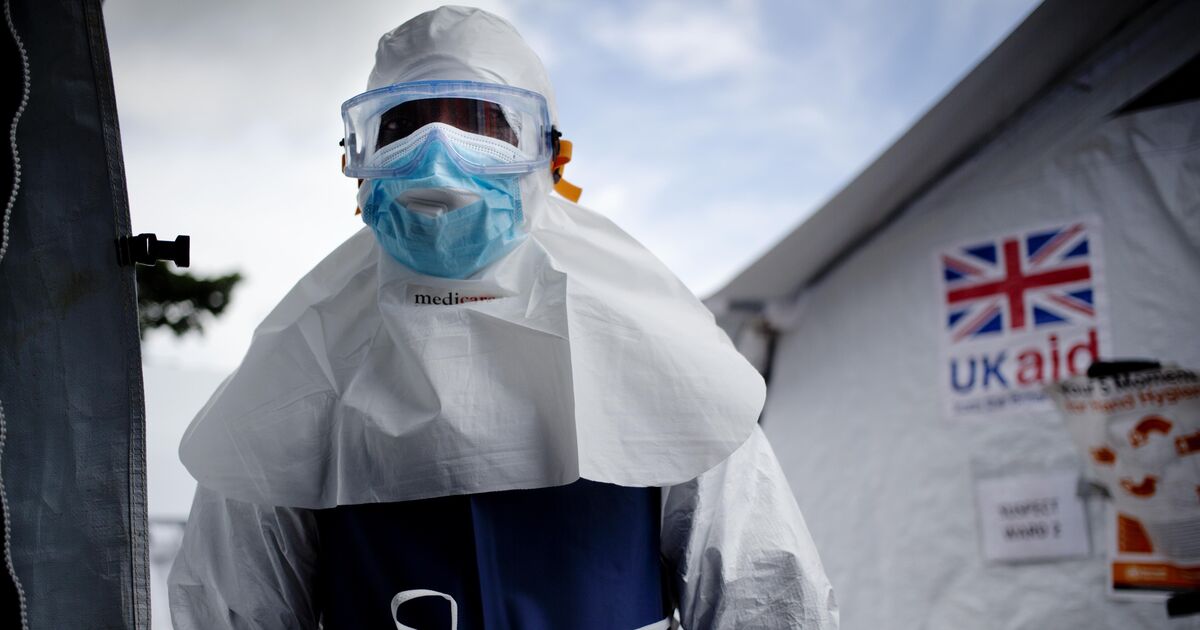
UK Aid supported Sierra Leone during ebola outbreak (Image: Kate Holt / Arete)
We talk a lot these days about hard power – being strong enough to defend ourselves. Lord Robertson is absolutely right to raise the alarm on our defence investment gap. But as a former senior military officer, I know we would be foolish to allow this to come at the expense of our nation’s soft power. We gain this through diplomatic missions, consulates, and through overseas aid.
New figures show UK aid spending has hit a near 20-year low – as countries around the world scale back support despite growing global threats. In a world which is increasingly uncertain and complicated, where global conflict is on the rise, now is not the time to be cutting our overseas aid budget.
The idea that we can make Britain safer by cutting aid to fund defence simply does not add up. You do not strengthen security by scrapping the very programmes that help prevent wars in the first place. Aid is a vital tool in how we prevent conflict. Crucially, it is Britain’s first line of defence.
Read more: ‘Rachel Reeves just humiliated the UK – we should all be worried at what’s next’
Read more: Ebola outbreak leaves thousands at risk of deadly virus’ bleeding eyes

Charlie Herbert, right, on ground with ebola survivors in Sierra Leone in 2014 (Image: Kate Holt / Arete)
In my life, between the battlefields of Afghanistan, Iraq and Somalia to the poorest slums of Sierra Leone, I have seen first hand time and again why overseas development aid matters to our safety and security. Robbing Peter to pay Paul is not the right answer. BOTH defence and aid need to be supported, as does wider funding for diplomacy. So why would I, as a former senior military officer, argue for this? Because I know better than most this is in our national interest.
Take Somalia for example – it is a fragile state, significantly affected by conflict and by climate change. If we step back from funding countries like this, the problem does not stay there. It spills over. By using development assistance to enhance security overseas, we increase security at home and decrease the number of refugees trying to reach our shores via small boats.
And then there is our health. I have witnessed how terrifying it can be when public systems are weak. During the Ebola outbreak of 2014, I helped to lead the UK’s response in Sierra Leone. We raced against the clock to contain a deadly virus that threatened the world. We started in the capital city of Freetown by quarantining a house.
Then the whole street. We had to find the sick, and fast. But when we saw the government-run treatment centre we realised we had a big problem. People could go freely in and out. It was a death trap. Within hours we had the situation under control. We set up protocols, emergency hospitals, safe burial sites to prevent contamination. None of this would have been possible without UK Aid.
We used all the instruments of British national power, military, diplomatic, development aid, to prevent Ebola becoming a global pandemic and to contain it instead as a regional epidemic. We succeeded. But that level of capability depends on sustained, long-term overseas development aid.
I can tell you that the threat of a global pandemic offers perhaps the most significant risk to the trinity of stability, security and prosperity. If Covid taught us anything, it is that we must not take risks with global health. What if the world faces another pandemic on the scale of the Spanish Flu in 1918?
That caused up to 100 million deaths. A new global pandemic with even a two or three percent case fatality rate would kill tens of millions of people. So why has our government decided, as part of wider aid cuts, to cease all UK contributions to the global pandemic fund run by the World Health Organisation? That is the very fund which helps prevent such a catastrophe.
Beyond crisis responses like this, development aid is money we use to bring about better governance and more effectively functioning nations, to reduce corruption and build stronger economies. When applied correctly and strategically over the long term, it improves global stability. It works at every stage, pre, during and post-conflict. It raises our profile as a nation. And sends a powerful message to the world that we are a responsible, morally coherent nation.
The payback to us of every pound we spend on aid is far greater than the cost. These cuts do not make strategic sense. It is madness.
- Major General Charlie Herbert spent 34 years in the British Army, led the UK’s military response to the ebola crisis in Sierra Leone and served as senior NATO advisor in Afghanistan. Visit firstlineofdefence.uk/