One of the experts said Africa’s debt crisis should not be viewed only through economic indicators but through its impact on ordinary citizens
At least 32 African countries now spend more on debt servicing than on healthcare, exposing the growing human cost of the continent’s worsening debt crisis, experts said on Wednesday at the opening of the sixth edition of the AFRODAD Media Initiative (AFROMEDI VI) in Nairobi, Kenya.
Participants at the continental media training also heard that 25 African countries currently spend more on debt repayments than on education, while about 57 per cent of Africans live in countries where governments spend more servicing debt than on health and education combined.
The three-day programme, organised by African Forum and Network on Debt and Development (AFRODAD) and supported by Transparency International Kenya and Stop the Bleeding Africa has brought together 45 journalists from 29 African countries under the theme, “Partnering with Media to Advance Socio-Economic Justice and Africa’s Common Position on Debt.”
AFROMEDI, launched by AFRODAD in 2021, was created to strengthen the capacity of African journalists to report on debt, public finance, governance, and development issues across the continent.
According to the organisation, the initiative has trained hundreds of journalists from more than 35 African countries and built a growing network of reporters focusing on debt accountability and socio-economic justice.
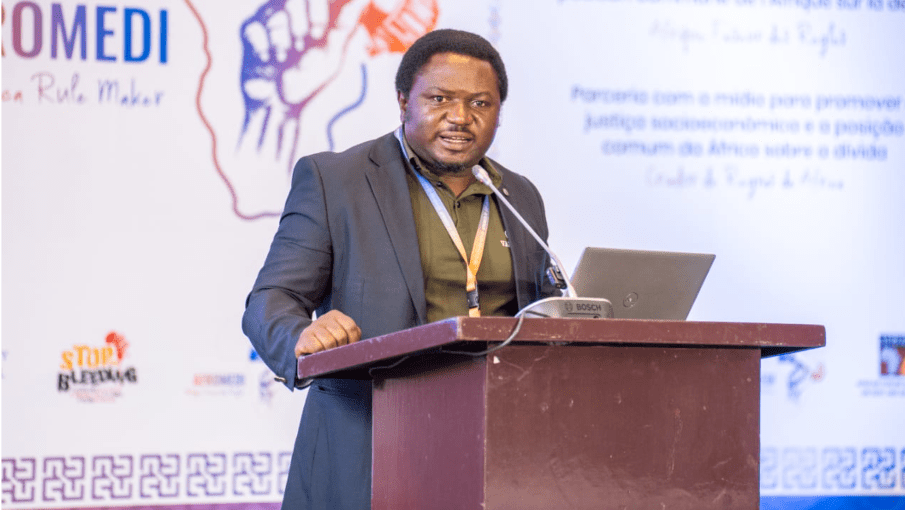
Speaking during the opening session on Africa’s debt landscape and reform agenda, AFRODAD Interim Executive Director, Theophilus Yungong Jong, explained that Africa’s debt burden was increasingly undermining investments in critical public services.
“Every debt payment is money not spent on schools, hospitals or infrastructure,” Mr Jong told participants.
He said Africa’s debt crisis should not be viewed only through economic indicators but through its impact on ordinary citizens.
“Debt is the classroom that was never built, the clinic without medicine, and the scholarship that was cancelled,” he stated.
Mr Jong described AFROMEDI as more than a training programme, saying it was created to bridge the gap between complex policy discussions and public understanding of debt-related issues across Africa.
“There was a missing link. And that missing link was journalism—not as a messenger, but as a force that can make complex and opaque issues human and visible,” he said.
According to him, about 600 journalists from 37 African countries have participated in previous editions of the initiative since 2021.
He urged journalists to strengthen investigative reporting on sovereign debt, illicit financial flows, extractive governance, and public finance accountability.
“Your independence is your greatest asset. But independence does not mean silence,” he added.
Data presented during the session from reports by the International Monetary Fund (IMF), World Bank, African Development Bank, and the United Nations Development Programme (UNDP) showed that Sub-Saharan Africa’s average public debt has doubled over the past decade.
Facilitators said the region’s debt level rose from about 30 per cent of GDP before the COVID-19 pandemic to nearly 60 per cent by the end of 2024.
Africa’s external debt service payments also increased sharply from about $61 billion in 2010 to an estimated $163 billion in 2024, according to figures presented during the programme.
Participants heard that African countries are increasingly borrowing at some of the highest commercial rates globally, particularly through Eurobond markets.
Recent Eurobond issuances by countries including Kenya, Côte d’Ivoire and Benin reportedly carried interest rates exceeding eight per cent, significantly higher than rates offered by multilateral lenders such as the IMF and World Bank.
The session noted that private creditors now hold about 35 per cent of Africa’s external debt stock, while multilateral institutions account for about 39 per cent.
Chinese lenders hold roughly 12 per cent.
Facilitators said the growing influence of private creditors has complicated debt restructuring efforts because many commercial lenders are reluctant to participate in coordinated relief arrangements.
Participants were also warned about the rising dependence on domestic borrowing across African economies as access to cheaper external financing tightens.
According to the facilitator, excessive domestic borrowing could weaken local financial systems by crowding out credit to businesses and households.
The programme reviewed debt distress situations in countries including Zambia, Ghana, Ethiopia, Egypt, Djibouti and Sudan.
Citing IMF–World Bank debt sustainability assessments, facilitators said 21 low-income African countries are either already in debt distress or at high risk of falling into one.
The training also criticised the pace of the G20 Common Framework for Debt Treatments, describing it as slow and inadequate in responding to Africa’s debt challenges.
Facilitators argued that the mechanism has struggled partly because private creditors, who hold a significant share of Africa’s debt, remain largely outside coordinated restructuring processes.
Participants were introduced to the African Common Position on Debt adopted during the African Union debt conference held in Lomé in May 2025.
The framework calls for reforms to the global financial system, the establishment of a legally binding multilateral debt resolution mechanism under the United Nations, improved debt transparency, and stronger African-led financial institutions.
More details here...