Public affairs analyst, Jide Ojo, has described the All Progressives Congress (APC) presidential primary as a “coronation,” arguing that the exercise lacked real competition.
Ojo spoke on Channels Television’s The Morning Brief on Monday while reacting to the APC presidential primary election conducted across 8,809 wards in the 36 states and the Federal Capital Territory.
According to him, the process appeared predetermined and would have been more competitive if the party had taken more time to organise the exercise.
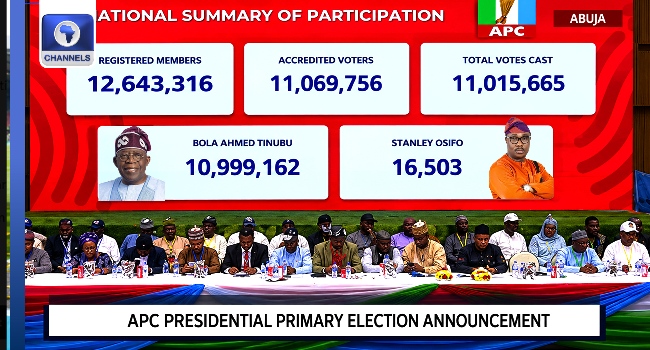
“We saw that this whole thing was just a coronation. Somebody spent N100 million to score 16,503 votes and in 21 states the guy got zero, in his native Edo, he got only one vote,” he said.
He was referring to businessman and former Peoples Democratic Party (PDP) member, Stanley Osifo, who contested against President Bola Ahmed Tinubu after purchasing the APC’s N100 million nomination form.
President Tinubu emerged winner of the primary with a total of 10.9 million votes, while Osifo polled 16,503 votes.
Ojo, however, said Osifo had the right to participate in the contest regardless of the outcome.
READ ALSO: Tinubu Declared Winner Of APC Presidential Primary With 10.9m Votes
“Some are insinuating he was sponsored; there are no evidence to show that, so I will work within the remit of what we know — that he is a businessman, he has invested his N100 million and for whatever he is worth, today we are talking about him.
“He has put his family name on the electoral map of Nigeria any time we are talking about this 2027 election,” he said.
The analyst added that Osifo’s participation would remain part of the political conversation surrounding the election cycle.
“We are going to be talking about a man called Osifo that contested against the president. If that is the name he wants to make that made him invest that sum of money, it’s within his right to do so, but I think the election would have been more competitive if the APC had taken more time to plan it,” he added.
Speaking further, Ojo questioned the turnout figures recorded during the primary, describing some of the results as difficult to reconcile with the realities on ground.
“Beyond the figures, when you also look at the probability of the turnout, how possible is it to have over 90 per cent turnout in an election that even most party members did not know the voting centres? How did that happen?” he queried.
He also cited Rivers State as an example, noting the speed with which results were announced despite the state’s terrain and the multi-layered collation process usually associated with elections.
“Even in an INEC-conducted election, where you are supposed to move results from polling unit to ward level collation, local government collation down to the state collation.
“In this election, they said it was held at ward level. At what point were they able to move results from ward collation to local government collation before the state collation, and yet you were able to return huge figures before dusk?” he stated.
Ojo, however, said attention would now shift to how the general election would eventually unfold.