Wale Igbintade
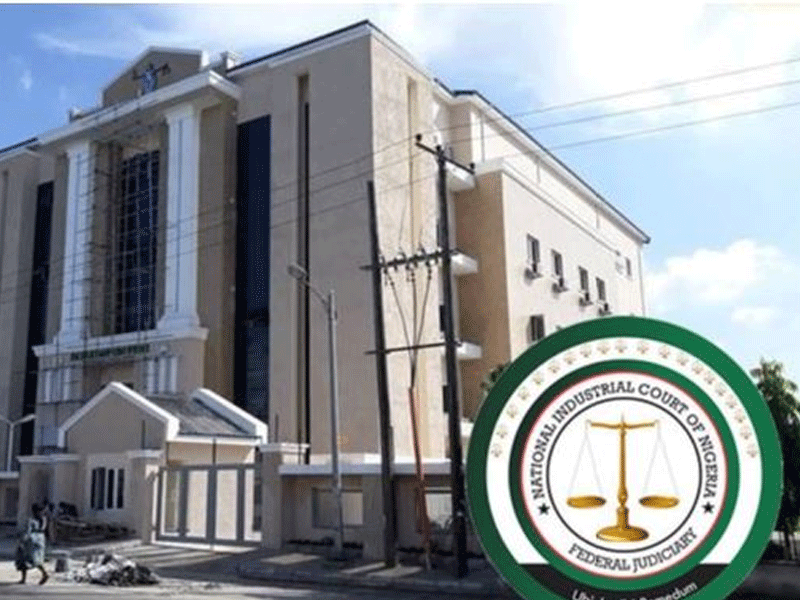
President of the National Industrial Court of Nigeria (NICN), Justice Benedict Kanyip, has urged judges handling failed bank liquidation cases to strictly adhere to the statutory order of priority, insisting that depositors must rank above all other claimants, including employees, shareholders, and general creditors.
He also raised constitutional concerns over provisions of the Nigeria Deposit Insurance Corporation (NDIC) Act that restrict courts from issuing garnishee orders and injunctions against the corporation, questioning whether such immunity can withstand the enforcement mandate of Section 287 of the 1999 Constitution.
Kanyip made the remarks in Lagos while delivering the keynote address at the 2026 Sensitisation Seminar for Judges of the Federal High Court, organised by the National Judicial Institute (NJI) in collaboration with the NDIC.
The seminar also involved the Investment and Securities Tribunal and focused on improving the efficiency of bank liquidation and depositor protection.
He said the judiciary remains central to financial stability, particularly in resolving disputes arising from bank failures and liquidation processes, noting that confidence in the financial system depends on fair and timely adjudication of such cases.
According to him, the financial sector remains the backbone of economic development, providing the infrastructure for credit, investment, insurance, and broader commercial activity.
He warned that instability in the banking system could trigger wider economic distress, underscoring the need for strong regulation and efficient judicial intervention.
Recalling Nigeria’s banking crisis of the 1980s and 1990s, Kanyip said the sector was plagued by weak corporate governance, insolvency, illiquidity, poor asset quality, and high levels of non-performing loans, conditions that later necessitated sweeping regulatory reforms.
He also referenced a personal experience from the pre-2008 banking era, when he was advised to take a loan to buy shares in a commercial bank shortly before the sector’s collapse, describing it as an illustration of the risks associated with financial instability.
On deposit protection, the judge explained that deposit insurance schemes are designed to safeguard depositors in the event of bank failure, strengthen public confidence, and encourage savings.
However, he warned that poorly designed frameworks could create moral hazard and encourage reckless banking behaviour.
“Deposit insurance can therefore have pitfalls as well as benefits,” he said, citing global commentary on financial crises and regulatory responses.
Kanyip provided an overview of the legal framework governing bank liquidation under the NDIC Act 2023 and the Banks and Other Financial Institutions Act (BOFIA) 2020, noting that once the Central Bank of Nigeria revokes a banking licence, the NDIC automatically assumes the role of liquidator.
He explained that the NDIC is empowered not only to wind up failed banks but also to intervene early through resolution tools such as bridge banks, asset restructuring, acquisitions, and financial assistance to prevent full collapse.
The judge emphasised that Nigerian law places depositors at the top of the hierarchy in liquidation proceedings, ahead of all other creditors.
He said this priority structure is intended to protect public confidence and shield retail depositors from the impact of bank failures.
He added that directors, shareholders, and employees may face personal liability where their actions or negligence contribute to the failure of a financial institution.
Kanyip also cited provisions of the NDIC Act that cap insured deposits at N500,000 for most institutions and N200,000 for microfinance banks, noting that no other entity is permitted to operate a competing deposit insurance scheme in Nigeria.
However, he drew attention to provisions restricting courts from issuing garnishee orders, injunctions, or execution processes against the NDIC, describing the issue as one that may require constitutional interpretation in light of Section 287 of the 1999 Constitution, which mandates compliance with court judgments.
He referenced recent NDIC actions in the liquidation of Heritage Bank, noting that the corporation had paid about N70.9 billion in liquidation dividends to depositors, including a second tranche of N24.3 billion to depositors with balances above N5 million, following an earlier payment of N46.6 billion.
According to him, the development reflects improved asset recovery and growing confidence in the deposit insurance framework.
Kanyip called for stronger risk-based supervision, early regulatory intervention in distressed banks, modernised legal frameworks, and technology-driven reforms to improve claims processing and asset recovery.
He also stressed the need for public awareness of deposit insurance and faster reimbursement of insured deposits to reduce panic withdrawals and strengthen financial stability.
He said judges have a critical responsibility in failed bank cases, including adjudicating disputes, determining creditor priority, validating NDIC actions as liquidator, and ensuring accountability in financial malpractice cases.
“As judges, we must ensure that the process of closing banks and paying depositors is handled fairly, transparently, and in accordance with the law,” he said.
Also speaking, NDIC Managing Director and Chief Executive Officer, Mr. Thompson Oludare Sunday, represented by Executive Director, Corporate Services, Mrs. Emily Osuji, said effective bank liquidation and depositor protection depend heavily on timely judicial intervention.
“The successful discharge of these mandates is deeply dependent on the clarity, consistency, and timeliness of judicial pronouncements,” he said.
Sunday noted that delays and conflicting judicial decisions in liquidation matters could frustrate asset recovery, depositor reimbursement and financial sector stability.
“Sound and well-reasoned judicial decisions contribute directly to depositor confidence, investor trust, and the overall resilience of the national economy,” he added.