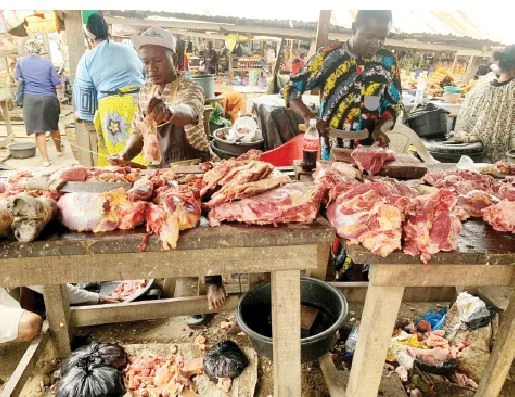
Residents and traders across parts of Lagos, Ogun and Kaduna states have lamented fluctuating food prices and poor patronage ahead of the Eid-el-Kabir celebration, describing the economic situation as unbearable for many families preparing for the festive period.
NGBREAKINGNEWS Metro correspondents gathered this during visits to markets in the states on Tuesday.
Our correspondent, who visited the Ikotun Market in Lagos, observed a low turnout of buyers as traders complained about reduced patronage despite the availability of food items and livestock.
Buyers and traders who spoke with our correspondents identified tomatoes, peppers, meat and other cooking ingredients among commodities that had recorded sharp price increases compared to the previous year.
Some residents expressed fears that many households might not be able to celebrate the festival comfortably because of the worsening cost of living and rising prices of essential commodities.
One of the traders, identified simply as Erimide, lamented that the price of tomatoes had increased by over 100 per cent compared to the previous Eid-el-Kabir season.
According to her, the situation had made it difficult for many customers to buy food items in reasonable quantities.
“I can’t even afford to buy tomatoes at the rate they are selling them now. Last year, a paint bucket of tomatoes was around N7,000, but now it is about N20,000. That is too expensive for ordinary people,” she said.
Another resident, Rasheedat Akanbi, who was shopping for Sallah food items at the market, also decried the sharp increase in the prices of tomatoes and other cooking ingredients.
She stated that the rising prices had significantly affected her budget for the celebration.
“I bought a basket of tomatoes for about N40,000 last year, but as I speak to you now, it is around N100,000. How do they expect people to survive with this kind of increase?” she queried.
Meanwhile, traders and residents at Akute Market in Ifo Local Government Area of Ogun State reported a sharp decline in the prices of staple food items such as rice, groundnut oil and palm oil.
Some traders who spoke with our correspondent on Tuesday said the prices of the commodities had dropped significantly compared to last year.
According to them, a 25-litre keg of palm oil, which sold for between N60,000 and N65,000 last year, is now being sold for N38,000.
Similarly, a 25-litre keg of groundnut oil currently sells for N52,000, compared to between N70,000 and N75,000 recorded during the same period last year.
The traders also noted that the price of rice had reduced considerably. While a bag of rice sold for between N70,000 and N80,000 last year, the cost of a cup of rice, which ranged from N1,300 to N1,400, has now dropped to N1,000.
A NGBREAKINGNEWS Metro correspondent who visited Magboro Market in Ogun State on Tuesday gathered that there was a low turnout of buyers as traders lamented poor patronage.
Speaking with our correspondent, a meat seller identified simply as Mr Gafaru complained about low patronage, blaming it on the rising cost of livestock and dairy products ahead of the Sallah celebration.
According to him, many residents who usually patronised meat sellers during festive periods have now reduced the quantity they purchase or avoid the market completely because of the high prices.
He explained that the increasing cost of cows had also made it impossible for traders to reduce prices without incurring losses.
“This same period last year, I already had many customers coming around to buy meat, but things are very slow now because of the high cost.
“I cannot even reduce the price because I also bought at a very high rate. A cow that was around N800,000 last year now costs about N1.4m. If we sell lower than the market price, we will run at a loss,” he added.
Another trader, Aisha Lawal, said, “Most of those who usually patronise the market are office workers who are yet to finish from work. That is why the turnout is still low for now.
“But the prices of food items and fuel have really affected people. Many residents now prefer to buy small quantities from nearby sellers because things are too expensive,” she said.
A butcher, identified simply as Sheriff, also lamented the poor turnout of customers, describing the current economic situation as unbearable.
“People aren’t coming to the market. I haven’t witnessed this in years. The economy is so hard and crumbling,” Sheriff said.
Another butcher, Taiwo, noted that unlike previous Eid celebrations when markets were overcrowded, the market was unusually calm despite the availability of meat.
He, however, expressed hope that buyers might come later in the day after withdrawing cash from banks.
Taiwo added, “Unlike previous Eid ce,lebrations when the market was always overcrowded and movement was difficult, the market is now unusually empty. We are hoping people will still come later in the evening.”
Similarly, a trader identified simply as Iya Ibeji said the rising cost of goods and transportation had worsened hardship for many families.
According to her, N10,000 was no longer enough to prepare a pot of soup for her household.
“It is surprising that Ileya has already started, and the market is still filled with goods at this time. Things are really hard for people,” she said.
At Ibafo Market in Obafemi-Owode Local Government Area of Ogun State, some buyers who spoke with NGBREAKINGNEWS Metro said the sharp increase in the prices of staple foods, soup ingredients, fish, rice, beans and condiments had forced many families to reduce spending and cut down on meals.
A resident, Joy Eze, said the hike in prices had seriously disrupted preparations for the celebration, noting that many basic food items were now beyond the reach of average Nigerians.
“Yes, it has definitely affected me because things are very expensive in the market. Tomatoes are very expensive, pepper is expensive, and meat is a no-go area.”
Speaking further, Eze lamented that many families had been forced to reduce food consumption because of the harsh economy.
Another buyer, Miss Oluwafunmike, also lamented the rising cost of staple foods, stressing that prices had increased significantly compared to last year’s Sallah period.
“It has really affected me because compared to last year, things were much better. Last year, I bought cassava flour for N700, but now it is N1,200.
“The rice we use to make poundo yam was between N3,000 and N3,500 last year, but this year it is now N5,000. The bag I bought for N1,500 last year for Sallah is now N3,000,” she said.
She added that many residents were now forced to buy food items based strictly on their financial capacity.
A fish seller identified simply as Iya Korede Eleja also blamed the high cost of food items on rising fuel prices and transportation costs.
She disclosed that the prices of frozen fish and turkey had almost doubled compared to what was obtainable during the last Eid-el-Kabir celebration.
“As of last year, things were still a bit better, but this year things are more expensive. Last year, a carton of Titus fish was N25,000, but this year it is now N90,000.
“Kote fish last year was N42,000, but now it is N85,000. Fish and turkey are the most expensive food items this season,” she said.
Speaking on customers’ reactions, the trader noted that many buyers now purchased fewer quantities because of the rising prices.
“Most customers are surprised after hearing the price of fish. Some who want to buy three pieces of fish will end up buying one just so that they can have something to eat with their food because things are very expensive,” she added.
In Kaduna State, residents also lamented soaring ram prices ahead of the Eid-el-Kabir celebration, with some large breeds now selling for as much as N1m in major livestock markets.
Checks by NGBREAKINGNEWS Metro at major livestock markets within the Kaduna metropolis showed that medium-sized rams now sold for between N200,000 and N450,000, while larger and exotic breeds attracted prices ranging from N700,000 to N1m.
Many residents described the development as alarming, saying the rising prices had placed the Sallah sacrifice beyond the reach of many families already struggling with economic hardship and rising living costs.
Speaking at the Zango Livestock Market in the Tudun Wada area of Kaduna, a civil servant, Suleiman Aliyu, said many households might not be able to afford rams this year.
Another resident, Halima Sani, said several families were now considering buying chickens instead of rams because of the high prices.
Sani added, “Things are very difficult. Some people are now thinking of buying chickens instead because ram prices are becoming impossible for ordinary workers.”
Traders, however, blamed the increase in livestock prices on insecurity, transportation costs and the prevailing economic situation in the country.
A livestock dealer, Salisu Abdullahi, said the cost of transporting animals from rural communities and neighbouring states had increased significantly because of insecurity and rising fuel prices.
“Transport is one of the biggest problems. Drivers charge more because of insecurity on the roads and the high cost of diesel and fuel,” Abdullahi said.
Another trader, Ahmed Lawal, also linked the situation to cattle rustling and attacks in some northern communities, which he said had disrupted livestock supply to markets.
Lawal added, “Insecurity has reduced the number of animals coming to the market. Many herders and suppliers are afraid because of attacks and rustling.”
Some residents appealed to the government to urgently address inflation and insecurity, warning that the worsening economic situation was affecting religious and social life across the country.
A resident, Lukman Ayuba, said he could no longer afford to buy rams for his parents this season because of the increase in prices.
“Ordinarily, I buy nothing less than two rams for the Eid celebration — one for me and one for my parents — but I do not have the financial strength to do that now. The prices have quadrupled. Imagine that the money for one ram can buy a plot of land somewhere,” he said.
Our correspondents observed that livestock markets across Kaduna continued to record low patronage as many prospective buyers stayed away because of high prices and low purchasing power.
The rising cost of food items and livestock comes amid worsening inflation and economic hardship following the removal of the fuel subsidy and fluctuations in the foreign exchange market, which have triggered increases in transportation costs and the prices of essential commodities across the country.
Eid-el-Kabir, also known as the Feast of Sacrifice, is one of the major Islamic festivals celebrated by Muslims worldwide and is marked by the slaughtering of rams and other animals in remembrance of Prophet Ibrahim’s obedience to Allah.
However, many Nigerians say the current economic realities have made the annual religious celebration increasingly difficult to enjoy.