The World Health Organization has declared an Ebola outbreak in the eastern Democratic Republic of Congo a public health emergency of international concern, after critical missteps allowed the disease to spread largely undetected.
By the time new infections were confirmed last week, the suspected cases already made it one of the largest on record.
Two Congolese officials said that detection delays enabled the virus to reach rebel-held territory and cross into Uganda’s capital.
Local funeral practices exacerbated the spread. Diagnostic tests in a local laboratory were calibrated for the wrong Ebola strain, and samples sent to Kinshasa were not stored or shipped properly, the officials added.
Experts warn that these delays now threaten to severely hamper containment efforts.
“It’s just a scattered mess right now. I don’t think we have anything close to a real idea of how many cases there are,” said Craig Spencer, an emergency physician and public health professor at Brown University.
“It’s going to be quite some time before you’re able to piece this together.”
The outbreak is centred in the northeastern province of Ituri, a remote part of Congo grappling with poor health infrastructure and armed conflict.
The WHO has so far reported 80 suspected deaths, eight laboratory-confirmed cases and 246 suspected cases in Congo, though the true number may be much higher.
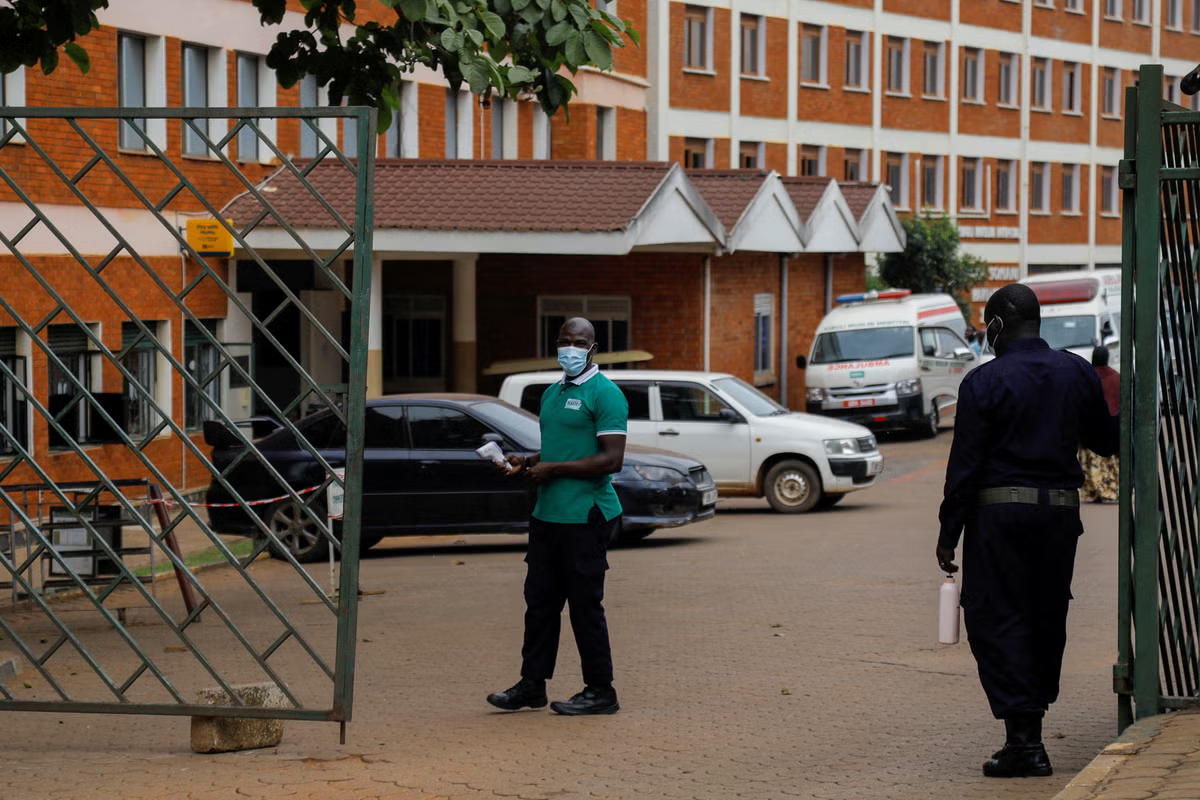
The first known patient developed fever, vomiting and hemorrhaging and died at a medical centre in Bunia, Ituri’s capital, on 24 April, Samuel Roger Kamba, Congo’s health minister, told reporters on Saturday.
The person was a health worker, meaning there is little chance they were the first to become sick, Dr Spencer said.
The dead bodies of Ebola victims are contagious, but mourners gathered for a funeral, believing the death was caused by a mystical illness, Mr Kamba said.
“Everyone is touching him, everyone is doing this … and that’s when the cases start to explode,” Mr Kamba said.
Jean-Pierre Badombo, a former mayor of Mongbwalu town, said that there were an estimated 60 to 80 deaths in Mongbwalu alone, with “six, seven, eight deaths per day”, prompting local officials to alert health authorities.
The WHO has said it was informed of an unknown illness with high mortality in Mongbwalu on May 5, including four health workers who had died within four days, and dispatched a rapid response team.
Jean-Jacques Muyembe, director of Congo’s National Institute for Biomedical Research (INRB), said local health officials in Ituri began taking samples for testing in Bunia.
The laboratory there used testing cartridges specific to the Zaire strain of Ebola, which is the strain behind 15 of Congo’s previous Ebola outbreaks, including a 2018-2020 epidemic in the country’s east that killed more than 2,200 people.
But the current outbreak is caused by the Bundibugyo strain, which last surfaced in Congo in 2012 and, according to MSF, has an estimated case mortality rate of 25-40 per cent.
The Bunia laboratory lacks the genetic sequencing equipment needed to identify strains other than Zaire, Muyembe said, noting that only laboratories in Kinshasa and in the eastern city of Goma, which is under rebel control, can do that work.
After the tests in Bunia came back negative for the Zaire strain, the laboratory set the samples aside rather than escalating them, Mr Muyembe said.
“The reflex should have been to contact Kinshasa and send them to our laboratory here for further investigation,” he said.
When the samples were finally sent to Kinshasa, the process was botched, Mr Muyembe said.
The specimens arrived at 17 degrees Celsius (63 degrees Fahrenheit), when they should have been kept at 4C (39F), he said.
They were also shipped in microlitre rather than millilitre quantities, limiting the number of tests INRB could run, he said.
Africa’s top public health agency finally announced the outbreak on 15 May. WHO Director-General Tedros Adhanom Ghebreyesus made his declaration of a public health emergency the following day.