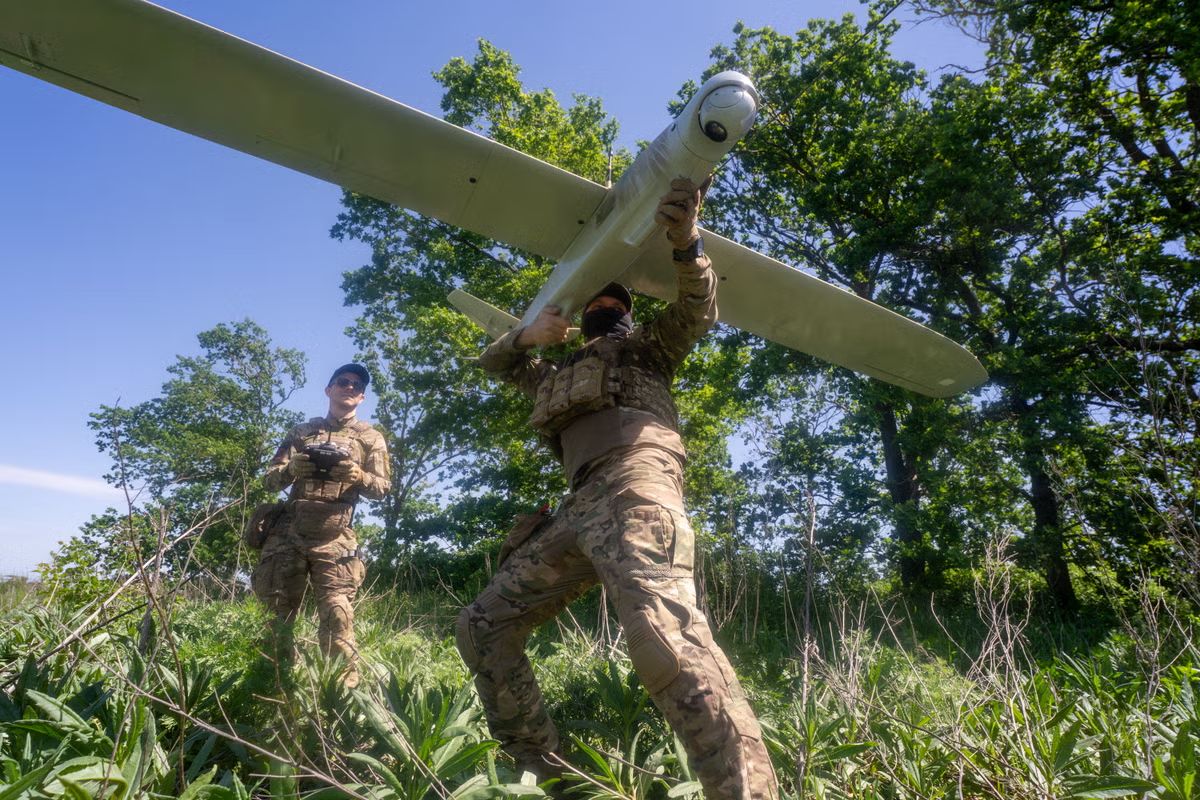
The war between Russia and Ukraine has brought an unlikely weapon to the forefront – the unmanned aerial vehicle, better known as a drone – changing the landscape of global conflict.
The Ukraine-Russia war is the first to use the weapons on a widespread scale, with hundreds of thousands deployed across the four years since the Russian president Vladimir Putin ordered his forces to invade Ukraine in February 2022.
Just this weekend, Putin launched 600 drones in retaliation for what Moscow claimed was a Ukrainian drone strike on a school in the Russian-controlled Ukrainian region of Luhansk.
But now these light aircraft threaten to spread the deadly war into mainland Europe, with experts claiming Putin has found a new way to agitate the West.
Last week Latvia’s prime minister Evika Silina resigned, causing the collapse of her coalition government, after backlash over an insufficient response to a Ukrainian drone incursion into the country’s airspace.
On Wednesday, Lithuania issued an emergency alert shutting down the capital’s Vilnius airport, as well as the country’s parliament building, which was evacuated.
Both countries called on Nato to boost air defences in the region after the drones flew over the Russian border and exploded at an oil storage facility in Latvia.
The fallout has exposed some of the limits of Europe’s air defences and threatens to damage goodwill towards Ukraine.
Experts told The Independent that the stray Ukrainian aircraft could be symptomatic of something more sinister – Russia hijacking weapons systems to direct Ukrainian aircraft into Europe.
“Ukraine uses core UAVs to basically overload Russian defence,” explains Mykola Bielieskov, an analyst based in Ukraine. These “saturation attacks”, whereby a swarm of the unmanned aircraft are sent at a single location all at once, are a common method used in drone warfare. “But not all of the UAVs are protected in the same way.”
Because decoy drones are used to fool air defences, they can be more susceptible to what is known as “spoofing”. Russia has been known to use the technique to jam radio signals and force the aircraft to veer off course and into the Baltic states.
Spoofing involves transmitting fake signals that imitate a real GPS satellite signal, to mislead a phone, ship or aircraft into thinking it is in a different place.
The tactic has been acknowledged by the victims of the stray drones, with Lithuanian foreign minister Kęstutis Budrys saying on Tuesday that Russia is “deliberately” redirecting Ukrainian drones into Baltic airspace with electronic interference.
Mr Budrys accused Moscow of “waging smear campaigns” after Russia’s Foreign Intelligence Service, the SVR, made unsubstantiated claims on Tuesday, that Ukraine is preparing to begin launching drone attacks against Russia from the territory of the Baltic countries.
“It is possible that the drones are diverting off their original paths into Baltic airspace due to Russian electronic warfare,” says Christina Hayward of the Institute for the Study of War.
“This may be accidental, but Moscow may be deliberately using its EW to direct the drones into the Baltic states in order to create provocations and build friction in Ukrainian-Baltic relations.
“Moscow has been trying to frame the incidents as alleged evidence that Nato states are directly participating in Ukrainian strikes on Russia and may aim to use these claims to justify future Russian violations of Baltic airspace. Moscow may claim that it needs to violate and shoot down drones in Baltic airspace out of self-defence.”
With the UK and other European nations quietly easing off Russian sanctions, Ukraine may feel more urgency in attacking energy infrastructure in a bid for survival. On the other hand, support from Ukraine’s partners across Europe has led to a rise in production of the aircraft.
Mr Bielieskov says that Ukraine produced four million UAVs last year and is on track to almost double its production this year, with almost seven million drones to be produced this year.
However, while there has been a lot of emphasis on Ukraine’s drone capabilities and innovation, he warns that this is not a substitute for heavier weaponry.
An apartment building near his home was destroyed by a classic cruise missile carrying 500kg of TNT in comparison to the 50 to 75kg that can be carried by a drone, often to be intercepted before hitting their target.
“The story is a bit more complex. On the front line it’s been better, but it doesn’t mean that we can protect everything given the shortage of anti-ballistic missile defences,” he says.
Nevertheless, Ukraine’s limitations have driven innovation, with the country’s expertise now sought across Europe and the Middle East for its cutting-edge approaches to this new frontier of modern warfare.
“The Ukrainian system is very different to that of Russia and has many advantages that have helped Ukraine develop such a robust drone industry,” says Ms Hayward.
“The Russian system is heavily centralised, which is good for scaling up production of a few products quickly, but creates a rigid system that is not as responsive to the military’s ever-changing needs.