Lagos State’s housing push is emerging as one of the biggest government-backed job creation channels in Nigeria’s construction and real estate sector, with the state government revealing that its ongoing housing projects generated 4,793 direct and indirect jobs within the last year alone.
The jobs span skilled, semi-skilled and unskilled labour across multiple housing construction sites and estate management operations supervised by the Lagos State Ministry of Housing and its agencies.
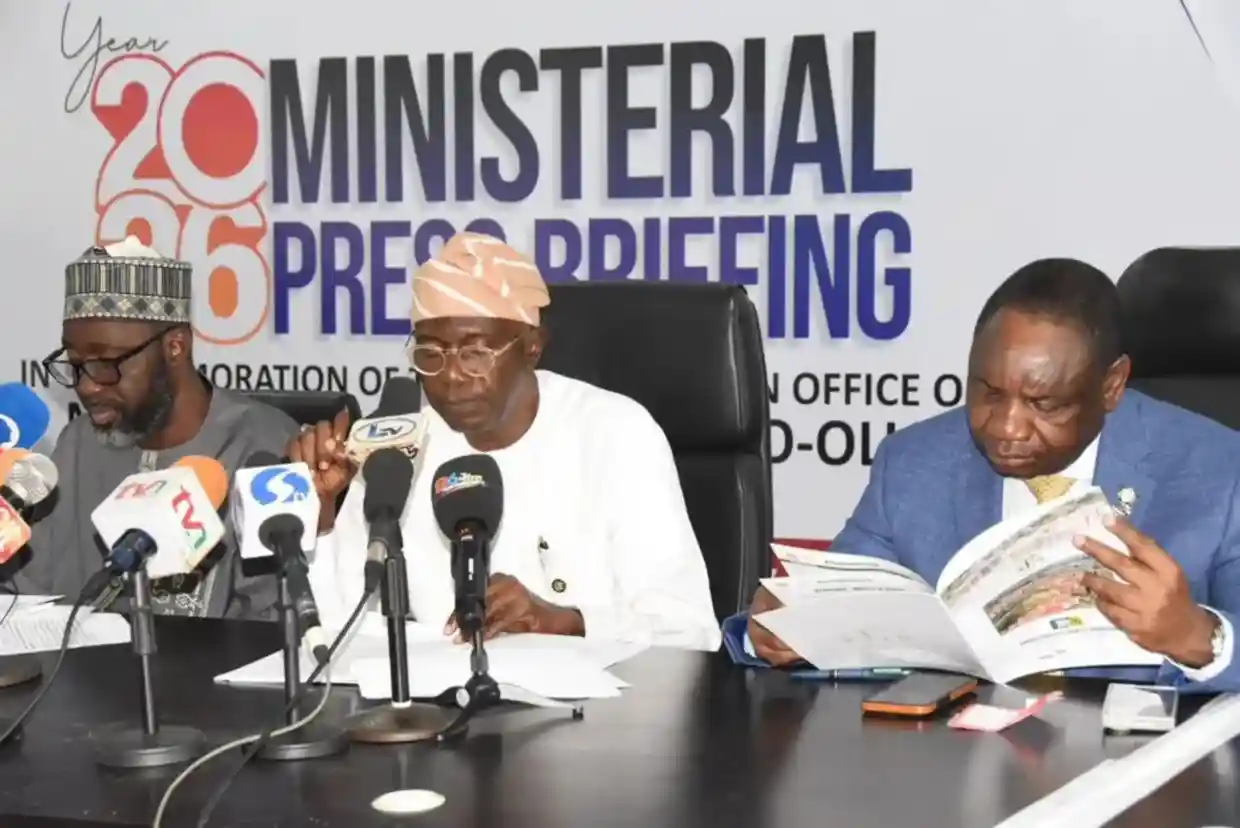
The disclosure was made by the Commissioner for Housing, Hon. Moruf Akinderu-Fatai, FCIS, during the 2025 Annual Ministerial Press Briefing held at the Bagauda Kaltho Press Centre in Alausa, Ikeja, as part of activities marking the third year of Governor Babajide Olusola Sanwo-Olu’s second term in office.
The latest figures show how Lagos is increasingly positioning housing construction not just as an infrastructure policy, but also as an economic growth and employment strategy at a time when unemployment, inflation and housing shortages continue to pressure millions of Nigerians.
According to Akinderu-Fatai, the state’s housing interventions have now increased Lagos housing stock by 10,623 units over the last seven years through a combination of direct government funding and Public-Private Partnerships (PPPs).
Out of the total figure, 4,414 homes were delivered through direct budgetary allocation by the Ministry of Housing, while private sector partnerships contributed 6,209 housing units.
While the housing delivery numbers remain significant, the employment impact has become one of the most important parts of the programme, especially for artisans, suppliers, technicians, engineers, construction workers and estate support personnel who depend on the building sector for income.
“Construction work has aided the economic buoyancy of artisans, suppliers, professionals and others involved at both the demand and supply angles of home ownership,” Akinderu-Fatai said during the briefing.
Industry experts have repeatedly described construction as one of the fastest ways governments can stimulate economic activity because of its ability to absorb labour at different skill levels.
In Lagos, ongoing projects under the Ministry of Housing are creating opportunities for bricklayers, welders, carpenters, electricians, painters, plumbers, machine operators, surveyors, architects, security workers and facility managers.
The state government also disclosed that another 888 jobs were created through the facility management structures operating across government-owned estates.
These jobs include cleaners, artisans, security personnel and estate maintenance workers engaged to support completed housing schemes across Lagos.
The employment numbers come amid growing concerns over Nigeria’s worsening housing crisis and rising cost of living, which have made affordable accommodation increasingly difficult for many residents.
Akinderu-Fatai said Lagos continues to battle a housing deficit estimated at more than 3.3 million units, driven by rapid urbanisation, population growth and migration into the state.
According to him, Lagos currently has a metro population exceeding 17.8 million people, with an annual growth rate of about 3.8 per cent.
The Commissioner noted that the state’s housing strategy is being implemented against the backdrop of a wider global housing crisis.
Citing UN-Habitat data, he said nearly half of the global population, estimated at 3.4 billion people, currently lack access to safe and adequate housing, while global housing deficits have surpassed 268 million units.
He added that Nigeria mirrors the global challenge.
According to the Commissioner, estimates by the National Housing Data Technical Committee inaugurated by the Federal Ministry of Housing and Urban Development put Nigeria’s housing deficit at 14.925 million units, with another 15.2 million homes classified as substandard or structurally inadequate.
Despite these challenges, Lagos says it is scaling up housing delivery through both state-funded projects and private sector collaboration.
Akinderu-Fatai explained that the Sanwo-Olu administration has adopted a mix of affordable housing initiatives, direct intervention and PPP arrangements designed to increase access to decent housing for low and middle-income residents.
“Partners benefit from simplified approvals, tax incentives, creative financing models and supportive regulations that collectively boost affordable housing for the low and medium-income brackets,” he said.
Part of the state’s ongoing expansion includes five major housing schemes currently under construction and expected to be completed between the second and fourth quarters of 2026.
The projects include the 576-unit Egan-Igando Mixed Housing Scheme, the 528-unit LagosHOMS Sangotedo Phase II, LagosHOMS Ibeshe Phase II, the Epe Housing Scheme at Itamarun and the Workers’ Village Housing Project in Ipaja.
The Commissioner also disclosed that joint venture developments in Ikorodu, Ipaja, Ilubirin and Eti-Osa are expected to add another 3,791 units to the state’s housing stock.
Additional approvals have also been granted for 202 new units at Abraham Adesanya Housing Estate and 114 luxury apartments at Orange Island in Eti-Osa.
The government recently commissioned two major housing projects in 2025 — the 420-unit Akinsanya Sunny Ajose Estate Phase I and the 233-unit Abraham Adesanya Housing Estate.
According to the Ministry, these projects increased the total number of housing estates completed under the Sanwo-Olu administration to 23 since 2019.
The Lagos State Development and Property Corporation (LSDPC) is also expanding its own portfolio.
Akinderu-Fatai disclosed that LSDPC completed 12 housing projects and delivered 1,190 homes within the last seven years, while another 29 ongoing projects are projected to deliver 3,149 additional units.
Beyond construction, the state government says it is also focusing on housing access and consumer protection.
The Lagos State Mortgage Board, according to the Commissioner, has assisted more than 20,000 residents through mortgage support and Rent-To-Own programmes over the last 12 years.
He said 100 beneficiaries exited the Rent-To-Own scheme in August 2024 after completing their repayment plans, while another 110 beneficiaries completed the programme in July 2025.
Akinderu-Fatai also announced that plans are being finalised for a pilot Monthly Rental Scheme aimed at reducing the burden of yearly rent payments on low-income earners.
The proposal comes at a time when many Lagos residents continue to struggle with upfront rent demands and rising accommodation costs across the state.
A new Tenancy Bill currently before the Lagos State House of Assembly is also expected to strengthen housing regulation and tenancy administration.
According to the Commissioner, the proposed law will require mandatory registration of estate agents under the Lagos State Real Estate Regulatory Authority (LASRERA), speed up tenancy dispute resolution and eliminate exemptions across Lagos.
On the regulatory side, LASRERA said it recovered N270.02 million from fraudulent real estate operators between 2025 and 2026.
The agency also received 505 petitions from members of the public and resolved 39 cases within the review period.
Akinderu-Fatai said LASRERA has expanded enforcement operations and stakeholder engagement across the state, while new satellite offices have been opened in Agege, Ojodu and Igbogbo-Baiyeku.
The Commissioner acknowledged that the sector still faces challenges including inflation, land disputes, litigation and encroachment issues affecting housing projects.
However, he maintained that the state government would continue to pursue sustainable housing delivery through stronger monitoring systems, financing partnerships and expanded private sector participation.
For Lagos, the housing sector is increasingly becoming more than just a social infrastructure programme. It is now evolving into a major employment driver with growing economic impact across construction, real estate services, facility management and urban development.