Bennett Oghifo
Key players in Nigeria’s real estate sector have identified the Lagos mainland as the next major frontier for property investment and urban regeneration, citing rising infrastructure development, increasing demand for premium residential and commercial spaces, and untapped opportunities across the metropolis.
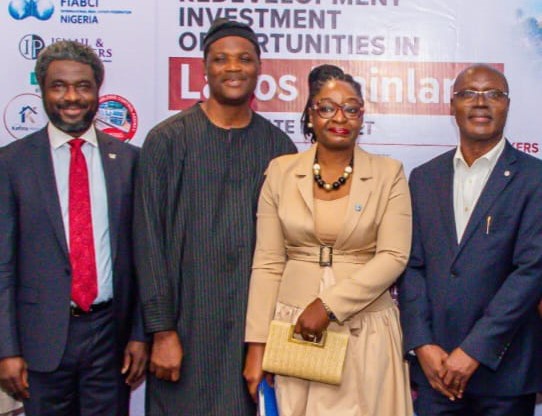
This position was unanimously echoed at the Exclusive Estate Conference 2026, where developers, financiers, academics, legal experts and government stakeholders gathered to discuss redevelopment trends and investment prospects within mainland Lagos.
Delivering the welcome address, Chairman of Exclusive Estates, Peter Adobamen, said the conference was convened to reshape investment conversations that have historically favoured Lagos Island, stressing that the mainland now presents stronger opportunities for sustainable returns.
According to him, Lagos mainland is undergoing a major transformation driven by infrastructure upgrades, transit-oriented development and growing demand for quality housing and commercial assets.
Adobamen noted that while investment attention had traditionally been concentrated on the Island, the narrative was rapidly changing as mainland districts continue to demonstrate resilience and high-yield potential.
“Lagos continues to evolve significantly, and the mainland has become a space of enormous opportunities. The mainland has proven to be resilient, highly yielding and rich with untapped potential. Capital only flows where it is welcomed and where investors are well informed, and that is precisely why we are here today,” he said.
He disclosed that the conference also marked the official launch of the Lagos Mainland Real Estate Industry Report, described as a comprehensive analytical document designed to guide institutional and private investors in navigating opportunities within the sector.
According to him, the report goes beyond statistics and charts to examine the interaction between economic indicators and property valuation while promoting transparency and structure within the Lagos mainland real estate market.
He added that Exclusive Estates remains committed to driving the property market through data-driven intelligence, strategic advisory services and industry collaboration.
Adobamen expressed appreciation to sponsors, stakeholders and participants for supporting the initiative and contributing to conversations aimed at repositioning the mainland property market.
Speaking further on the rationale behind the conference, Adobamen said Exclusive Estates, with offices in Lagos and Abuja, decided to convene industry stakeholders because of the rapid transformation taking place across mainland Lagos.
He explained that the firm’s interest extends beyond brokerage and investment advisory to include thought leadership and knowledge management within the real estate sector.
“We observed several dynamics happening within the Lagos mainland market. As Professor Timothy Nubi noted, about 85 per cent of Lagosians reside on the mainland. That statistic alone raises several developmental and housing concerns which require strategic attention,” he said.
He identified shrinking land mass, ageing structures and financing constraints as major challenges confronting urban renewal projects across areas such as Ikeja, Surulere and Yaba.
According to him, many of the buildings within these districts are over 70 years old, while ownership succession issues and high redevelopment costs continue to complicate regeneration efforts.
Adobamen said the conference brought together government officials, banks, developers, legal practitioners and academics to collectively explore workable solutions to these challenges.
He added that the organisers honoured distinguished contributors to the real estate industry, including the Director, Centre for Housing Sustainable Development, UNILAG, Prof Timothy Gbenga Nubi, Stanbic IBTC Bank, BusinessDay Newspaper and Chairman of the Day, Mr. Frank Okosun.
He urged investors to redirect attention towards the Lagos mainland, insisting that the area represents the true “gold mine” of the state due to its massive population concentration and growing economic activities.
Also speaking at the conference, Chapter President, FIABCI Nigeria, Mr Akin Opatola, highlighted gentrification as an inevitable feature of urban redevelopment.
According to him, older and derelict buildings across Lagos will naturally give way to modern structures as redevelopment activities intensify.
Opatola noted that one increasingly successful redevelopment model involves partnerships between landowners and developers, where landowners contribute property assets while developers provide funding and technical expertise.
He explained that such partnerships have become attractive alternatives to commercial bank financing, especially in an environment characterised by high interest rates and short loan tenures.
“Landowners who possess land but lack development capital now enter strategic partnerships with developers who have the funds but do not own land. Together they redevelop these properties successfully,” he said.
He noted that the arrangement allows both parties to avoid burdensome financing structures while accelerating urban renewal initiatives.
According to him, redevelopment opportunities span residential, commercial and retail sectors, including luxury, middle-income and affordable housing segments.
Opatola stressed that landowners often remain at the centre of redevelopment decisions because they determine the type of projects they want executed on their properties.
He, however, cautioned stakeholders to mitigate risks through proper legal guidance, sound financial advisory services and credible partnerships.
The estate expert maintained that government resources alone would be insufficient to address Lagos’ urbanisation challenges, stressing the need for increased private sector participation and public-private partnerships.
He cited successful redevelopment models in cities around the world, including Kigali, as examples Lagos could emulate.
Meanwhile, Professor Timothy Nubi called for inclusive and humane approaches to urban regeneration, warning against redevelopment strategies that displace vulnerable residents without adequate compensation.
Nubi argued that many so-called slum communities occupy valuable waterfront and prime lands capable of funding their own redevelopment if properly managed.
According to him, regeneration projects should adopt stakeholder-driven models that adequately compensate residents and resettle them within redeveloped communities.
“The development of Lagos should not cause people to lose everything they have. Redevelopment must be designed as a win-win process for everyone involved,” he said.
He criticised forced evictions and inadequate compensation practices, noting that many displaced residents receive payments equivalent to only a few years’ rent.
Nubi insisted that proper valuation processes must be undertaken to determine the true worth of affected properties and ensure fairness to residents.
Using communities such as Oworonshoki and Bariga as examples, he explained that low-rise structures occupying large expanses of land could be redeveloped into modern high-rise settlements capable of accommodating existing residents while freeing up significant land space for new developments.
He warned that redevelopment projects lacking stakeholder engagement often face resistance, litigation and intervention from international organisations, thereby frustrating government objectives.
According to him, sustainable urban regeneration can only succeed where residents, developers and government authorities work collaboratively through transparent consultation and equitable compensation frameworks.
“We cannot leave slums the way they are, but redevelopment must be properly planned and implemented in a manner that respects the rights and dignity of the people,” he added.