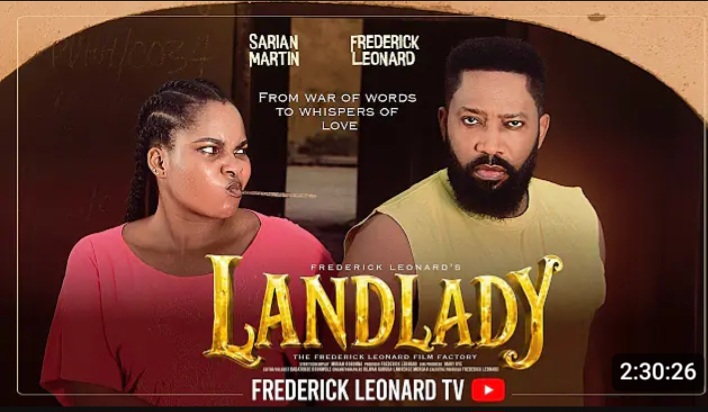
REVIEW OF LANDLADY
Landlady is a gripping Nigerian YouTube Nollywood drama featuring Frederick Leonard in a strong lead role alongside Sarian Martin. The movie revolves around the life of a dominant and influential landlady whose authority over her tenants and environment becomes the foundation of conflict, manipulation, and emotional warfare. It is a story that blends drama, tension, revenge, and power struggle in a modern urban setting.
The film reflects how authority can easily turn into oppression when control is abused, and how ordinary people can rise against injustice when pushed too far. It is a character-driven drama that thrives on emotional intensity and moral confrontation rather than action.
STORY OVERVIEW
The story follows a strict and powerful landlady who rules her property with an iron hand. She is feared by her tenants due to her harsh rules, aggressive personality, and unwillingness to compromise. For her, maintaining control over her property is more important than maintaining peace with the people living under her authority.
Frederick Leonard’s character becomes central to the unfolding conflict. He is introduced as someone who finds himself entangled in the landlady’s strict world—either as a tenant, a victim of her control, or someone indirectly affected by her decisions. As the story progresses, tension begins to build between him and the landlady due to disagreements, injustice, or hidden past events that connect them.
At first, the landlady appears to have full control over every situation. However, as events unfold, cracks begin to appear in her authority. Her past decisions, hidden secrets, and emotional vulnerabilities begin to surface, revealing that her strong exterior is built on unresolved pain and fear of losing control.
Frederick Leonard’s character gradually becomes part of the resistance against her dominance. What starts as a simple landlord-tenant relationship transforms into a psychological and emotional battle where truth, revenge, and justice begin to collide.
THEMES OF POWER AND CONTROL
One of the strongest themes in Landlady is abuse of power. The film shows how authority figures can misuse their position when there is no accountability. The landlady represents a system where fear replaces respect, and control replaces understanding.
Her character demonstrates how power can isolate a person emotionally. While she commands respect on the outside, she struggles internally with trust and emotional connection. The movie suggests that extreme control often leads to resistance, conflict, and eventual downfall.
JUSTICE AND RESISTANCE
Another major theme in the film is resistance against oppression. Frederick Leonard’s character represents individuals who are forced to stand up against injustice. At first, he may appear calm or patient, but as the landlady’s actions become more unbearable, he begins to challenge her authority.
The film carefully builds this transformation, showing that resistance is not always immediate it often develops after repeated emotional pressure and injustice.
The story highlights how ordinary people can be pushed into confrontation when fairness is removed from leadership or authority structures.
EMOTIONAL CONFLICT AND CHARACTER DYNAMICS
The emotional tension in Landlady is driven by strong character interactions. The landlady is not a simple villain; she is a complex character whose behavior is shaped by past experiences, fear, and emotional trauma.
Frederick Leonard’s character provides balance in the story. He represents calm reasoning, emotional strength, and moral resistance. The interaction between both characters creates constant tension, especially in scenes involving confrontation, negotiation, and emotional breakdown.
The film uses dialogue heavily to build suspense rather than action scenes. Every argument and discussion carries emotional weight and reveals deeper layers of the characters.
CHARACTER DEVELOPMENT
The landlady undergoes a subtle but important transformation. At the beginning, she is dominant, confident, and seemingly untouchable. However, as pressure builds, her emotional weaknesses begin to surface. The audience slowly begins to understand that her harshness may be a defense mechanism shaped by fear or past betrayal.
Frederick Leonard’s character remains consistent in moral strength but also evolves emotionally as he becomes more involved in the conflict. His role is not just to oppose the landlady but to expose the emotional truth behind her actions.
Supporting characters mainly tenants and community members help reflect the impact of the landlady’s behavior on everyday people.
EMOTIONAL IMPACT
The emotional strength of Landlady comes from its realism. Many viewers can relate to situations involving landlords, tenants, and abuse of authority in everyday life. The film captures the frustration of living under unfair control and the emotional pressure of dealing with intimidation.
The tension builds slowly but effectively, making each confrontation more impactful. Instead of relying on action, the movie uses emotional dialogue, silence, and facial expression to create intensity.
CINEMATOGRAPHY AND STYLE
The movie follows a modern Nollywood YouTube production style. It focuses on urban environments, residential settings, and close-up emotional shots that emphasize character reactions.
The pacing is steady, allowing the story to develop gradually. The film prioritizes storytelling over visual effects, which helps maintain focus on emotional conflict and character psychology.
The production style is simple but effective, making the story easy to follow and emotionally engaging.
STRENGTHS
One of the biggest strengths of Landlady is its strong central performance by Frederick Leonard, whose calm and controlled acting style adds depth to the emotional conflict.
The film also succeeds in portraying power dynamics realistically. The relationship between authority and resistance feels believable and relatable.
Another strength is the emotional tension, which is sustained throughout the movie without needing excessive action or complicated plot twists.
WEAKNESSES
Some viewers may find the pacing slightly slow, especially in the early stages where character development takes priority over action.
The storyline may also feel familiar to audiences who have watched similar landlord-tenant conflict dramas in Nollywood.
A few supporting characters could have been more deeply developed to strengthen subplots.
FINAL VERDICT
Landlady is a powerful Nollywood drama that explores authority, resistance, emotional control, and justice. With strong performances especially from Frederick Leonard it delivers a compelling story about power imbalance and the consequences of abuse of authority.
It is best suited for viewers who enjoy serious Nigerian dramas centered on emotional conflict, societal issues, and character-driven storytelling rather than action-heavy plots.
#LandladyMovie
#FrederickLeonard
#NollywoodDrama
#YouTubeMovies