By Izighe Bitrus Adamu and Olikita Ekani
ABUJA, Nigeria–Nigerian troops repelled an Islamic State West Africa Province assault near the Cameroon border on May 22, killing 12 fighters in the third clash this week, according to reports.
The pre-dawn firefight in the Kirawa axis of Borno State was the latest engagement in a counterterrorism campaign that has grown markedly more lethal since American intelligence and surveillance assets returned to Nigeria’s northeast this spring.
Troops Repel Pre-Dawn Attack
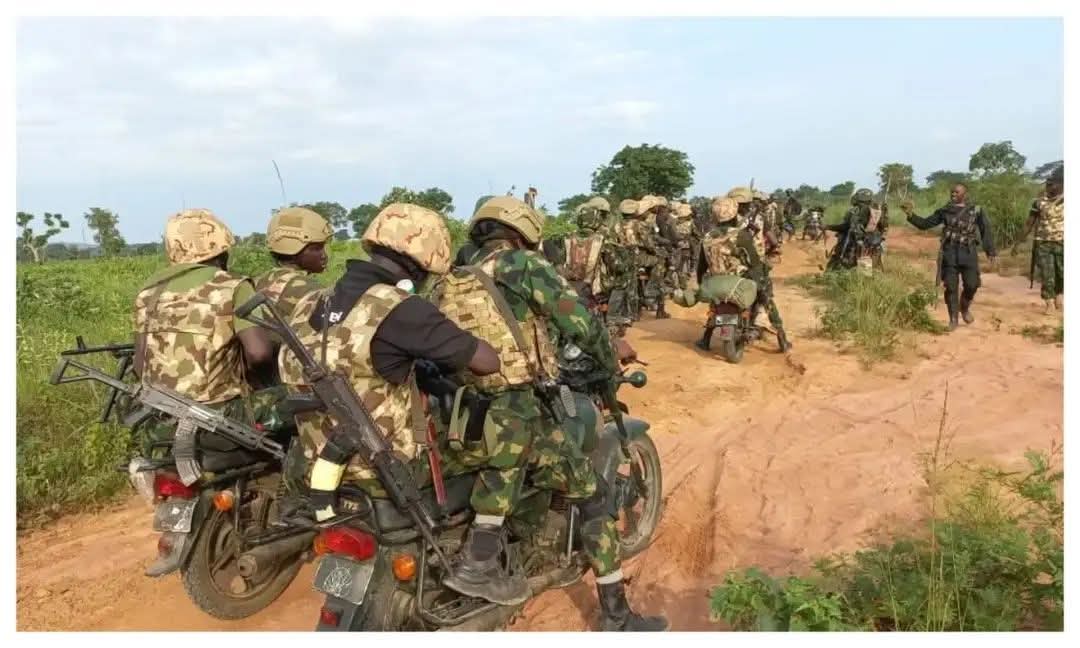
Fighters of the Islamic State West Africa Province (ISWAP) and allied Boko Haram elements tried to overrun positions held by the 153 Task Force Battalion along the Nigeria–Cameroon frontier in the early hours of May 22, the Joint Task Force (Northeast) said.
Soldiers operating under Operation Hadin Kai, backed by the Civilian Joint Task Force, detected the infiltration and answered with heavy fire, forcing the attackers back across the Cameroonian boundary in disarray.
Twelve Killed, Weapons Seized
Troops confirmed 12 fighters killed and recovered AK-47 rifles, rocket-propelled grenade launchers, ammunition, and a PKT machine gun, the military said. Blood trails along the withdrawal routes pointed to further casualties among the retreating column.
The clash was the third in a single week — a tempo the Military High Command credited to sustained “operational pressure” on insurgent cells in the Lake Chad Basin.
“Exploitation operations continue to track fleeing elements and recover additional materiel,” said Lt. Col. Sani Uba, the task force’s media information officer.
The engagement unfolded only a few miles from territory where the United States has quietly rebuilt a surveillance presence after losing its principal Sahel outpost two years ago.
America’s Eyes Return to the Northeast
In March 2026, the Nigerian military confirmed that U.S. forces had deployed MQ-9 Reaper drones and a small advisory contingent to support intelligence operations against ISWAP.
A defense spokesman, Maj. Gen. Samaila Uba, described the aircraft as reconnaissance platforms meant to help Nigerian forces detect, track and disrupt terrorist activity rather than to carry out strikes themselves.
The deployment followed the 2024 closure of Air Base 201 in neighboring Niger — a $110 million facility that once housed more than 1,000 American personnel and anchored U.S. drone operations across the region — after the country’s junta ordered Washington’s withdrawal.
Since late 2025, contractor-operated surveillance flights have monitored the Sambisa Forest and Lake Chad areas, staging out of Accra, Ghana.
That intelligence architecture has underwritten a sharp escalation. Between May 16 and 19, U.S. Africa Command and Nigerian forces conducted coordinated strikes around Metele in Borno State that the Nigerian government said killed 175 ISWAP and Boko Haram fighters.
The offensive opened with a special-forces raid that killed Abu-Bilal al-Minuki, identified by both governments as the second-in-command of the global Islamic State network and a U.S.-sanctioned terrorist since 2023.
A Border That Cuts Both Ways
The Kirawa fighting is geographically inseparable from that wider campaign. The settlement sits directly on the Nigeria–Cameroon border, inside the same operational zone American reconnaissance aircraft have watched for months.
It also lies near Garoua, the northern Cameroonian city that has hosted U.S. drone operations against Boko Haram for years, making the frontier one of the most closely monitored stretches of the entire conflict.
Whether American sensors fed directly into the May 22 engagement is unclear, and the task force statement made no mention of foreign assistance. But the pattern holds: constant overhead surveillance, fast detection of insurgent movement, and Nigerian troops in position to respond before attackers can mass.
Questions Over the Mission’s Scope
The deepening partnership has not been free of controversy. U.S. officials have at times framed the Nigerian campaign through the lens of an alleged “Christian genocide” — a characterization that the Nigerian government and many analysts dispute as a poor fit for the country’s actual security threats.
Critics have also questioned civilian casualties and the quality of targeting intelligence, pointing to American strikes in Sokoto State in December 2025.
For now, both Abuja and Washington describe the American role as strictly non-combat — intelligence, surveillance and reconnaissance meant to close the gaps that have long let ISWAP and Boko Haram melt across the porous Cameroonian border.
The May 22 clash at Kirawa, ending with a dozen fighters dead and an aborted assault, is the kind of outcome both governments cite as evidence the arrangement is working.