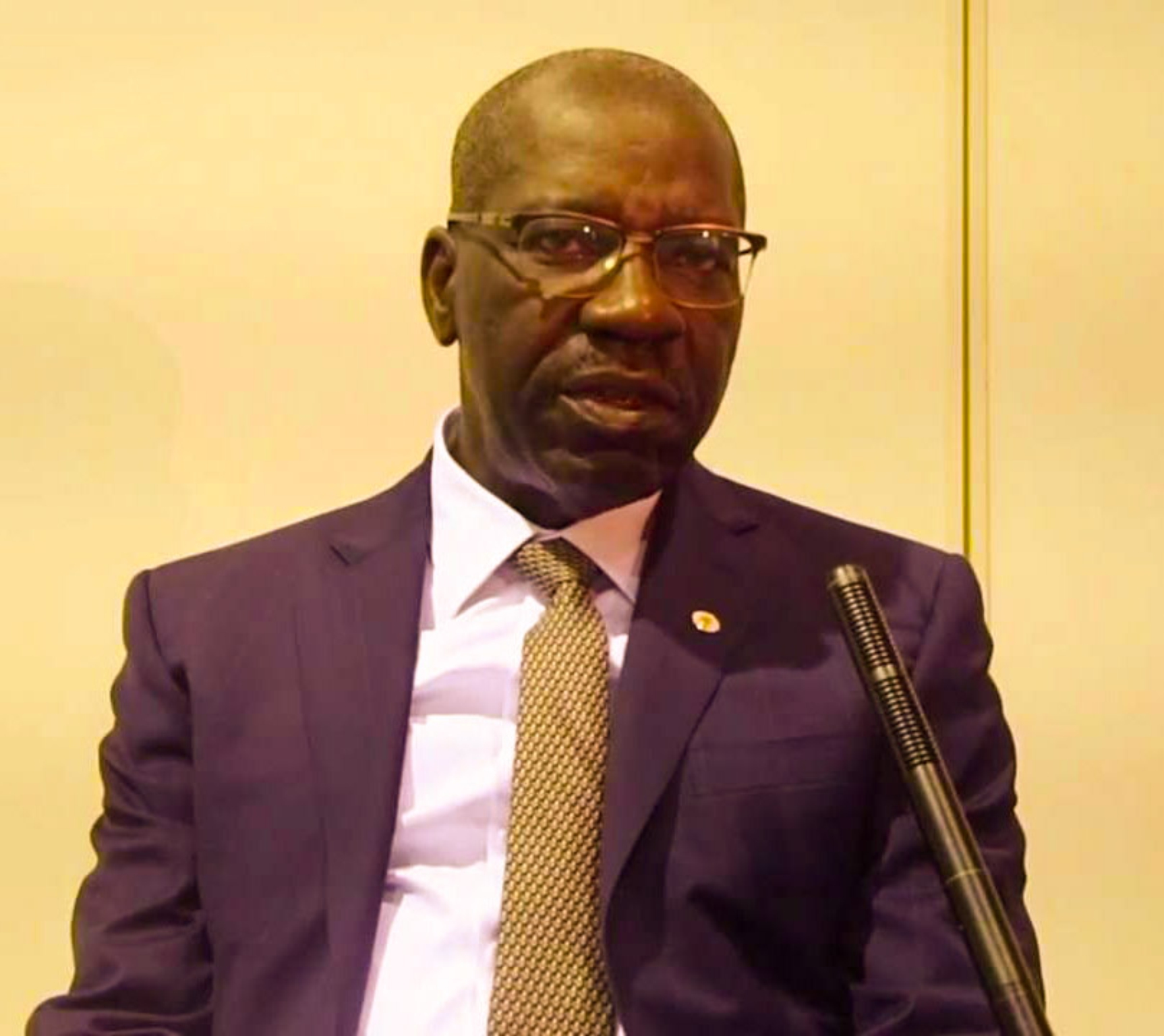
ICESCO nations explore EdoBEST model
Emmanuel Addeh in Abuja
A former Governor of Edo State, Mr. Godwin Obaseki, has warned that Africa’s projected population growth of about 2.82 billion by 2060 could trigger a severe socio-economic crisis unless governments at all levels rethink education, skills development, and employment systems.
Obaseki, a Visiting Researcher, School of African Studies, Boston University, United States, said this while delivering a keynote address at the 3rd Islamic World Educational, Scientific and Cultural Organisation (ICESCO) Dialogue, in London, United Kingdom, a statement by his media office said.
Obaseki noted that Africa is entering a decisive period in which nearly 2 billion additional people will require education, employment, and integration into productive economies over the next three decades, warning that the continent’s current systems are not adequately prepared to meet the demands.
Obaseki stressed that over 89 per cent of children in Sub-Saharan Africa are already in “learning poverty,” while millions remain out of school entirely, including an estimated 15 million children in Nigeria alone. He argued that without urgent investment in foundational learning, the continent risks producing a large but under-skilled workforce.
The summit convened ministers, policymakers, education experts and development partners to examine how countries can move beyond rhetoric and achieve practical gains in K-12 education systems. Central to the discussions was the growing recognition that foundational education remains the bedrock of economic growth, social stability and long-term national development.
The Edo Basic Education Sector Transformation (EdoBEST) programme, initiated by Obaseki, to transform basic education through technology again took centre stage at the forum as ICESCO member states explored the programme as a model to drive education transformation, improve foundational learning and tackle learning poverty across its 1.7 billion population.
Obaseki at the event shared success story and insight on how the EdoBEST programme which was set up to tackle the decay in Edo’s basic education system and tackle learning poverty evolved into a large-scale education reform programme that produced tangible classroom results and gaining global recognition, including from the World Bank, amongst others.
In the address titled: “From Political Commitment to Classroom Results: Lessons from Edo State,” Obaseki, in narrating how the programme progressed from political declarations to practical implementation, noted that successful education reforms begin with leadership making education the government’s most visible and consistent priority, rather than merely one item among competing agendas.
Noting that the migration crisis which saw more than 30,000 Edo youths stranded in Libya pushed his administration to make education reform its top priority upon assuming office in 2016, Obaseki restated that the EdoBEST programme raised teacher attendance to 82 per cent and expanded structured learning to more than 400,000 pupils across the State.
“Every naira we put into EdoBEST was a naira we could have put into something visible. Roads. Hospitals. Ceremonies. We chose long-horizon investment over short-horizon spectacle. That choice has to be defended every single budget cycle,” he stated.
According to him, reform programmes succeed when governments are able to mobilise public trust and maintain momentum despite bureaucratic resistance, vested interests and the short-term pressures of politics.
Speaking on sustainability, Obaseki argued that reforms must outlive the administrations that initiate them. This, he said, requires building strong institutions, establishing credible financing mechanisms and creating public expectations that make it difficult for future governments to reverse progress.
The London dialogue also explored how technology and Artificial Intelligence can support education system transformation. Presentations from policymakers and development partners examined how AI-driven tools are already assisting governments in lesson design, learning analytics, system monitoring and accountability.
The summit further provided a platform for ministers and senior officials from ICESCO member states to exchange experiences on reform implementation. Discussions focused on how countries can bridge the persistent gap between policy ambition and classroom realities, while also identifying the practical interventions capable of producing results within the next two to three years.
Supervisor of the Education Sector and Director of the ICESCO Translation and Publication Centre, Dr. Ahmed Albanyan, highlighted the organisation’s ongoing efforts to advance girls’ education and promote green education in its member states.
Notably, these efforts include ICESCO’s project to help girls who dropped out of school return to education in Yemen, and the ICESCO Global Green Education Progress Tracker, developed in collaboration with UNESCO.
Albanyan emphasised the event’s role in promoting knowledge exchange and developing international partnerships to leverage modern technology and innovation to transform education and enhance the inclusivity of educational services.
ICESCO noted that member states collectively account for nearly half of the world’s children experiencing learning poverty. In countries such as Nigeria and Pakistan alone, an estimated 44 million children around the age of 10 are unable to read and understand a simple text.
These statistics, the organisation said, underline the scale of the crisis confronting many developing nations and explain the growing emphasis on foundational learning as a development priority.