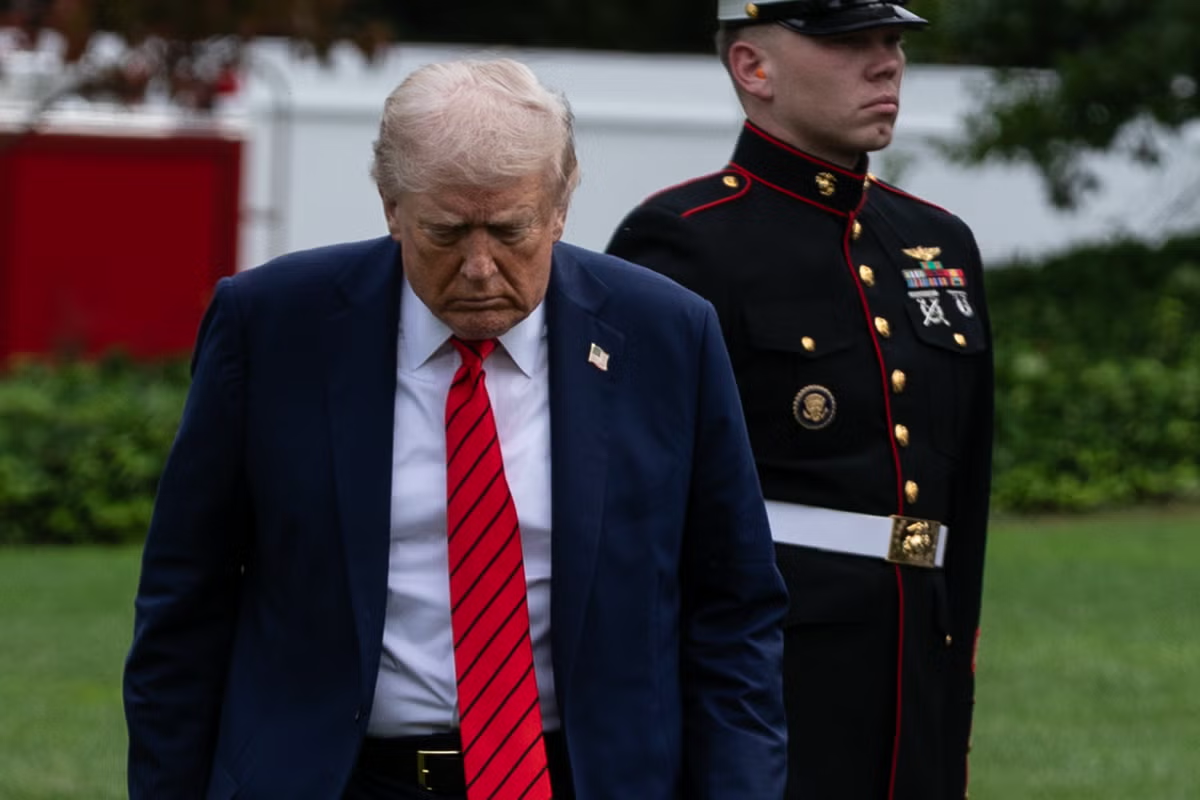
President Donald Trump said he will make a “final determination” on a preliminary deal to prolong the truce with Iran. His statement came after uncertainty over the status of an agreement that would extend the current truce by 60 days, during which Iran and the US would discuss the future of Tehran’s nuclear program, a person with knowledge of the matter said.
Still, Vice President JD Vance earlier told reporters that it was too early to know “when or if” a deal with Iran would be reached. Treasury Secretary Scott Bessent said only that “the teams have been going back and forth,” when pressed if an interim agreement had been clinched. Iran’s Tasnim news agency said the text of the interim deal has changed in recent days and isn’t yet finalised, without providing more details.
Also Read: Trump says US naval blockade of Strait of Hormuz ‘will now be lifted’
Crude has weakened in May on speculation that some form of accord would be reached, although the warring parties have hailed progress before, only for the stalemate to drag on.
Several vessels transiting through the strait have been attacked in recent days, underscoring the “very real” risks that remain for shipowners in the Persian Gulf, whether or not a peace accord is signed, Chevron Corp. Chief Executive Officer Mike Wirth said.
“There still has been kinetic activity this week, some of which has been reported in the media — some of which has not,” Wirth said on Bloomberg TV on Friday. “We see risks very real still in that environment.”
But Wirth added that oil traders seem to be betting that the conflict is nearing a resolution, keeping price gains muted. “The psychology of the market has been this is closer to the end rather than the beginning,” he said.
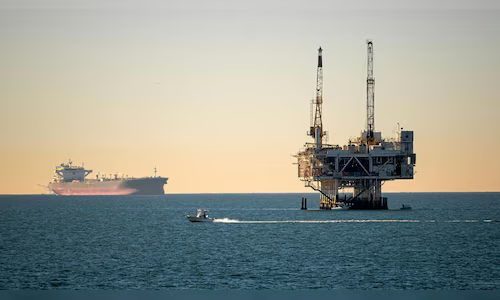
While the effective closure of Hormuz — which is subject to blockades by Washington and Tehran — has curbed global energy supplies, a range of solutions, from bumper US exports, a slowdown in Chinese imports and emergency reserve releases, have quelled the worst of the market impact.
Roughly one-quarter of the non-Iranian large oil tankers trapped inside the Persian Gulf at the outbreak of the Iran war have managed to slip out.
Also Read: Trump could become first living person on a US bill in 150 years with $250 proposal
At this stage, it remains unclear how sticking points in the negotiations — including the Islamic Republic’s nuclear program, Iran retaining control over Hormuz, and sanctions relief — stand to be addressed. The waterway’s reopening and Iran turning over highly enriched uranium were Trump’s “red lines” necessary for any pact, Bessent said.
Even if a truce extension is agreed, multiple hurdles stand to impede the resumption of oil flows. Among them, mines in the Hormuz waterway must be removed, shut-in fields may take months to restart, and damage to energy infrastructure from drone and missile strikes needs to be repaired. In addition, vessels would take weeks to reach importing nations.
“Iran will have to abide by all agreements, and that in itself is a large ask for the market,” said Dennis Kissler, head of energy trading at BOK Financial Securities Inc. “While a pickup in the Strait of Hormuz traffic is promising, we will need to see that stabilise for a while to justify WTI prices in the mid- to low-$80/bbl area.”
Data this week highlighted growing tightness in the US as the crisis dragged on. Among the figures, distillate stockpiles sank to the lowest in more than two decades, and holdings of crude at the Cushing, Oklahoma, hub fell for a fifth week to 23 million barrels, pushing them closer to the 20-million-barrel mark that’s generally seen as the minimum operating level.
Also Read: US delegation to visit India next week to advance interim trade deal talks, says envoy