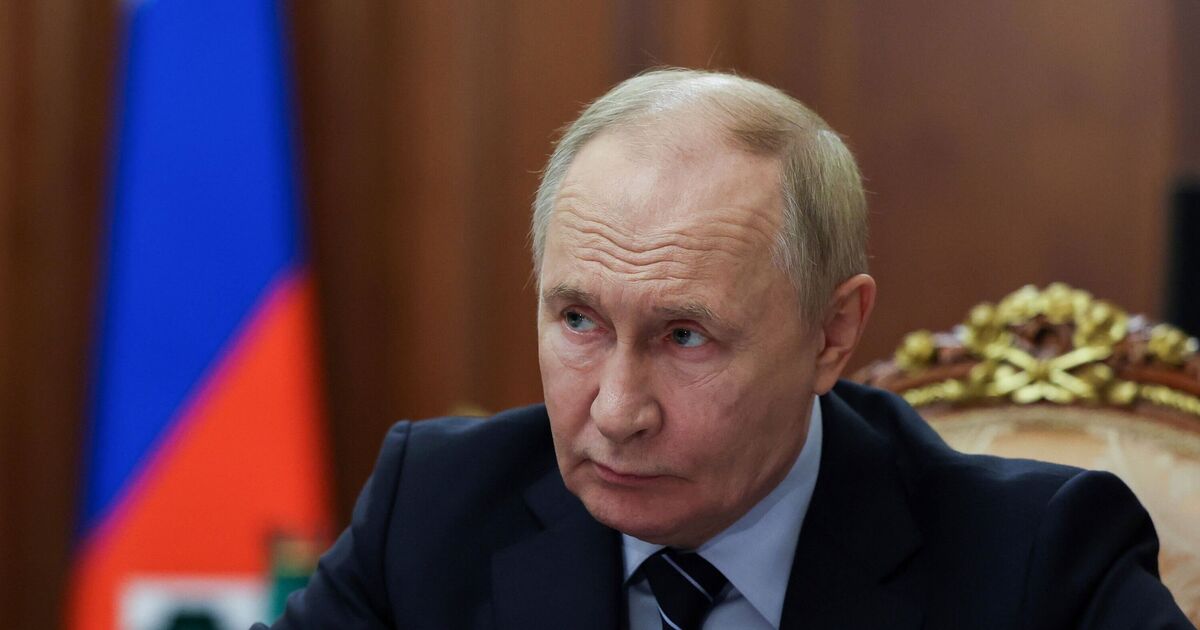
Russia is actively preparing for an invasion of the Baltic states in a major military challenge to the West, according to a new analysis.
Such a thrust by Vladimir Putin would test NATO’s resolve to defend three small member states – Estonia, Latvia and Lithuania – amid the possible start of a nuclear World War Three.
The claim comes from specialist Russian-language war channel Volya, which includes experts from Russia, Ukraine, Belarus, and the Baltics.
The claim also comes after Dmitry Medvedev, Putin ally and former President, warned of a “nuclear apocalypse” as war between Russia and NATO is “inevitable.”
“Since mid March, we have begun receiving confirmations from sources in the Russian Ministry of Defence and other structures that Vladimir Putin’s plans to invade the Baltic states have moved to the next stage,” said the independent outlet.
The aim “is not to start a war with NATO, but to trigger a major crisis within the alliance by invading Latvia, Estonia and Lithuania and, ideally, bring about its effective fragmentation.
“The Russian political leadership believes that European countries will be reluctant to fight a nuclear power, especially without direct support from the United States.
“Vladimir Putin and his circle believe that major European countries would not risk going to war with Russia over the Baltic states”.
The Russian war plans would avoid fighting too close to Poland – which boasts one of Europe’s strongest and most modern armed forces.
Putin sees ex-Soviet states Lithuania, Latvia and Estonia as “lesser states,” says the analysis.
In Estonia – where around 900 British troops are stationed – Russians would invade via Tartu not the more obvious Narva, and “move directly towards Tallinn, block NATO bases and training grounds along the way, and cut off Estonian forces from supply routes and the possibility of organised retreat”.
The aim would be to lessen the chances of new NATO states Finland and Sweden from joining the war, perhaps independently of the alliance.
“A Russian invasion of Latvia would be presented not as an act of aggression but as a special operation to protect persecuted [ethnic] Russians, while attacks on Estonia and Lithuania would be framed as a response to ‘aggressive militaristic actions’ or ‘terrorist attacks by nationalists’.
“In this way, Putin hopes to leave a path open for negotiations with major European countries by maintaining that, formally, there was no war.”
This involves military “purely military matters, such as the completion and formation of new combined arms armies and a second formation of two army corps, the 11th and 14th”.
It includes “the build-up of armoured vehicles, tanks and artillery, missile weapons and launch systems”.
But it also involves logistical preparations “such as building new and repairing old roads in border areas with Latvia, strengthening bridges and overpasses, and repairing and modernising key railway junctions.
“By April, work to expand the capacity of the road network in the Pskov, Novgorod and Smolensk regions was 90 percent complete.
“Modernisation of railway hubs in Smolensk, Velikiye Luki and Pskov has also been completed.”
Similar road and rail improvements across Russia have been mothballed since 2025, said Volya.
“In 2026, road construction and repairs were carried out only in Russian regions bordering Estonia and Latvia.
“In addition, roads leading into Belarus from the Pskov and Smolensk regions were repaired, and duplicate routes were built, including gravel and asphalt roads designed for heavy military equipment.”
The channel warned: “Preparation is ongoing and its pace is increasing, but preparation does not mean there is a 100 percent certainty of invasion.”
It pointed to “construction and upgrading of lateral roads connecting major highways near the Latvian border” and claimed that “all railway switches at major junction stations in Smolensk, Velikiye Luki and Pskov were completely replaced, allowing both personnel and military equipment to be transported in larger volumes than before.”
The channel claimed that Russia would use its neighbour Belarus “as a secure logistics base and a safe parking area for armoured vehicles, artillery, air defence systems and missile systems.”
The new roads would allow “rapid movement of these assets to the border and into combat zones.
“They would also allow Russian Iskander missile systems to move from Belarus into the Pskov region, launch strikes, and then return to Belarus, which would formally remain outside the conflict.”
Maps allegedly show that Russian missiles “could cover the entire territory of Latvia and large parts of Estonia and Lithuania.”
Putin has previously claimed he could grab all three Baltic state capitals within two days – along with other territory, although his boasts about Kyiv provided wrong.
In 2014, Putin told then Ukrainian president Petro Poroshenko: “If I wanted, in two days I could have Russian troops not only in Kyiv, but also in Riga, Vilnius, Tallinn, Warsaw and Bucharest.”
But the channel said its report was “preliminary information”.
“As far as we know, the Russian General Staff does not yet have a detailed operational plan specifying units, formations, tasks and movement routes, partly because the formation of these forces is still ongoing.”
Baltic sources have recently downplayed the prospect of an early Russian invasion but all three states has massively built up their border defences.