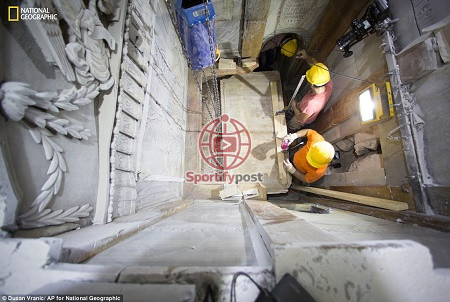
The burial slab that many Christians believe once held the body of Jesus Christ has been uncovered by scientists for the first time in centuries.…....
The original surface was exposed during the restoration work being done at the Church of the Holy Sepulchre in the Old City of Jerusalem, according to the National Geographic.
Until then, marble had encased the slab since at least 1555 AD.
The organization is filming the work being done at the church, which is considered the most sacred site in Christianity.
Fredrik Hiebert, the National Geographic Society’s archaeologist-in-residence, said: ‘The marble covering of the tomb has been pulled back, and we were surprised by the amount of fill material beneath it.
‘It will be a long scientific analysis, but we will finally be able to see the original rock surface on which, according to tradition, the body of Christ was laid.’
Christian tradition says Christ’s body was laid on a slab cut from a limestone cave after his crucifixion by the Romans more than two thousand years ago.
He was resurrected three days after his death, according to scripture, and the women who came to anoint his body said no remains were found.
The burial slab was enclosed in a structure known as the Edicule – a word derived from the Latin term aedicule meaning ‘little house.’
An ornate structure with hanging oil lamps, columns and oversize candlesticks, the Edicule was erected above the spot where Christian tradition says Jesus’ body was anointed, wrapped in cloth and buried before his resurrection.
It stands a few hundred yards from the site of Jesus’ crucifixion.
With its stone staircases, gilded ornamentation and many dark chambers, the church is one of Christianity’s holiest shrines.
But that hasn’t stopped clerics from engaging in turf rivalries over the years.
The Roman Catholic, Greek Orthodox and Armenian churches are responsible for maintaining separate sections, and each denomination jealously guards its domain. While the clergymen who work and pray at the church generally get along, tensions can rise to the surface. In 2008, an argument between Greek Orthodox and Armenian monks erupted into a brawl.
This time, the clergymen put aside their differences — a reflection of the dire need for the repairs. Last year, Israeli police briefly shut down the building after Israel’s Antiquities Authority deemed it unsafe, prompting the Christian denominations to join forces.
The Edicule and the tomb are currently being restored by scientists from the National Technical University of Athens.
The university’s chief scientific supervisor Professor Antonia Moropoulou told National Geographic that it is ‘the critical moment’ for restoring the Edicule.