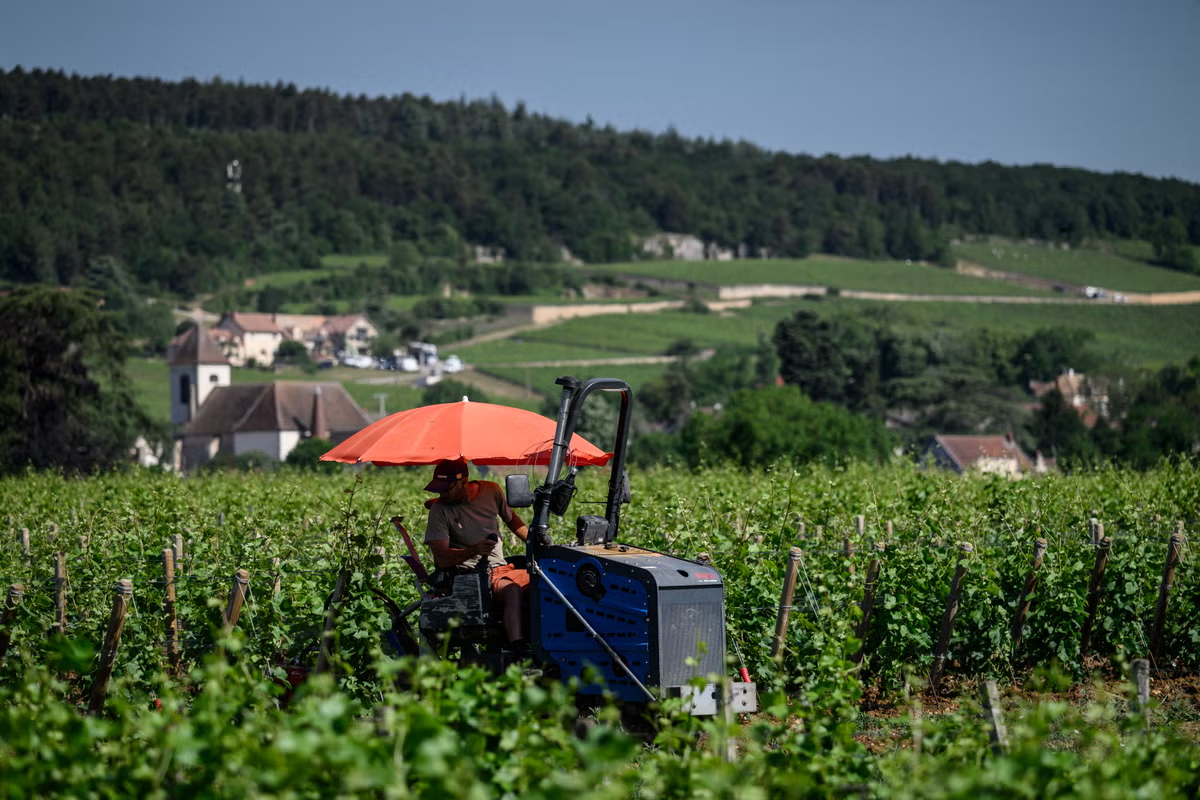
Beneath the glare of the hot May sun, a small, grey tractor trundles across the verdant landscape of Gevrey-Chambertin. A farmer rides the machine through his vineyards, dressed in a light T-shirt and cap, with a parasol overhead to guard against the heat.
France is growing used to longer, hotter summers marred by deadly wildfires and water-related fatalities, part of a burgeoning trend across the continent as the climate warms. Last year, an area the size of Cyprus was ravaged by fires in the worst year on record by size.
But increasingly, those summers are starting earlier and affecting larger swathes of Europe. Britain’s sandy southern beaches were this week lined with revellers seizing upon unseasonal highs. In Munich, young people in swimming shorts clambered into the Eisbach canal to cool off, while in Vienna, the river Wien, meandering through the City Park, was almost bare as temperatures pushed 30C.
The warmer weather was underscored by tragedy as 12 deaths in open water were recorded in the UK. In France, at least seven people have died, including five who drowned in lakes, rivers or near beaches as western Europe battled exaggerated temperatures.
Analysts warn that while southern Europe will likely face the highest temperatures this year, it will be the cooler north that comes under the most strain, lacking the means to contend with a warmer world.
The heatwave moving through Europe is caused by a weather phenomenon known as a heat dome, in which a massive circulation of hot, dry air from North Africa has moved north and become trapped under a stationary, high-pressure anticyclone over Western Europe.
Dr Laurence Wainwright, senior departmental lecturer and researcher at Oxford University, told The Independent that this is highly unusual for late May, and forecasts a longer and hotter European summer to follow this year.
Modelling suggests this year will be hotter than usual as a result of four interacting factors, he said: cyclical fluctuations in sea surface temperatures in the North Atlantic; widespread soil-moisture depletion; large pockets of static high atmospheric pressure blocking the usual flows of weather; and climate change.
In the UK and France, those trends have been felt in record temperature highs for May. AccuWeather meterologist Peyton Simmers said the recent heat across the UK was “exceptional for both its intensity and timing”, pointing to provisional highs of 35.1C in Kew Gardens on 26 May. France hit 36C.
Even as the scorching temperatures start to subside in the UK this weekend, the underlying high-pressure system causing the heatwave will remain “firmly entrenched” across mainland Europe, Dr Wainwright added.
Germany is especially exposed to prolonged heat, with “abnormally elevated temperatures” expected to continue to at least a fortnight, while Spain, Portugal and southern Europe are expected to endure “severe, compounding thermal acceleration” deep into June.
By mid-to-late June, we could see “July-tier” heat across swathes of Europe, weeks ahead of schedule, he said.
Europe is warming faster than the global average. Between 2015 and 2024, the global mean temperature was 1.24-1.28C warmer than the pre-industrial level, making it the warmest decade on record. But European land temperatures in the same period were up 2.19-2.26C.
Big dense cities like London and Paris suffer a compound ‘urban heat island’ effect, by which the millions of cars and people give off heat, and man-made roads and buildings absorb and hold it. Temperatures in the city can be 12C warmer than the surrounding countryside.
Crucially, while southern Europe has had centuries to adapt to a warm climate, the cooler north is arriving new to the problem, having designed its houses to trap and savour glimpses of warm weather.
“The biggest challenge is the amount of legacy building stock that simply wasn’t designed for the climate conditions we’re now experiencing,” explained Rebecca Lydon, director of sustainability at the UK branch of Stantec, a global sustainable design and engineering consultancy.
“Many of our buildings in urban environments aren’t as energy efficient as they could be and weren’t built to cope with sustained periods of high heat. Historically, buildings in the UK have focused on retaining heat during winter. However, they now need to be capable of managing excess heat in summer,”
Dr Wainwright added that while temperatures are likely to be hottest in Southern Europe, it will be countries in the north whose systems will likely feel the most strain.
“The UK will perhaps be the worst impacted by the predicted hot, long summer ahead. The country, everything from its cities to air-con-less offices and homes through to train tracks that buckle in the heat and oft-heat-overwhelmed health system, simply isn’t designed for hot weather,” he said.
This could translate into excess deaths, Dr Wainwright said, citing the reported 2.1 per cent increase in all-cause mortality found for each 1C increase in temperature past 20C, and the 10 per cent spike in hospital presentations for mental-health reasons during heatwaves.
Dr Laurie Parsons, reader in human geography at Royal Holloway, University of London, said some demographics were more at risk than others. In countries like the UK, age is the most immediate factor, but the risk of death or illness is also strongly correlated with certain diseases, dementia, mental health conditions and lifestyle.
“Certain medications, obesity, heavy alcohol intake, and living in deprived areas or poorly ventilated housing significantly amplify these risks,” he said. “In other words, if age is the first underlying risk factor, poverty is the second.”
Countries across Europe are harnessing tech solutions with passive design principles and the natural environment to better manage the heat.
“One of the key lessons is that we already have many of the solutions and we don’t need to wait for new tech or approaches to be invented or emerge,” said Ms Lydon, stressing the importance of simple, proven design principles like better shading, orientation and ventilation.
“We can also learn from countries with warmer climates. Features such as external shading or brise soleil are widely used to reduce heat impacts. These are simple design choices that we can adopt more in the UK.”