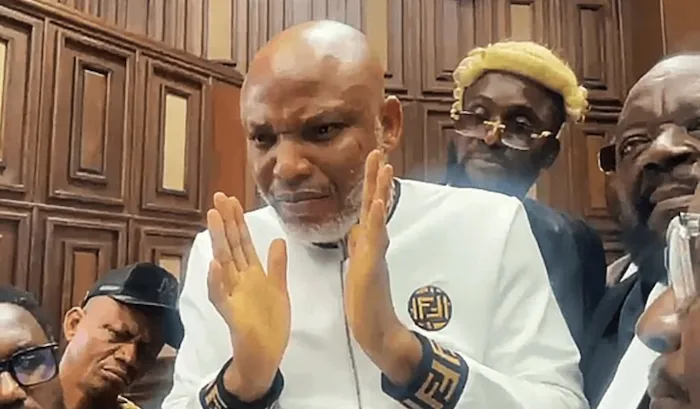
There was a time when the name Nnamdi Kanu dominated conversations across the South-East and beyond. Markets, churches, town unions, youth gatherings and even family compounds echoed with debates about his detention, his ideology and the future of the Igbo people. Back then, calls for his release came from different corners of society with passion and urgency.
Today, that loud voice appears to be fading.
Many supporters now wonder: what changed? Why does it suddenly feel like the agitation for Kanu’s freedom is no longer receiving the same attention from political leaders, influential voices and even ordinary citizens? Has the conversation been buried beneath political calculations ahead of 2027? Or has fatigue, fear and division weakened what once looked like a united cause?
These are uncomfortable questions, but they deserve honest reflection.
For many Ndi Igbo, Kanu is more than a detained figure. To his supporters, he represents resistance, frustration and the cry of a people who feel politically marginalized in Nigeria. Whether one agrees with his methods or not, there is no denying that his message resonated deeply with thousands of young Igbo people who felt unheard for decades.
That is why the silence feels heavy.
The Shift From Agitation To Politics
One major reason for the reduced public pressure may be politics. Nigeria is gradually entering another election cycle, and attention is shifting toward alliances, power calculations and the battle for 2027. Politicians who once spoke boldly about Kanu’s case now appear more cautious, perhaps unwilling to offend the federal government or jeopardize political ambitions.
Some Igbo leaders may believe quiet diplomacy is more effective than public confrontation. Others may simply not want to be associated with separatist rhetoric in an already tense political climate.
But this silence has created an emotional vacuum among many supporters who expected consistent advocacy, especially from leaders elected by the people of the South-East.
Fear Has Also Played A Role
Another angle many people avoid discussing is fear.
Over the years, insecurity in the South-East has complicated the entire conversation surrounding agitation. Killings, sit-at-home enforcement, clashes with security agencies and economic disruption have created fear across the region. As violence increased, many people who once openly supported agitation became more reserved.
Some now worry that speaking too loudly could attract security attention. Others fear being wrongly labelled or misunderstood.
The result is a region where many people still hold strong opinions privately but avoid expressing them publicly.
Has Ndi Igbo Become Divided?
The Igbo position on Kanu’s detention is no longer as unified as it once appeared.
There are those who strongly believe his continued detention is unjust and politically motivated. There are also those who feel the South-East must move toward economic development, political negotiation and stability instead of confrontation.
This division does not necessarily mean people hate Kanu. Rather, it reflects a growing debate within the region about the best path forward for Igbo interests in Nigeria.
Still, even among critics, many believe his matter should be resolved politically instead of dragging endlessly through the courts and public tension.
The Human Angle Many Forget
Beyond politics and ideology is the human side of the story.
For his followers, Kanu is a son, a symbol and a voice they believe spoke boldly when many leaders remained silent. They argue that prolonged detention only deepens anger, mistrust and alienation among young people in the South-East.
His supporters insist that dialogue, fairness and justice are better solutions than prolonged confrontation.
The Bigger Question