Speaking to CNBC-TV18 as US Secretary of State Marco Rubio began his first official visit to India, Shankar said the outreach from Washington was aimed at stabilising a relationship that had faced friction across several fronts over the past year.
“I think we have to wait and see,” Shankar said, referring to Trump’s recent praise of PM Modi and India.
Her comments come as Rubio met Prime Minister Modi and External Affairs Minister Dr S. Jaishankar in New Delhi, with discussions centred on trade, defence, energy, investment and strategic technologies. Rubio described India as one of Washington’s “most important strategic partners” and expressed confidence that a bilateral trade agreement could be completed within weeks.
Shankar said Rubio had struck the right tone by emphasising continuity in India-US ties and the strategic importance of the partnership. However, she cautioned that diplomatic messaging alone would not be enough.
“Secretary of State Rubio has said all the right words, set the tone for the relationship, emphasising the importance of the strategic partnership and the element of continuity,” she said. “But I think we have to wait and see if the rhetoric is matched by concrete outcomes.”
According to Shankar, the relationship had encountered pressure over trade, mobility and broader strategic questions, particularly around Washington’s policy towards China and its reliability as a balancing force in Asia.
“There were ambiguities and uncertainties in the China policy articulated by the Trump administration from time to time,” she said.
Energy emerged as one of the key themes during Rubio’s visit. The US Secretary of State clarified that sanctions on Russian oil were never directed at India and said Washington remained committed to helping partners diversify energy supplies. Jaishankar similarly underscored energy security as a priority for New Delhi.
Shankar said energy cooperation offered clear scope for expansion but warned against any expectation that India would become dependent on a single supplier.
“Buying more from the US is something we would like to do on our own terms, but not exclusively,” she said.
She noted that India’s energy decisions are guided by availability, reliability and affordability, while logistical realities and refinery configurations also shape crude purchasing patterns.
The former envoy also pointed to lingering concerns over how sanctions and tariff measures had affected perceptions of the US in India. She recalled that India had previously faced punitive tariffs linked to purchases of Russian oil while other buyers were not treated similarly.
“I think we need to avoid such scenarios in future where the US seeks to squeeze India’s energy options,” Shankar said. “That plays very badly in terms of how the US is perceived in India.”
Also Read | Trump says India can rely on US ‘100%’, calls himself a strong supporter of PM Modi
Trade negotiations remain another sensitive area. Rubio suggested that a trade pact may be close, but Shankar said the outlook remains clouded after the US Supreme Court ruling that disrupted Trump’s tariff framework.
She argued that tariff arrangements proposed earlier had appeared uneven, with Washington seeking to maintain elevated tariff levels while pressing India for wider duty reductions.
“Unless the relative tariff structure assigned to different countries becomes clearer, it would be premature for India to accept 18% tariffs when we are currently paying 10%,” she said.
Also Read | Rubio visits Taj Mahal with wife a day after talks with Modi, Jaishankar
Rubio also addressed visa and green card concerns during his visit, insisting that reforms were not directed specifically at Indians. On West Asia, he reiterated that preventing Iran from obtaining a nuclear weapon remained a central US objective.
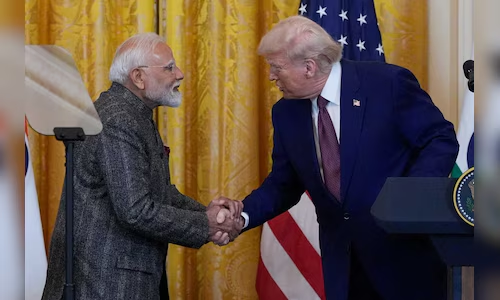
Trump, who joined an event at the US Embassy by phone, sought to reinforce the diplomatic mood by saying India could count on him “100%”. For Shankar, however, the real test of renewed warmth lies beyond rhetoric and in whether policy differences can be narrowed in the months ahead.