The Trump administration plans to send U.S. citizens exposed to Ebola to Kenya, instead of bringing them home, according to a report.
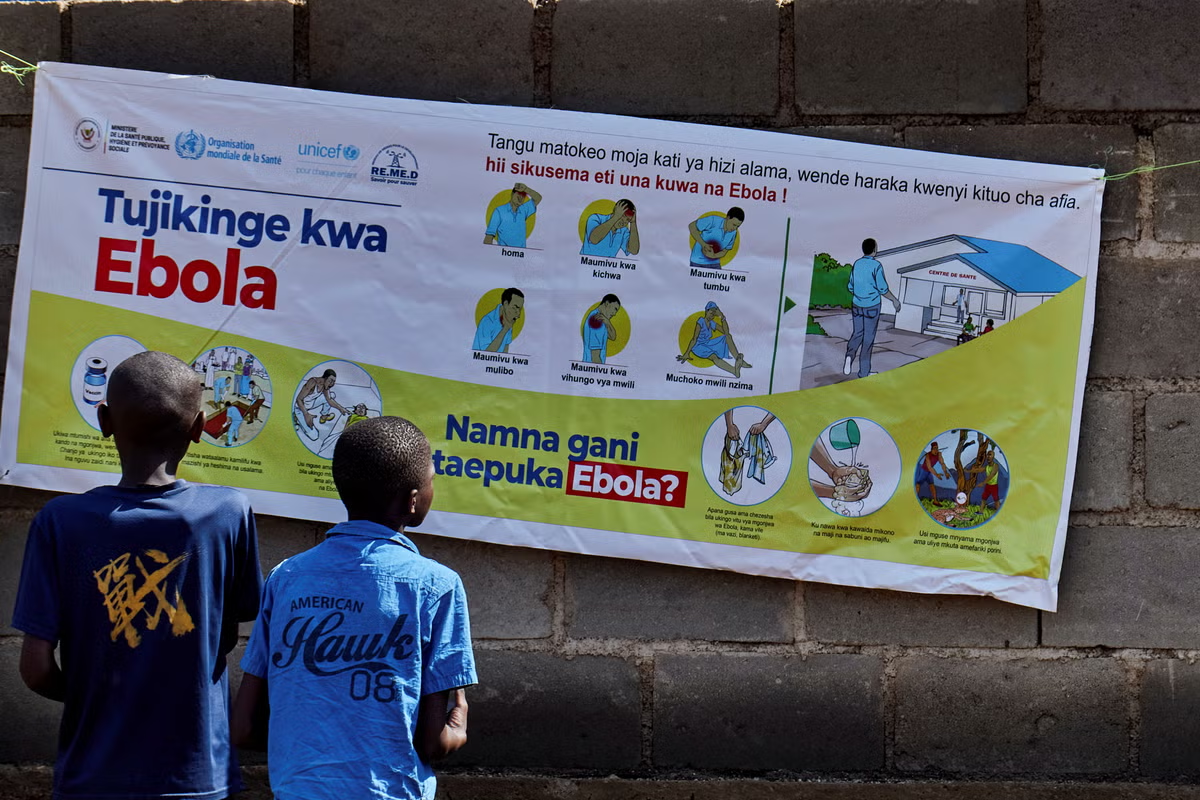
The ongoing Ebola outbreak is centered in the Democratic Republic of Congo, with some cases also being detected in Uganda. The World Health Organization has declared the outbreak as a public health emergency of international concern in a press release.
Now, the Trump administration plans to send Americans exposed to the virus to Kenya instead of the U.S. for observation and treatment, three sources with knowledge of the plans told The New York Times. In the past during outbreaks, people exposed were brought home for treatment in specialized units.
Two of those sources claimed that the plan would keep U.S. citizens possibly exposed to Ebola out of the country. The sources spoke on condition of anonymity because they are not authorized to speak about the matter publicly.
Public Health Service officers are being trained to deploy to Kenya to provide medical care to U.S. citizens who are considered to be at high risk of developing Ebola, according to the report. Initially, the plan was to monitor those Americans in Kenya and to move anyone who began showing symptoms to Europe.
Now, the administration plans to provide treatment in Kenya too, according to the report. Government scientists and physicians who show symptoms will also be treated in the East African country.
In a statement given to The Independent, the White House confirmed that it is establishing a “state-of-the-art facility in Kenya through a coordinated effort with the Departments of State, Health and Human Services, and War.”
“The facility is designed to provide access to high-quality care for Americans who would need to quickly get out of DRC and quarantine without the risks of a lengthy transport back to the U.S,” an administration official said. “Time is of the essence for Ebola patients, and this facility will enable Americans in the region who contract Ebola to receive lifesaving care as quickly as possible without 12-plus hours of medevac flight time.”
The official added that treatment capabilities at the facility are “expected to be able to care for the full-spectrum of Ebola Virus Disease,” including critical care needs.
The official concluded by saying that each case will be evaluated for “forward transport for more advanced care as appropriate in order to maximize patient outcomes.”
Dr. Tom Inglesby, the director of the Johns Hopkins Center for Health Security at the Bloomberg School of Public Health, told The Times that he was surprised by the plan not to repatriate Public Health Service officers back to the United States.
“We have a strong ethical commitment to care for them with the best possible care in the U.S,” he said.
Dr. Craig Spencer, a public health expert at Brown University, told the newspaper that he believed leaving U.S. citizens in Africa was a “dramatic abdication of what we owe our own.”
Spencer said he contracted Ebola back in 2014, after treating patients in Guinea. He was treated at Bellevue Hospital in New York City for 19 days.
Spencer also told the newspaper that the facility in Kenya may be better than one in the Congo, but that it could not match one established specifically for Ebola in the U.S.
“I find it hard to believe that they’re going to be able to stand up in the span of a couple days, or even months, a similar system that has been created over the past decade to do exactly this,” he said.
According to the CDC, officials in the Congo have reported 906 suspected cases and 105 confirmed cases, as of May 26. The country has also reported 223 suspected deaths and 10 confirmed deaths. Officials in Uganda have confirmed 7 cases and 1 death, the CDC noted.
The current outbreak is caused by the Bundibugyo ebolavirus, which is related to but distinct from the Zaire ebolavirus. The latter was responsible for the 2013-2016 Western African Ebola virus epidemic.
This article has been produced as part of The Independent’s Rethinking Global Aid project
More details here...