Adam Dixon, Adam Smith Chair and Director at Panmure House, and Satoru Nagao, Non-Resident Fellow at the Hudson Institute, said the renewed US-China dialogue should not be viewed as weakening the importance of the four-nation bloc comprising India, the United States, Japan and Australia.
The Quad meeting comes as US Secretary of State Marco Rubio visits India for talks on trade, defence, strategic technology and regional security.
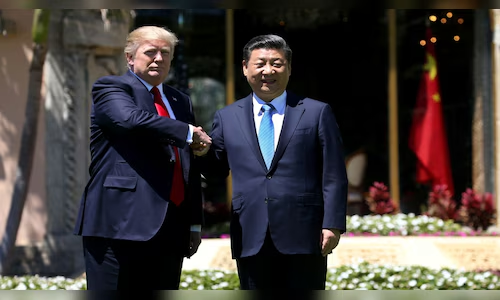
Questions over the grouping’s future relevance had emerged after the recent Trump-Xi summit signalled a possible thaw in ties between Washington and Beijing.
Dixon rejected the suggestion that stronger US-China engagement would dilute the Quad’s role.
“The Quad is led by democracies,” Dixon said. “Trump is trying to balance the relationship with China and have a less hostile relationship. Ultimately, that’s better for international relations.”
He said the grouping continued to matter because it brought together four major Indo-Pacific democracies with shared strategic interests.
Rubio, during his India visit, described the Quad as an alignment of nations capable of influencing global events and called India the cornerstone of America’s Indo-Pacific strategy.
Nagao argued that the US-China summit itself underscored why the Quad remained strategically relevant.
“The main purpose of the US-China summit is stabilised competition,” Nagao said. “But this means that competition itself will continue.”
According to him, the Quad’s original strategic purpose — balancing China’s growing influence — remains unchanged despite attempts by Washington and Beijing to stabilise ties.
“That is why this is a very important strategic turning point,” he said. “In the long run, China is the only country capable of challenging the status of the United States.”
Nagao added that the Quad meeting would give member countries an opportunity to better understand Washington’s evolving China strategy following the Trump-Xi talks.
The experts also pointed to growing concerns around maritime security and freedom of navigation, particularly amid tensions in West Asia.
Dixon said the Quad was more likely to focus on maintaining open sea lanes than directly intervening in debates over Iran’s nuclear programme.
“Freedom of navigation is non-negotiable,” he said, warning against any attempt to disrupt shipping through the Strait of Hormuz.
The issue has gained importance as global energy markets remain sensitive to geopolitical risks in West Asia.
Also Read | Energy ‘driving force’ behind Russia-China ties, Putin tells Xi
Nagao also addressed concerns in Japan over Trump’s recent remarks on Taiwan, after the US President suggested Taipei should avoid moves towards formal independence.
While acknowledging some unease in Tokyo, Nagao said most Japanese experts did not believe the US would abandon Taiwan because of its strategic significance.
“Taiwan is like a knife at China’s neck,” he said, referring to the island’s geographic position near China’s coastline.
Also Read | Marco Rubio backs stronger India-US defence, trade and Quad ties
The Quad meeting in New Delhi is expected to focus on regional security, critical minerals, resilient supply chains and emerging technologies, including semiconductors and artificial intelligence.
Rubio’s India visit has also centred on trade negotiations and energy cooperation, with both sides indicating that progress towards a bilateral trade agreement could come within weeks.