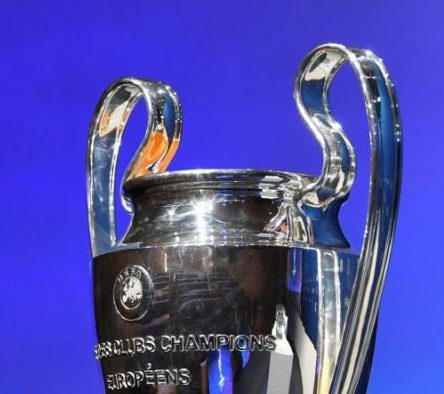
The UEFA Champions League (UCL) final is being billed as the “best attack” (Paris Saint-Germain) vs. the “best defence” (Arsenal) in European football, the unstoppable force colliding with the immoveable object.
And like all storytelling tropes, there’s a strong grounding in reality.
On Saturday night, PSG could end up with the highest-scoring season of any side in the Champions League era, while Arsenal have conceded less than half a goal a game (0.43) in this tournament.
Cue predictions of PSG laying siege to the massed ranks in the Gunners’ defensive third, with Arsenal relying on the ever-familiar (and effective) set-piece strategy in response, with the occasional sortie in transition sprinkled in.
However, it’s just as likely that this isn’t what we’re going to see at the Puskas Arena on Saturday.
Both coaches, PSG’s Luis Enrique and Arsenal’s Mikel Arteta, know full well the value of misdirection and versatility.
After a buccaneering wild ride of a first leg against Bayern Munich – final score, 5-4 PSG – that saw them go man-for-man all over the pitch and turn the clash into a blacktop run on fast forward, PSG dialled it back in the return.
Aided by Ousmane Dembélé’s early goal, they made it about clogged passing lanes, controlled tempo and disruption from deep.
Luis Enrique’s attacking juggernaut had only 27 percent of the ball in the second half and, tellingly, they were more than comfortable playing that way.
It was the equivalent of Michael Buble getting a diamond grill and rapping instead of crooning. And making it work.
Arteta is also capable of pulling tactical rabbits out of his hat.
Arsenal made the transition from possession.
It’s just one of the many options at Arteta’s disposal and it’s a sharp contrast with PSG.
We may not know the “how” of Luis Enrique’s vision for Saturday – as we saw against Bayern, they’re also more than capable of changing things up – but we know the “who”.
Assuming Achraf Hakimi is fit enough to start, the starting XI is set.
Not so with Arsenal.
In addition to the midfield scenario above, Arteta has choices to make at left back (the more athletic Piero Hincapié or the more pass-oriented Riccardo Calafiori?) as well as up front: do you choose the wrecking ball that is Viktor Gyökeres or the more rounded Kai Havertz, who, because superstition is part of the football even at the highest level, has already scored a Champions League winner in a final?, attack-minded, make-the-extra-pass-to-find-the-cutback style of the past few seasons (he did learn his trade under Pep Guardiola, after all: specifically the pass-heavy version of Pep we saw between 2016-19) to what they became this year: a unit that is more physical, more compact and more risk-averse.
One that relies less on taking the game to the opposition and more on punishing errors, individual moments (which is why a guy like the unpredictable Eberechi Eze was such a huge pick-up in the summer) and yes … set-pieces.
But – and too many overlook this – it’s not like they can’t go back. We saw a bit of it when they faced Manchester City in the league, a game they lost, but also one in which they tried to out-football their opponent.
And, to some degree, the shift in style away from the Martin Odegaard-Bukayo Saka right-flank possession chain that they relied on so heavily last season had to do with the injuries that slowed both this past season.
Now that they’re fit and firing again, who’s to say Arteta won’t be tempted to throw a curveball and revert to some version of last year’s model?
Indeed, there’s a growing buzz around the possibility that Arteta might try to cram Odegaard, Eze and Myles Lewis-Skelly into the same midfield, alongside Declan Rice – and at the expense of a deep-lying playmaker.
Martín Zubimendi, who has been a fixture most of the season and whose signing was deemed essential last summer.
That’s right: the same Lewis-Skelly who is still just 19 years old, and who emerged last year as a more-than-competent left back before virtually disappearing until a month ago, only to reappear as a midfielder.