He said the development strides recorded in Abia within three years went beyond infrastructure projects and reflected a restoration of dignity, hope and trust in governance.
A Human Rights lawyer, Chidi Odinkalu, has said that sustainable governance in Nigeria must move beyond physical infrastructure to prioritise people, dignity and institutional integrity.
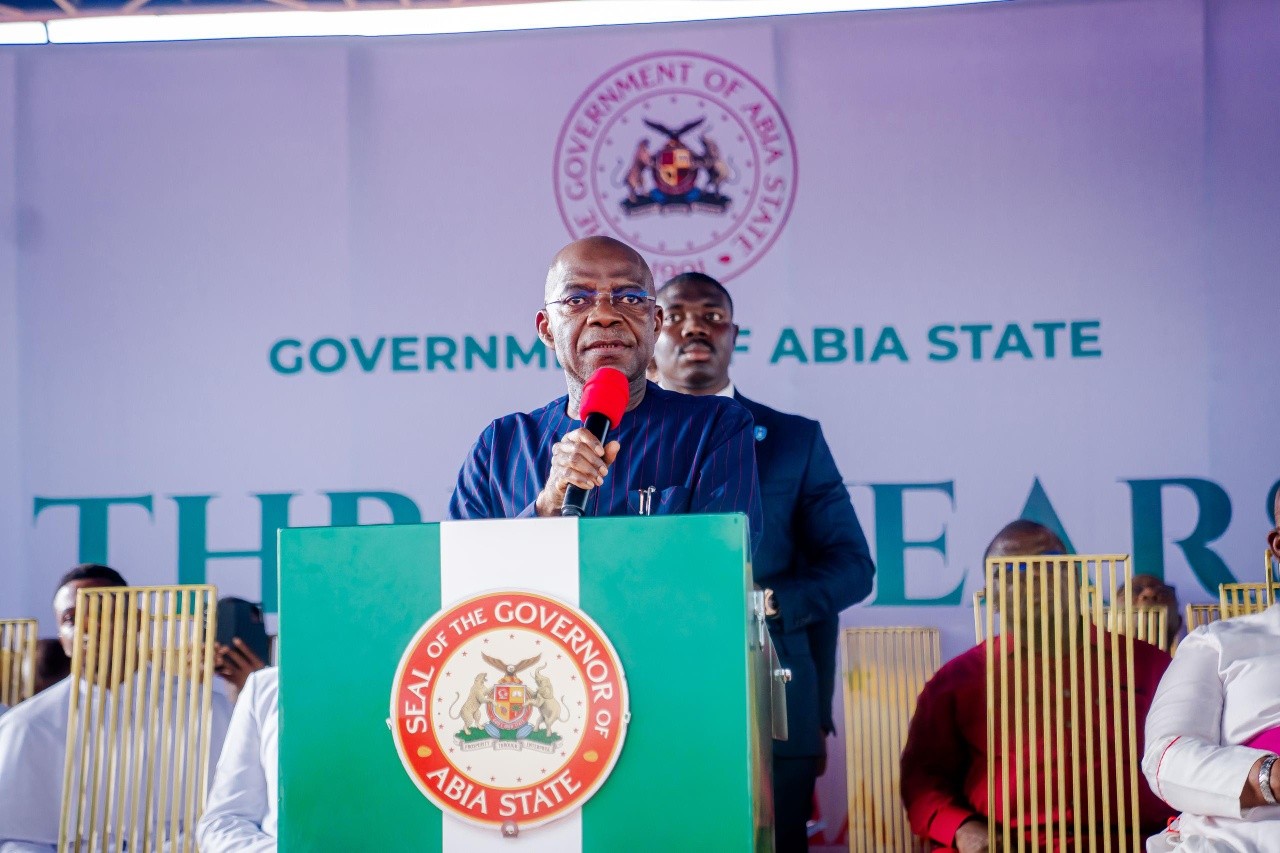
Mr Odinkalu, a professor, said this on Thursday in Umuahia while delivering a keynote lecture during the Abia Anniversary Lecture organised to commemorate the third year anniversary of Governor Alex Otti-led administration.
He warned that projects alone could not guarantee development and emphasised the need for purposeful leadership that directly impacted citizens’ lives in the state.
Mr Odinkalu said the state’s various economic sectors have been transformed within the past three years and could serve as a reference point for broader governance lessons in Nigeria.
He said the development strides recorded in Abia within three years went beyond infrastructure projects and reflected a restoration of dignity, hope and trust in governance.
“I want to be very clear: projects matter, but projects will not last if the people do not have and the people do not own them.
“That is why investment in the people is where it all begins,” he said.
The keynote speaker said that for nearly 24 years, Abia suffered what he described as “desgobierno”, a Spanish expression meaning “ungovernment”.
“You cannot be perpetrating ungovernment against your own people and at the same time accusing Nigeria of marginalising them,” he said.
According to him, the South-east should focus less on complaints of marginalisation and more on demonstrating capacity for effective governance.
“If you cannot manage 29,500 square kilometres, guarantee peace, guarantee safety, guarantee development, guarantee roads, guarantee water, guarantee healthcare, guarantee children go to school, why do you want to manage Nigeria?
“We can out-govern the rest of Nigeria and start creating a dignified population, a place where things work.
“Nigeria will tell you, ‘you know what you have done to your place, come and do it for us’,” he said.
Mr Odinkalu described what he called “The Alex Otti Challenge” as a template built on “a clear diagnosis, coherent strategy and a value system.”
He said that Otti’s government had restored legitimacy to governance in the state because it emerged from what he called a legitimate mandate.
“Anybody who can steal your mandate can steal anything that they prefer.
“This governor, because he has a legitimate mandate, has got to account to those who gave him the mandate,” he said.
Mr Odinkalu said improved road infrastructure, security, electricity and healthcare services had significantly transformed the state.
He said the administration had delivered over 1,000 kilometres of roads within three years, comparing the distance to Aba to Kano plus Okigwe to Uzuakoli”.
Mr Odinkalu pointed out that electricity projects and street lighting in Aba had reduced crime and improved business productivity.
“What is the biggest crime-fighting invention that this administration has done? Electricity; as a result of street lighting, crime has crashed in Aba,” he said.
Mr Odinkalu further commended the administration for prioritising social welfare through programmes such as health insurance, disability support services, maternal transport schemes and upgrades of primary healthcare centres.
“The biggest thing in my view that this administration has done is care.
“A government that cares. The infrastructure of care is self-evident for those who have bothered to look at it,” he said.
Mr Odinkalu also urged the state to leverage its growing number of universities to develop a research and development cluster capable of driving innovation and industrial growth.
He advocated for establishing a commercial dispute resolution hub in Abia to complement its industrial and commercial aspirations.
He also called for the creation of a women’s legacy enterprise fund in honour of the Aba women of 1929 to support female-owned small and medium enterprises.
“Our women in this part of the world have been central to our narrative.
“They represent enterprise communities and leadership communities,” he said.
Mr Odinkalu urged the people of the state to protect the gains already made by supporting enlightened civic participation and responsible leadership.