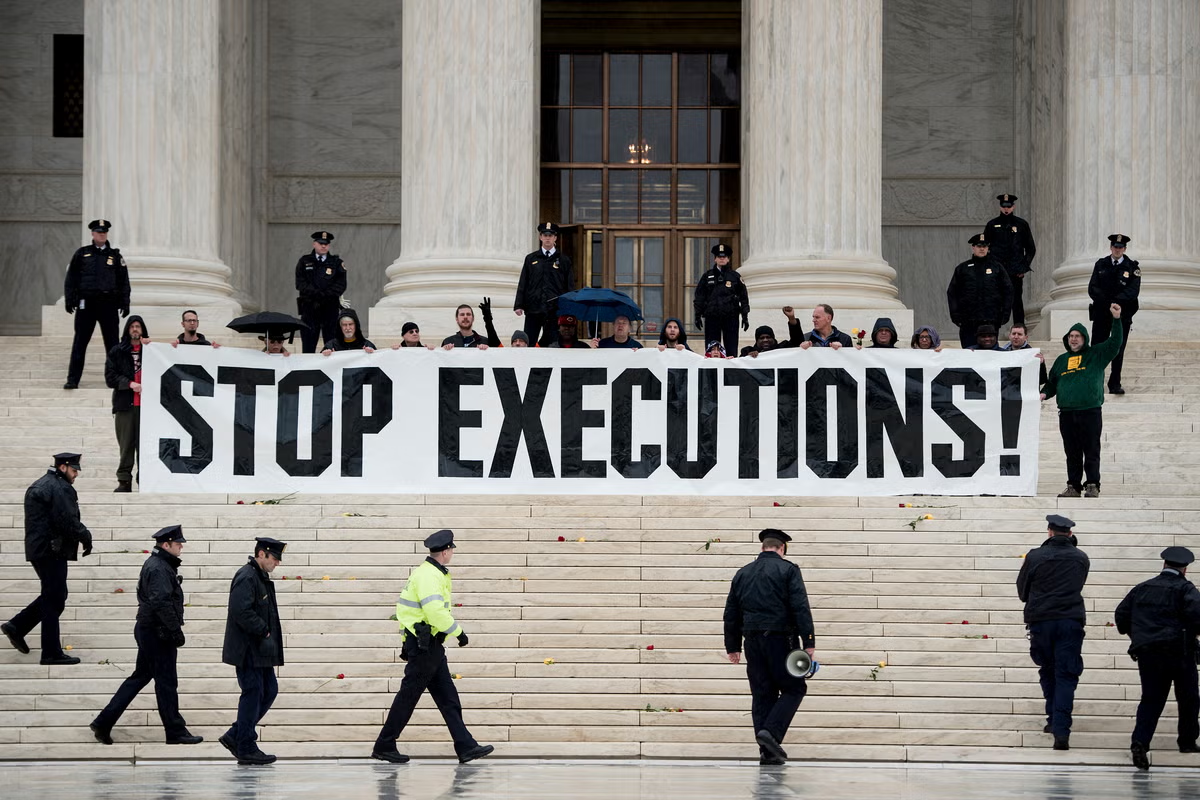
Alabama has asked the U.S. Supreme Court to set aside a judge’s ban on nitrogen gas being used for executions in order to execute a man Thursday night.
The eleventh-hour legal fight will determine if 49-year-old Jeffery Lee will be executed while also helping determine the future of the controversial execution method.
“As Alabama continues to defend its execution protocol in the courts, the governor remains prepared to move forward with the planned execution,” Mike Lewis, a spokesman for Alabama Gov. Kay Ivey, wrote in an email.
A federal judge on Tuesday ruled that Alabama’s nitrogen protocol violates the Constitution’s ban on cruel and unusual punishment. The Alabama attorney general’s office is appealing the decision.
The execution method of nitrogen hypoxia involves strapping a respirator to a condemned person’s face, replacing breathable air with pure nitrogen gas, causing death from oxygen deprivation.
A jury convicted Lee of two counts of capital murder for killing Jimmy Ellis and Elaine Thompson while robbing a pawnshop on Dec. 12, 1998.
Prosecutors said Lee entered Jimmy’s Pawnshop with a sawed-off shotgun and shot Ellis, the owner of the store, and Thompson, a store employee.
A jury voted 7-5 that Lee should receive a sentence of life imprisonment.
However, a judge overrode that recommendation and sentenced Lee to death.
Alabama in 2017 ended the practice of judicial override and no longer allows a judge to disregard a jury’s sentencing decision in death penalty cases. The state law abolishing judicial override was not retroactive.
Nitrogen has been used in eight U.S. executions – seven in Alabama, one in Louisiana. Lee was scheduled to be the ninth individual put to death by nitrogen.
U.S. District Judge Emily Marks ruled Tuesday, after an appeals court reversed her initial finding that the method was constitutional, that Lee had shown by a “preponderance of the evidence that the protocol constitutes cruel and unusual punishment in violation of the Eighth Amendment.”
The 11th U.S. Circuit Court of Appeals, in a 2-1 decision Wednesday night, rejected Alabama’s request to stay the ruling.
The court earlier said the three minutes that it could take for an inmate to lose awareness is an “intolerable” time frame, “given the suffering that would likely take place under Alabama’s nitrogen hypoxia protocol.”
A spokesman for the Alabama attorney general’s office confirmed Wednesday night that the state is appealing to the Supreme Court. The court has never ruled that a specific execution method violates the Constitution.
The case has put a spotlight back on the nitrogen execution method and the sharp disagreements over its use.
During the previous Alabama nitrogen executions, the inmates shook, pulled at the restraints and exhibited labored breathing at the start of the execution. During the state’s last execution by nitrogen gas, 30 minutes elapsed between Anthony Boyd exhibiting signs of being impacted by the gas and state officials closing the curtain to the viewing room to signal the execution was complete.
The state has maintained that the method is constitutional and causes no more suffering than other execution methods.
“If nitrogen hypoxia violates the Eighth Amendment because of a risk of anxiety and emotional discomfort, then so too must every other method of execution, many of which carry inherent risks of real physical pain,” state lawyers wrote in a Wednesday court filing to the 11th Circuit.
Lee’s attorneys said Alabama is attempting to move forward with an execution method that courts have found unconstitutional. His supporters have urged Ivey to commute his sentence to life imprisonment, which is the sentence that jurors at his trial had recommended.
“Alabama Attorney General Steve Marshall wants to execute Jeffery Lee under a death sentence the jury rejected using a nitrogen gas method that two federal courts have ruled unconstitutional. This execution is simply too flawed to move forward,” Lee’s lawyers said in a statement.
“We remain hopeful that Governor Ivey will intervene,” they added.