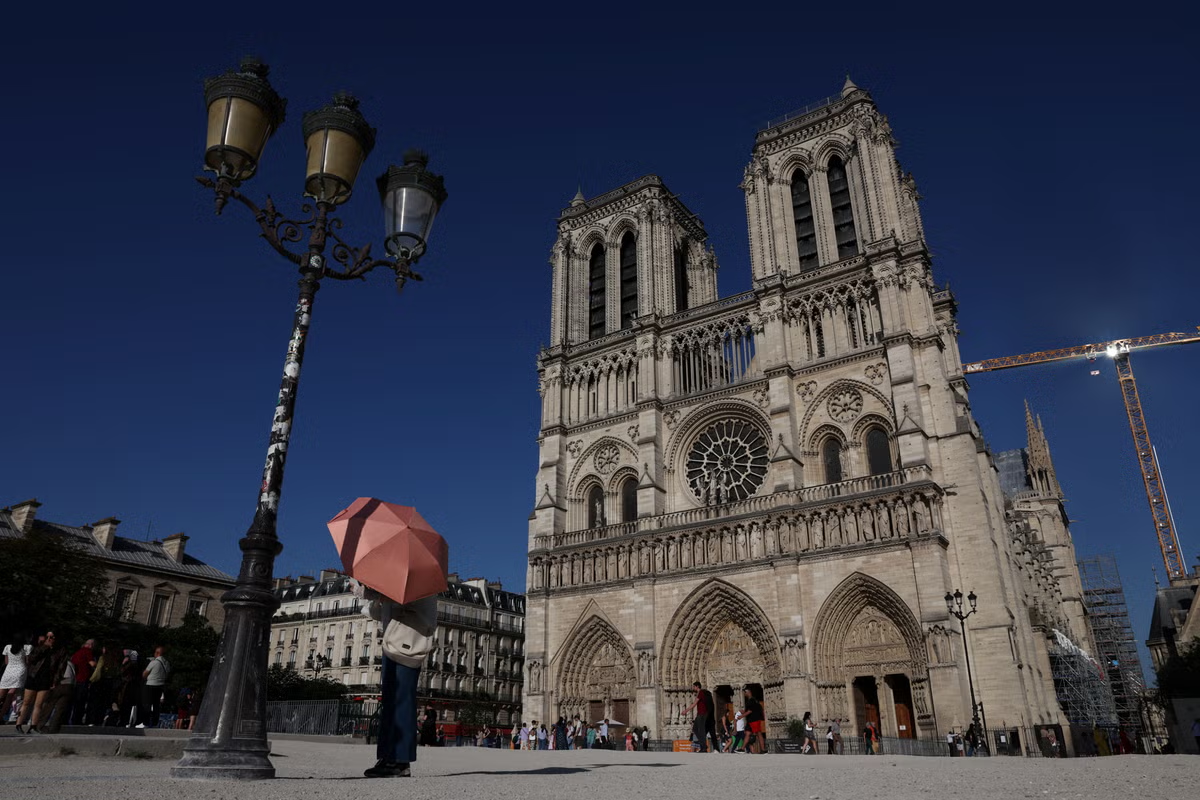
While tourists queue in the summer sun to ascend Notre Dame Cathedral and admire its iconic gargoyles, a remarkable archaeological excavation is unfolding just four metres beneath their feet. This deep dive into Paris’s past, reaching back 2,000 years to Roman times, is a direct consequence of the cathedral’s 2019 fire and the subsequent plans to revitalise its forecourt.
Following the devastating blaze that saw Notre Dame’s spire collapse, the cathedral is set to reopen in late 2024. As part of wider urban renewal, Paris aims to transform the currently stark square into a shaded, tree-lined space.
However, in a city steeped in history, no ground can be disturbed without first meticulously excavating what lies beneath, safeguarding against potential damage to invaluable historical artefacts.
Consequently, a section of Notre Dame’s forecourt has been transformed into an active excavation site – an open pit, cordoned off by barriers and traversed by a wooden walkway, mere steps from the bustling tourist queues. French media have already dubbed it the “dig of the century”.
Lucie Altenburg, a conservator with the Paris archaeology unit, highlighted the profound importance of the project. She told The Associated Press: “It’s a rare opportunity for us to work on something that’s tangibly going to make a difference to the history of Paris.”
Among the hundreds of objects unearthed so far are a fourth-century coin bearing the image of Emperor Constantine and fragments of medieval pottery. These shards are particularly intriguing, featuring faint, undeciphered markings painted on their interior – a mystery that has led some to liken it to a “modern Da Vinci Code”.
The ongoing discoveries have captivated visitors. Emily Carter, 34, a tourist from Manchester waiting in line with her two children, remarked: “It makes Notre Dame feel alive again. You come to see the cathedral, then realize there’s another city under your feet. That’s almost more moving.”
The first historical traces emerge just 50 centimetres down, but the team is still unearthing history four metres deeper. Some days, they fill as many as 15 crates with finds from ground that has remained undisturbed for decades.
This phenomenon is a common thread in ancient cities: history isn’t confined to museums but lies directly beneath the streets. Urban centres evolve, with each era building upon the remnants of the last, causing the ground level to gradually rise. Rome, for instance, has seen its ground level ascend by approximately nine metres since the fall of its empire in the fifth century AD.
Similarly, when Athens constructed its metro system for the 2004 Olympics, it triggered the largest excavation in Greek history, yielding tens of thousands of artefacts now displayed within the stations themselves. Paris, originating on the Île de la Cité in the Seine, is no different.
Centuries after Paris’s inception, Notre Dame itself rose on this very island. Camille Colonna, the lead archaeologist for the current dig, explained that at the cathedral’s birth in 1163, the entire square was densely packed with medieval houses, bisected by a single street.
As her team digs deeper, they have uncovered the cellars of these medieval homes, representing their specific historical period. Below these lie Merovingian and Carolingian grain pits, dating from the sixth to the tenth centuries. Deeper still, a dense Roman quarter from the fourth and fifth centuries has been revealed. In total, twenty centuries of history are stacked within just four metres of earth – roughly the height of two-and-a-half Napoleon Bonapartes.
Yasmine Benali, a 22-year-old archaeology student observing from behind the barriers, reflected on the significance: “Here you can see the layers — medieval Paris, Roman Paris, maybe even before that. It makes the city feel less like a postcard and more like something still being discovered.”
Intriguingly, some of the richest finds have emerged from the most unlikely of places: the deep pits beneath the medieval houses, which served as both latrines and rubbish dumps. From these, the team has retrieved entire jugs and cups, discarded centuries ago yet remarkably intact, alongside broken plates and animal bones.
Valentine Breloux, another archaeologist on the unit, noted the rarity of such discoveries: “It’s rare to find complete ceramics.” The soft, organic waste in these pits provided a cushioning effect, miraculously preserving the items whole over centuries.
Further confounding experts, conservators cleaning what appeared to be ordinary medieval pottery began to uncover faint reddish writing painted on the inside – the same mysterious markings appearing on shard after shard. Their meaning remains a puzzle yet to be deciphered. Breloux described these as the most “astonishing” of all the objects she has cleaned from Notre Dame.
The coins themselves initially appeared as black, rust-eaten discs. However, under X-ray, the face of Constantine, the Roman emperor who reigned in the early 300s AD, was revealed. Such artefacts, Altenburg explained, “can be invaluable in giving us the date of the (underground) layer.”
The Roman discoveries are particularly prized by archaeologists, representing the deepest, oldest, and least understood period. During Roman times, the settlement was known as Lutetia, with its primary centre located across the river on the Left Bank. As the Roman Empire declined, people retreated to the Île de la Cité, the future site of Notre Dame, fortifying the island with stones repurposed from earlier structures.
Colonna’s team found tangible evidence of this repurposing: a Roman doorstep, clearly from a much larger building, discovered in the dig. It had been carried over, inverted, and laid as paving in a road.
Every unearthed artefact is transported north to the city’s archaeology centre, which Colonna describes as “a huge archaeological store,” a veritable treasure house of Parisian history.
For archaeologists, this cathedral dig is a rare privilege. In France, as elsewhere, excavations typically only occur when new construction is imminent – a scenario akin to industrial quarry workers unexpectedly unearthing dinosaur remains. “This only happens because the city of Paris decided it wanted to beautify the area,” Altenburg noted.
The new square, anticipated to be largely complete by 2028, is envisioned as a woodland clearing featuring 160 new trees and a thin film of water designed to cool the stone in summer. This initiative forms part of Paris’s broader strategy to adapt to increasingly hotter summers brought on by global warming.
The tourists currently enduring the bare sun beneath the gargoyles will, in just a few summers, find themselves queuing in welcome shade.
Furthermore, the old underground car park is set to reopen as a visitor centre overlooking the Seine. Until then, the Notre Dame team harbours ambitions to delve even deeper – beyond the Romans, towards the Gauls who first named the city. “The hope is that we are able to go back in time even further than we’ve ever been before,” Altenburg concluded.