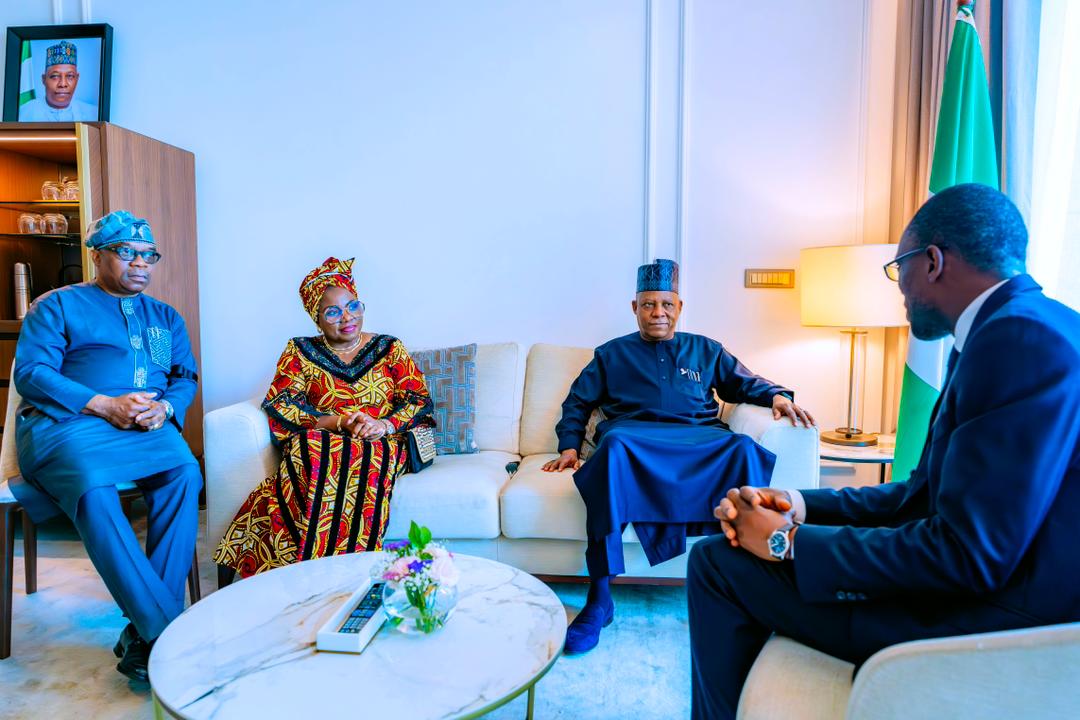
The judge inisisted that the conditions attached to the bail granted Mr El-Rufai in the phone-tapping trial were reasonable.
The Federal High Court in Abuja on Tuesday dismissed an application by former Kaduna State Governor, Nasir El-Rufai, seeking a variation of his bail conditions in the ongoing phone tapping case filed by the State Security Service (SSS).
Judge Joyce Abdulmalik held that the initial conditions attached to his bail were “intended to ensure his attendance at trial” and found no merit in the request to alter them.
The decision followed a bail variation application filed by Mr El-Rufai in the trial.
By the request, he sought an order of the court that granted the bail to alter part of the conditions attached to the bail which he could not meet after making frantic efforts.
The SSS filed the charges against Mr El-Rufai in February after he claimed during an Arise Television interview that he listened to a telephone conversation involving the National Security Adviser (NSA), Nuhu Ribadu.
The agency subsequently arraigned the former governor on 23 April on five charges.
He was granted bail on 18 May in the sum of N100 million with one surety.
One of the bail conditions was that his surety must be resident in either Maitama or Asokoro district of Abuja and must deposit the original Certificate of Occupancy of a landed property with the court registry.
The surety is also required to be a federal civil servant not below Grade Level 17 and must provide evidence of salary payments for at least three months, authenticated by a letter from the manager of the bank within the jurisdiction of the court.
The court also directed the defendant to submit a letter of attestation from the chairperson of the Kaduna State Traditional Council and two other members of the council.
The judge, while delivering the bail ruling that day, observed that the prosecution did not oppose Mr El-Rufai’s bail application.
She cited Section 36(5) of the Nigerian Constitution, which provides that every person charged with a criminal offence is presumed innocent until proven guilty.
On Tuesday, Paul Erokoro, a Senior Advocate of Nigeria (SAN), who represented Mr El-Rufai, told the court that his client was unable to meet some of the bail conditions and that he had filed an application for variation.
Moving the application filed on 2 June, the senior advocate thanked the court for granting bail to the defendant. However, he told the court that four of the bail conditions had not been met.
He said one of the unmet conditions was the Grade 17 officer surety in the federal service and requirement to own property in Maitama or Asokoro.
He said the defendant had approached several directors, but they said they did not own properties in Asokoro or Maitama. He added that salaries of directors were about N7.6 million before taxes and deductions, while properties in those areas cost billions.
He also drew the judge’s attention to a Supreme Court decision which, he said, noted that public officers do not present as sureties. He urged the court to “liberalise the conditions.”
He noted that the prosecution had filed a counter-affidavit, yet did not oppose bail initially. “So if they did not do that then, they cannot now insist that the bail must be on stringent conditions.”
“Liberalise the bail conditions. After all, the defendant’s children and family are known by everyone. Where is he running to?” he added.
Responding, the prosecution lawyer, Oluwole Aladedoye, also SAN, said in opposition to the application that the prosecution filed a counter-affidavit on 4 June.
He said the court did not give a price for properties expected of the Grade 17 officer. He added that Mr El-Rufai had served as minister and governor and should not have difficulty meeting the conditions.
He also stated that it was not for a defendant in a criminal charge to propose conditions convenient for him.
On the Supreme Court decision cited by Mr Erokoro, the prosecution lawyer cited a different authority and said no two cases were the same. He urged the court to dismiss the application and described the defence conduct as “unworthy.”
Responding, Mr Erokoro told the judge that the court was not moved by sentiment. He maintained that the lower courts must follow Supreme Court decisions. He said they were not proposing conditions but seeking review so the defendant could meet them.
He said it was not right that the defendant, who had not been convicted, had been in custody for four months because he could not meet bail conditions.
In his ruling, the judge noted that she had “considered conditions 2, 3, 6 and 9 of the bail order, which were being challenged.”
But she said Mr El-Rufai’s legal team did not substantiate claims that properties in Asokoro and Maitama in Abuja were valued between N3 billion and N20 billion, far above the N100 million bail bond the judge imposed.
The judge added that, although the court did not make any specific finding on property values in those areas when it granted bail, the defence did not present any evidence to support the claim on the price range of properties in the two places.
The judge also addressed the requirement for the defendant to produce an attestation from the chairperson of the Kwara State Traditional Rulers’ Council and two other members of the council. She maintained that the court “considered those conditions reasonable, given the standing of the defendant in society.”
In conclusion, the judge held that the “application for variation of bail conditions lacked merit” and was dismissed.