Civil society groups in Akwa Ibom took their campaign for environmental justice to NUPRC’s doorstep, demanding answers over $270 million in gas flare penalties as oil-producing communities complain of worsening pollution and neglect.
A coalition of civil society organisations, youth groups and community advocates has accused regulators and oil firms of failing to translate hundreds of millions of dollars in gas flare penalties into environmental relief and development for host communities in Akwa Ibom State.
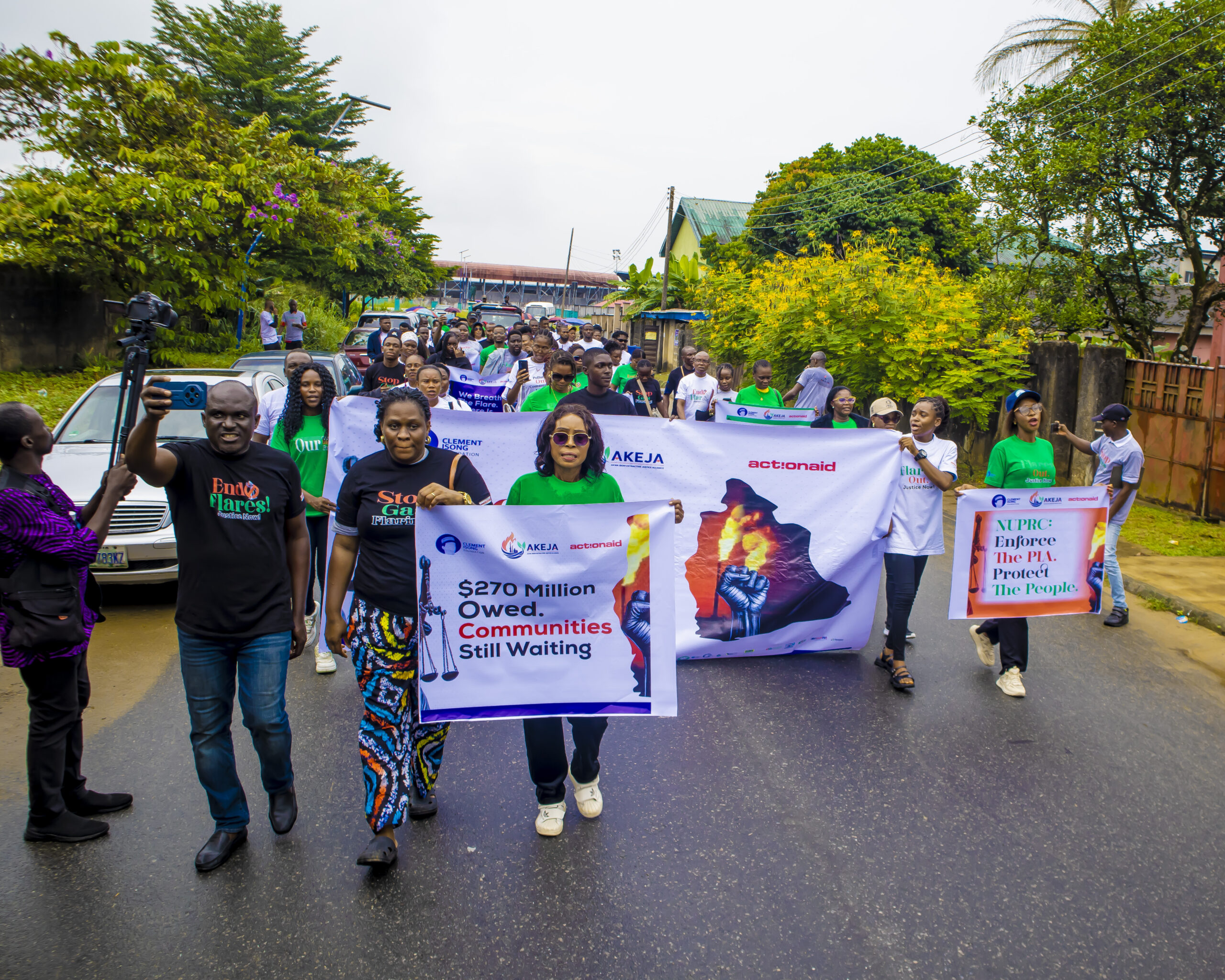
The coalition, operating under the Akwa Ibom Extractive Justice Alliance, staged a protest on Friday at the Nigerian Upstream Petroleum Regulatory Commission (NUPRC) office in Eket, Akwa Ibom State, demanding accountability for gas flare penalties and urgent action to address environmental degradation in oil-producing communities.
The protesters submitted a petition to the NUPRC, stating that communities hosting oil and gas operations continue to suffer pollution, poverty and inadequate infrastructure despite operators paying substantial gas flare penalties.
The coalition said over $270 million in gas flare penalties remained outstanding to host communities between 2021 and 2025 and called for a comprehensive public accounting of penalties assessed and remitted within the period.
Some of the inscriptions displayed by the demonstrators read: “We breathe the flare. Where is our money”, “$270 million owed communities still waiting”, “Seplat: New operator, full responsibility”, “Eastern Obolo is not a sacrificed zone”, “Executive order 9 hurts host communities. Reverse it”.
Others are: “Oil wealth does not equal community poverty”, “8 villages, no light, OML 13 burns all nights”, “NUPRC enforce the PIA, protect the people”, “Stop gas flaring! Polluters out, communities first”.
The demonstrators said the protest formed part of an international campaign against fossil fuel pollution involving communities and advocacy groups across Africa and South America.
Akwa Ibom Extractive Justice Alliance is a coalition of civil society organisations, youth groups, academics, and community advocates convened by the Clement Isong Foundation with support from ActionAid Nigeria.
According to the group, gas flare penalties exceeding $10.4 million became payable on Oil Mining Lease (OML) 13 between 2021 and 2023, yet communities in the area continue to experience persistent gas flaring.
The coalition cited communities such as Iko Town, Elekpon, Akpabom and Atabrikang in Eastern Obolo Local Government Area, where it said gas has been flared continuously since production commenced on OML 13 in May 2024.
It added that eight communities in Eastern Obolo still lack electricity despite the area’s significant gas resources.
PREMIUM TIMES reported that stakeholders at an environmental justice roundtable had called on oil firms and regulators to convert flare gas into electricity for Akwa Ibom oil and gas host communities grappling with years of power outage.
“OML 13 holds over five trillion cubic feet of gas. The energy being burned over these communities could instead be used to power them,” the coalition said.
The group also alleged that gas flaring activities in Ibeno Local Government Area have adversely affected air, water and soil quality across parts of Ibeno, Eket, Esit Eket and Onna local government areas.
It further said that residents can no longer rely on rainwater for domestic use and linked environmental degradation to the loss of coastal settlements through erosion.
The protesters argued that increasing penalty payments have not resulted in corresponding reductions in gas flaring.
Citing the Nigeria Extractive Industries and Transparency Initiatives oil and gas reports, the coalition said oil companies paid $646 million in gas flare penalties nationwide in 2025, the highest amount recorded in five years.
Despite this, it said, Nigeria flared 301.3 million standard cubic feet of gas in 2024, compared to 278.3 million standard cubic feet in 2023, missing its target of eliminating routine gas flaring by 2025.
“The data shows clearly that penalty payments are not translating into reduced flaring,” the group said.
PREMIUM TIMES reported that President Bola Tinubu through Executive Order 9 of 13 February 2026, directed that gas flare penalties be paid directly into the Federation Account.
The coalition criticised Presidential Executive Order 9 which it said suspended the remittance of gas flare penalties into the Midstream and Downstream Gas Infrastructure Fund (MDGIF) and redirected the funds to the Federation Account.
The coalition argued that the move undermined provisions of the Petroleum Industry Act 2021 designed to support environmental remediation and relief projects in host communities.
It called for the reversal of the order and the restoration of the previous framework for managing gas flare penalty revenues.
In its petition, the coalition requested the public release of all gas flare penalties assessed in Akwa Ibom since 2021, publication of flare-out plans submitted by operating companies and progress reports on gas flare capture projects in the state.
The coalition also demanded full compliance with Host Community Development Trust provisions under the Petroleum Industry Act and urged the regulator to engage the National Assembly on restoring gas flare penalty remittances to the MDGIF.
It said copies of its petitions had also been sent to the Akwa Ibom State Government, the Akwa Ibom State House of Assembly, the Economic and Financial Crimes Commission, relevant committees of the National Assembly and several oil and gas operators, including the Nigerian Exploration and Production Limited, Network Exploration and Production Limited, and Seplat Energy.
The group maintained that communities in Eastern Obolo, Ibeno, Eket, Esit Eket and Onna had exhausted conventional channels for raising their concerns and were determined to continue seeking accountability over environmental and development issues connected to oil and gas production in the state.