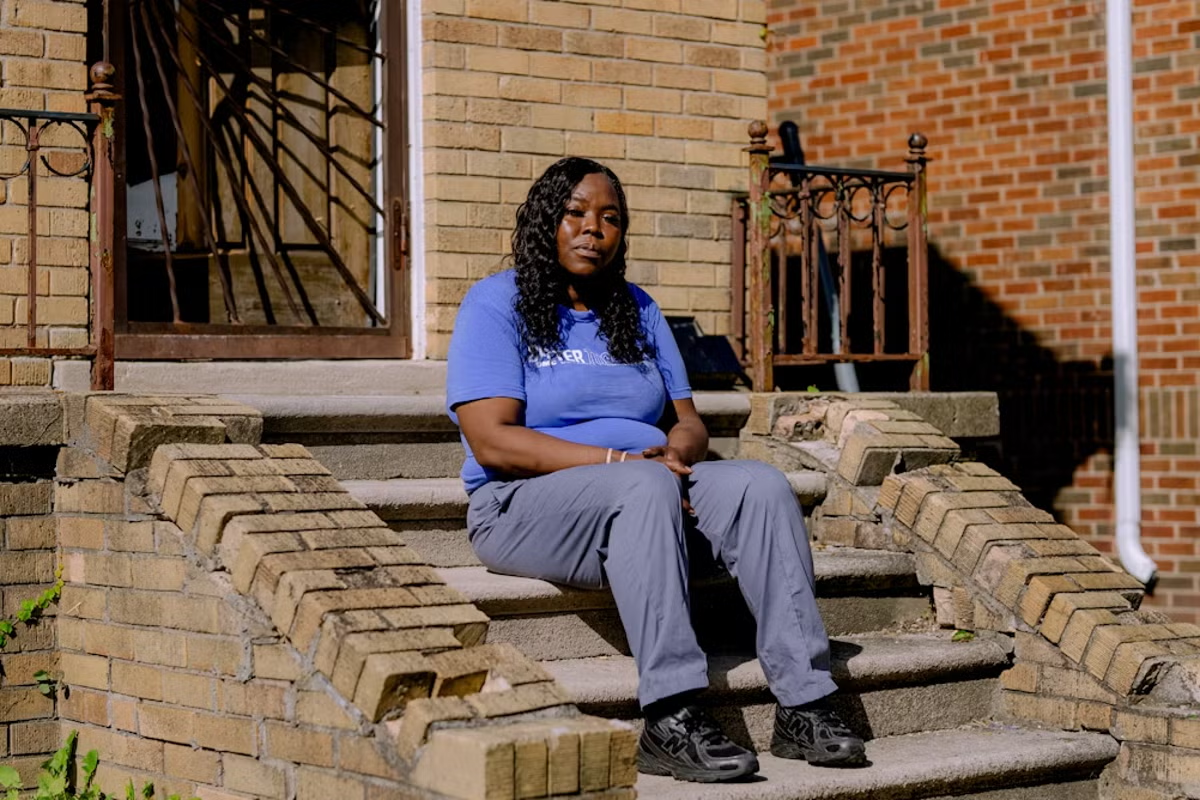
Buying her first home on Detroit’s far east side in 2021 was the moment when a lifelong dream finally came within reach for Kim Page.
“I accomplished something that I always wanted to do,” said Page, who grew up in the city. “I always wanted to buy my own home since I was like 18. I never wanted to rent from anyone.”
Page said she had saved $US15,000 and used $3,800 in cash to buy the single-family brick house on Britain Street. The house, owned by a friend planning to move out of Detroit, was “damaged pretty bad,” Page recalls. But the house was hers to care for, and she was determined to fix what was broken.
For the next several years, Page poured her sweat and paychecks into the property. Working first as a welder at automotive supplier Fisher Dynamics, and later as a phlebotomist, she paid for a dumpster, windows, a door, ceiling repair and an awning above her front porch. Page invested $27,000 in needed repairs and, in 2022, happily moved in.
But in August 2023, a storm damaged her roof. By March 2024, mold had grown inside the property, which made Page struggle to breathe; she moved in with family. She returned to the home in April 2024 for an appointment with a representative from the Federal Emergency Management Agency. That’s when Page noticed the locks had been changed. Perplexed but undeterred, she broke down the back door to get inside and purchased new locks, which she installed.
Then on a hot, summer day in July 2024, Page came home to discover all her locks had been changed again.
Searching for answers, Page called the Wayne County Register of Deeds’ Mortgage and Deed Fraud Unit. The staff confirmed she was a victim of deed fraud – a crime where scammers forge signatures to record a phony transfer of property ownership. Once criminals hijack the title, they can sell the property, rent it out or drain its equity with mortgages, potentially leaving the rightful owner to face the legal and financial fallout.
“I just was in shock,” Page said. “I can’t believe somebody really did this to me.”
Page reached out to me for help in March 2025. I’m a housing attorney, assistant professor at Michigan State University College of Law and director of the Housing Justice Clinic. I have represented dozens of victims of deed fraud.
I have also studied how property recording systems respond – or, more accurately, fail to respond – to fraud. My work examines how procedural gaps in title systems disproportionately harm elderly, low-income and minority homeowners.
Nationwide, deed fraud – also called quit claim deed fraud or home title theft – is a growing problem, including in New York, Boston, Miami and Philadelphia.
Exactly how big a problem it is, is hard to know. The FBI does not track deed fraud specifically, instead grouping it into a larger category of real estate crimes.
From 2019 through 2023, 58,141 victims in the U.S. reported $1.3 billion in losses relating to real estate crime, the FBI says. However, that number is likely undercounted because many people don’t know where to report it, are embarrassed they were victims or don’t know yet they have been targeted.
In Detroit, deed fraud may be particularly prevalent because so many housing deals are made in cash and many properties owe back taxes. The Wayne County Mortgage and Deed Fraud Unit has tracked more than 13,000 inquiries regarding deed fraud and has opened over 2,300 cases throughout Wayne County since 2005.
Committing deed fraud is remarkably simple. A deed is the legal document that transfers ownership of a home or other real property from one person to another. When a home is bought or sold, a deed is legally drawn up to reflect the transfer of ownership. That deed is then recorded with a county register of deeds, providing public notice of who legally owns the property.
A fraudster can forge the signature of the real owner – sometimes someone who is deceased. They can file a deed that appears valid on its face but isn’t.
They then record that false deed with a county register of deeds, the local government office that keeps public land records and other documents showing ownership, claiming title to property they do not actually own.
Fraudsters often target vulnerable people and properties, including elderly owners, families dealing with inherited homes, and houses that appear vacant or neglected, such as those behind on property taxes.
The incentive is clear: Once a fraudster appears to hold title, they can try to sell the property to an investor or an unsuspecting buyer looking for stable housing. I have seen fraudsters secure as much as $50,000 from one deal when they obtained a mortgage based on a fraudulent deed. One notable case of fraud targeted Elvis Presley’s former estate, Graceland.
In Michigan and most other states, recording offices do not have authority to substantively review a deed to determine whether it is fraudulent. If the document complies with technical formatting requirements, such as margin and font size, it must be recorded. Once stamped and indexed, the deed appears legitimate and can easily trick desperate buyers, investors, financial institutions and even police officers, lawyers and judges.
In other words, the recording process is largely administrative, not investigative. The government office accepts and files the document without first verifying that the person signing it actually had the legal right to transfer the property.
That means a fraudulent deed can enter the public record, look valid to the outside world and remain undiscovered for months or even years.
The housing market helps explain why Detroiters are more vulnerable to deed fraud.
Homes in Black neighborhoods nationwide are systematically undervalued compared with similar homes in white neighborhoods. Black borrowers are also more likely to be denied conventional mortgage loans. Detroit is about 73% Black, with a median household income of roughly $39,000 and a poverty rate exceeding 30%.
In a market where access to traditional financing is uneven and home prices are relatively low, cash sales accounted for 4 in 10 sales in February 2024.