The response to the rapidly-spreading Ebola outbreak in the Democratic Republic of the Congo (DRC) and Uganda has been undermined by foreign aid cuts, including from the UK, the development minister Jenny Chapman has admitted.
During an interview with the BBC World Service while on a trip to Kinshasa, the DRC capital, Baroness Chapman was asked: “The UK government is reducing foreign aid from 0.5 per cent to 0.3 per cent of Gross National Income (GNI) and redirecting those funds to defence and security… but when it comes to an outbreak like this one that has the potential to spread internationally, does that speak to how counterproductive that reduction in foreign aid budgets can be?”
“Yes, in a way,” Baroness Chapman replied. “But I would say we’re still spending just short of £10 billion on international development each year. So that’s a lot of money in anybody’s book. What we have to do is make sure we spend that really well.” Africa is being hit particularly hard by the cuts, with bilateral support to individual countries falling 56 per cent.
Earlier in the interview, she said of the wider response to the outbreak: “I’m not convinced we are sufficiently ready and we are under responding at the moment, but this can change and it does need to change.” Baroness Chapman described how a team from the UK is currently in Kinshasa and “working incredibly hard”.
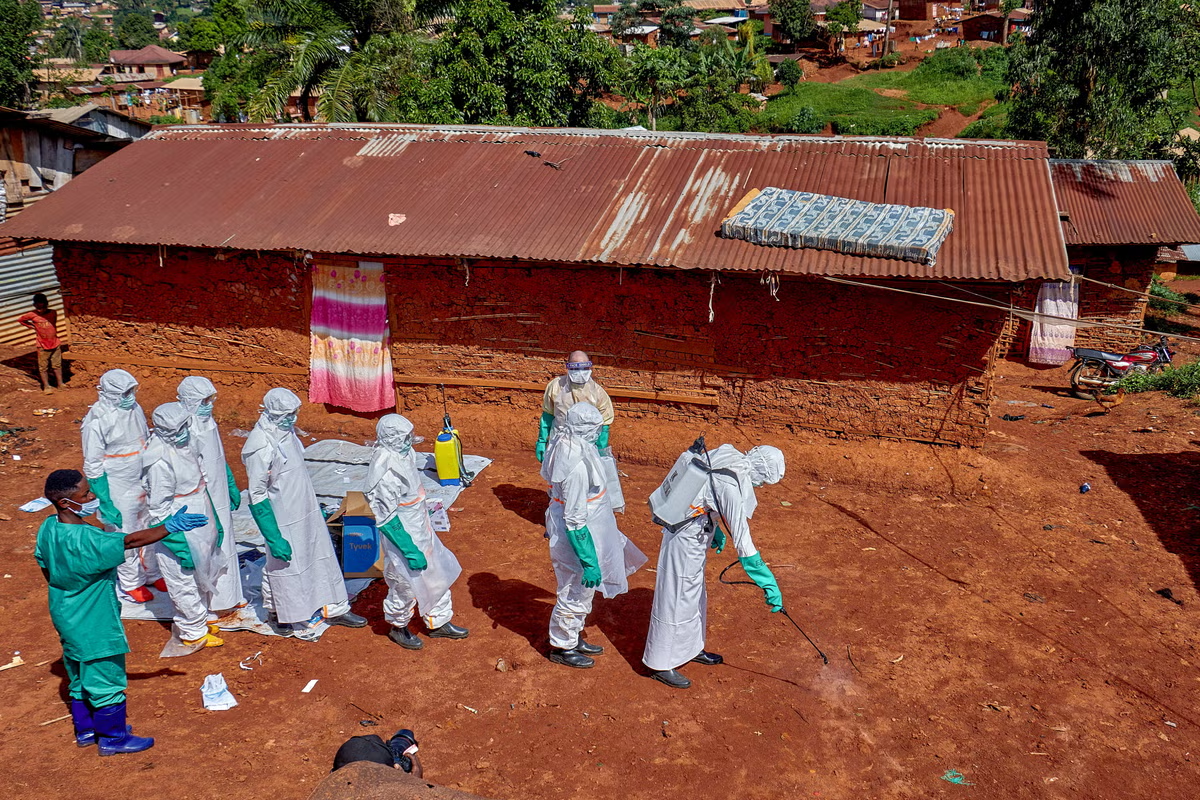
Health workers have spoken about the delay in confirming the outbreak, weeks after people started getting sick. The latest data finds from the World Health Organisation (WHO) says there have been 321 confirmed Ebola cases, including 48 confirmed deaths, while cases have also spread into neighbouring Uganda, with 15 confirmed cases and one death. Previous updates have spoken of around 1,000 suspected cases and more than 300 suspected deaths. The latest outbreak is a rare strain of Ebola known as Bundibugyo, has no proven vaccine or treatment and kills about a third of those infected.
The Congolese government has now re-opened the airport in the eastern Ituri province, which has been hit hardest by the ongoing outbreak, the government said. That revered a move that some residents said had cut them off from critical supplies. The International Rescue Committee warned on Monday that the outbreak was likely to be significantly larger and more advanced than official figures currently suggest. The virus might also have been spreading for up to three months before the first official cases were confirmed in mid-May, the aid agency said.
The UK has so far committed £21m to tackling the outbreak, just five per cent of the £427 million responding to the last massive outbreak of 2014 and 2015 in West Africa. The 2014/15 outbreak, the largest on record, involved more than 20,000 cases and 10,000 deaths across more than a year.
Rory Stewart, who served as the UK’s Africa minister during the another major Ebola outbreak in 2018, warned last month that the connection between aid cuts implemented by Donald Trump and the UK and outbreaks like this was “very strong”. Such cuts have “huge impacts”, he added “particularly on things like global health”.
“Pandemic preparedness – in other words, dealing with an Ebola outbreak or even a new version of a Covid outbreak – requires lots of people on the ground in places like DRC or Uganda who are able to detect cases, respond to them, quarantine and prepare responses,” he told BBC Radio 4. ” And it’s all the infrastructure behind that which is being undermined at the moment. And that’s a real threat, of course, to the world.”
Baroness Chapman said that she expects this new outbreak to go on for “months, if not longer… So there is going to be a question of resources.” She added: “I do think that we are going to have to spend more money on this outbreak and countering it. And this is not going to be something where you make an initial contribution, work really hard for a while, and it’s done. “
Baroness Chapman added that authorities in the DRC ultimately “want the capability to respond to outbreaks and to detect outbreaks themselves” without the help of aid agencies. Going forward, she continued, more UK development work is going to be focus on helping that.
“I think that the way that you need to, in the longer term, prevent these kinds of outbreaks is, yes, through the medical research that we also fund and the vaccine development, which we do as well. But it’s also through strengthening health systems in a country like DRC,” she said.
Baroness Chapman acknowledged, however, that such work would be “very difficult” in Eastern DRC, which is an area long-ravaged by war and insecurity. But, she claimed that even then, more aid would not automatically alleviate the situation. “A lot of this is about conflict prevention [and] aid budgets cannot do that on their own,” she said.
“The idea that just putting more international development money into this would have prevented it or is the only thing we need to do is that’s just you know that would be lovely if that was the case but that is that’s not the reality,” she added.
The Foreign, Commonwealth, and Development Office declined to comment on Baroness Chapman’s remarks when approached by The Independent.
This article was produced as part of The Independent’s Rethinking Global Aid project